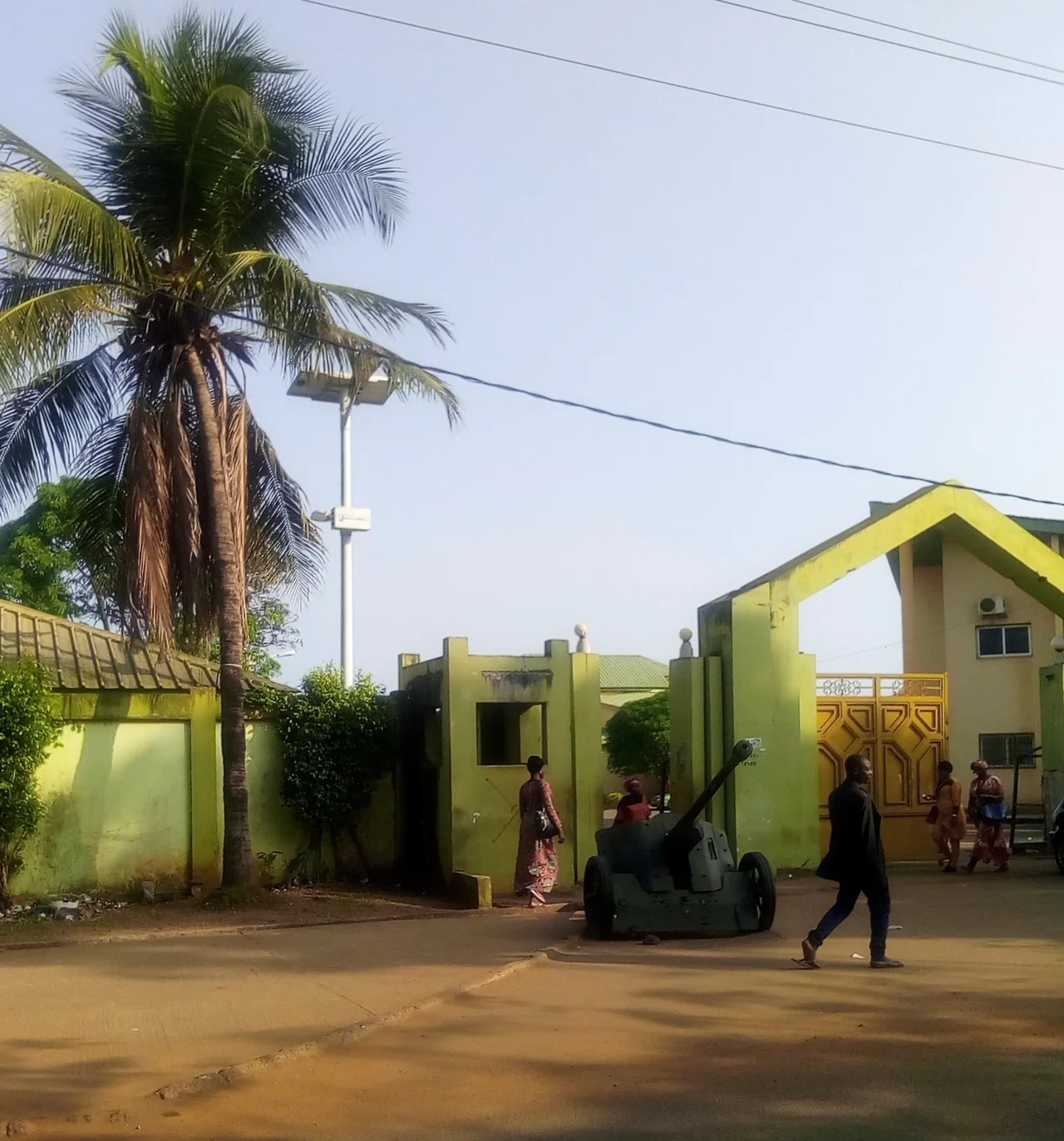

Camp Boiro
They called it the "black diet": no food, no water, until the body gave out. It was one of the cruelest methods used at Camp Boiro, a detention camp in the heart of Conakry where, for nearly a quarter of a century, the government of independent Guinea disappeared its own people. The dead were teachers and ambassadors, ministers and market travelers, bishops and ballet directors. Some estimates put the toll at nearly 5,000; others, ten times higher. Whatever the true number, behind it stands a single fact the camp's survivors have spent decades insisting we remember: these were people, each with a name and a family waiting at home.
A Promise Betrayed
In 1958, Guinea did something no other French colony dared. Offered a choice between autonomy within a French community and immediate independence, Guineans voted overwhelmingly for freedom, and Ahmed Sékou Touré became the new nation's first president. It was a moment of enormous hope. But the hope curdled. As the years passed, Touré's regime grew obsessed with conspiracies, real and imagined, purging rivals from within his own ruling party. The camp that became the instrument of those purges sat in central Conakry, on grounds that had once housed the colonial Republican Guard. Its prison block was built with help from Czechoslovakia. In 1961, the commandant ordered the windows made smaller, reasoning that they were too large for condemned men.
The Names We Know
The camp took its name in 1969 from Mamadou Boiro, a police commissioner thrown to his death from a helicopter that was ferrying prisoners. The list of those who passed through its cells reads like a roll call of a generation's promise. Fodéba Keïta, founder of Les Ballets Africains and a former defense minister, was shot after forced starvation in May 1969. Achkar Marof, a diplomat and director of Les Ballets Africains who served as Guinea's Permanent Representative to the United Nations, was executed in 1971; his family did not learn his fate until 1985. Loffo Camara, a former secretary of state, was hanged in January 1971, the only woman killed that night. Diallo Telli, the first secretary-general of the Organization of African Unity, returned home to serve his country and died of the black diet in 1977. These were not anonymous victims. They had built institutions, represented the nation abroad, and believed in it.
Inside the Walls
Survivors and chroniclers have preserved what daily life inside Camp Boiro was like. Prisoners received a scrap of bread the size of a matchbox in the morning and a ladle of plain rice cooked in dirty water at night. A Revolutionary Committee extracted confessions through torture, and prisoners measured their courage by a terrible standard: refusing to confess, and refusing to beg for food. According to one long-term inmate, El Hadj Ibrahima Diane, from 1972 to 1973 at least four bodies were carried from the cells each day and thrown into mass graves behind the prison. The cruelty did not spare visitors. In 1979 a man named Bah Mamadou returned from France to see his family; everyone in his vehicle was arrested at the border, and eight of his fellow travelers died of the black diet within a month.
The Fight to Remember
Touré died in 1984, and a military coup soon freed the surviving prisoners. The camp fell silent, but its survivors and the families of the dead would not let it be forgotten. The Association of Victims of Camp Boiro has fought for years to keep the memory alive and to build a memorial on the grounds. A 1991 government communiqué promised renovation and a monument; nothing followed. The association was forbidden from establishing a museum at the site. As recently as 2009, the buildings began to come down without word of whether anything would replace them, and the camp's records remained sealed or destroyed. The struggle here is not over what happened. It is over whether a nation will look at it, name it, and grant its dead the dignity of being mourned in the open.
From the Air
Camp Boiro lies in central Conakry, Guinea, at approximately 9.537°N, 13.686°W, on the Kaloum peninsula that forms the city center. The nearest airport is Conakry International (Ahmed Sékou Touré International, ICAO GUCY), roughly 12 km to the northwest. The site sits near sea level; the surrounding peninsula juts into the Atlantic, with mangrove coastline and the city's dense urban grid as visual references. Coastal haze and the wet season (April to November) frequently reduce visibility over Conakry.
Nearby Stories
- Pongo River (Guinea) 23 km away
- Kindia 28 km away
- Maritime Guinea 79 km away
- Operation Barras 88 km away
- King's Yard 98 km away
- Outamba-Kilimi National Park 110 km away
- Boké 152 km away
- Rocas Atoll 2633 km away