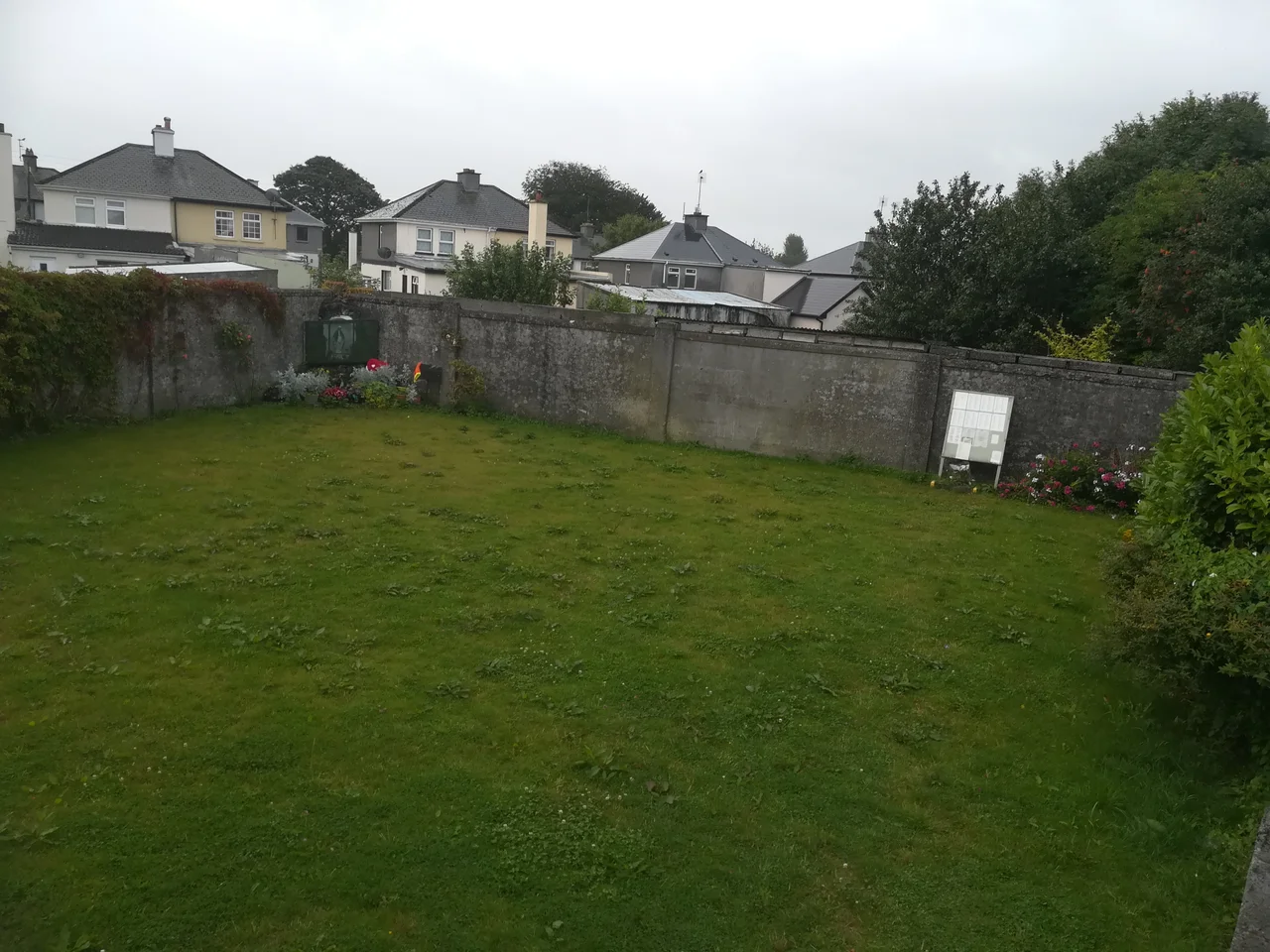

Bon Secours Mother and Baby Home
Catherine Corless did not set out to expose a national wound. She was a local historian researching the old Children's Home in Tuam, ordering death certificates one by one from the registrar's office at two euro each. When she finished, she had 796 of them. Children who had died between 1925 and 1961 at the Bon Secours Mother and Baby Home. There was no corresponding burial record. They were simply gone. What she found next, on a small green plot bordered by housing estates on the northwest edge of Tuam, would force Ireland to look at something it had decided long ago to forget.
The Home
Before the nuns arrived, the building was a workhouse, a relic of the Famine era when the destitute of north Galway were warehoused behind grey limestone walls. In 1925, the Bon Secours sisters took it over and renamed it. From then until it closed in 1961, the Home received unmarried mothers and their children, women whose pregnancies had marked them as fallen in the moral economy of mid-century Ireland. They came from across the country. They were not always free to leave. State inspections from 1949 described children at Tuam as emaciated and starved. The Commission of Investigation would later report that during certain years, one in every seven children born or admitted to Tuam died there - an infant mortality rate roughly twice the national average for the era.
Catherine Corless and the Death Certificates
Corless lived in Tuam. As a child she remembered the Home children kept apart at school, given a different door, a different schoolyard. As an adult historian she began assembling their story for the local journal. The death certificates told her the children had died, often of measles, of convulsions, of malnutrition, of conditions long since treatable. The cemetery records told her none of them had been buried in any consecrated ground she could find. A small grotto stood on a plot at the back of the former Home site, tended for decades by two local men who had heard rumours of children's bones there since their boyhood in the 1970s. Corless began connecting these threads in 2014. The Irish Mail on Sunday picked up her work. Then the world's press did.
The Septic Tank
In 2016 and 2017, a state-appointed Commission of Investigation conducted exploratory excavations. They found what Corless had long suspected: a significant quantity of human remains, infants and small children, interred in a disused underground structure with twenty chambers, related to the treatment of sewage. Carbon dating placed the burials in the period the Home was operating. Most dated from the 1950s. There was no individual grave, no marker, no name. The Commission's final report, published in January 2021, found that across eighteen Irish mother and baby institutions, around 9,000 children had died between 1922 and 1998. Taoiseach Micheál Martin issued a formal state apology. The Bon Secours sisters issued one of their own.
The Excavation
Full forensic excavation of the Tuam site began in earnest on 14 July 2025, conducted by the Office of the Director of Authorised Intervention. The work is expected to take roughly two years. International forensic specialists from Colombia, Spain, the UK, Canada, and the United States now work alongside Irish experts behind a 2.4-metre hoarding, attempting to recover, identify through DNA, and reinter with dignity the children whose burials were never recorded. In October 2025 the team announced the discovery of five sets of skeletal remains from the earlier workhouse era. In December 2025 came what Corless called a vindication: eleven sets of infant remains in coffins, all dating from 1925 to 1961, the years the Home operated. The first confirmation, in bone, that the children were where she had said they were.
What the Site Is Now
If you stand on the green today, you see a small memorial garden, a low statue, a quiet plot enclosed by suburban houses. Children played on this ground for decades without knowing. Mothers passed it. Many of those mothers - separated from their babies by adoption, by death, by the workings of an institution that often refused to tell them what had happened to their child - went to their own graves still searching. Peter Mulryan, who survived the Home, has a sister buried somewhere in this soil. Anna Corrigan has two brothers somewhere here. The excavation now underway is, among other things, an attempt to give each of those names a body to bury, and each of those families an end to the not-knowing.
From the Air
The former Bon Secours Mother and Baby Home site lies at approximately 53.508 N, 8.843 W on the northwest edge of Tuam, County Galway. From the air it appears as a small green enclosure within a residential estate. Ireland West Airport Knock (EIKN) is roughly 50 km north; Galway Airport (EICM, now closed to scheduled traffic) is 30 km south. The site is best viewed at low altitude in calm weather; this is a place of mourning, and a moment of silence is appropriate as you pass overhead.
Nearby Stories
- Marine Institute Ireland 1.8 km away
- Westport 2.9 km away
- Knock, County Mayo 3 km away
- Bellanagare Bog 4.3 km away
- Ballygar 7.4 km away
- Connemara Railway 8.1 km away
- Ardgraigue Bog 16 km away
- Inishmaan 21 km away