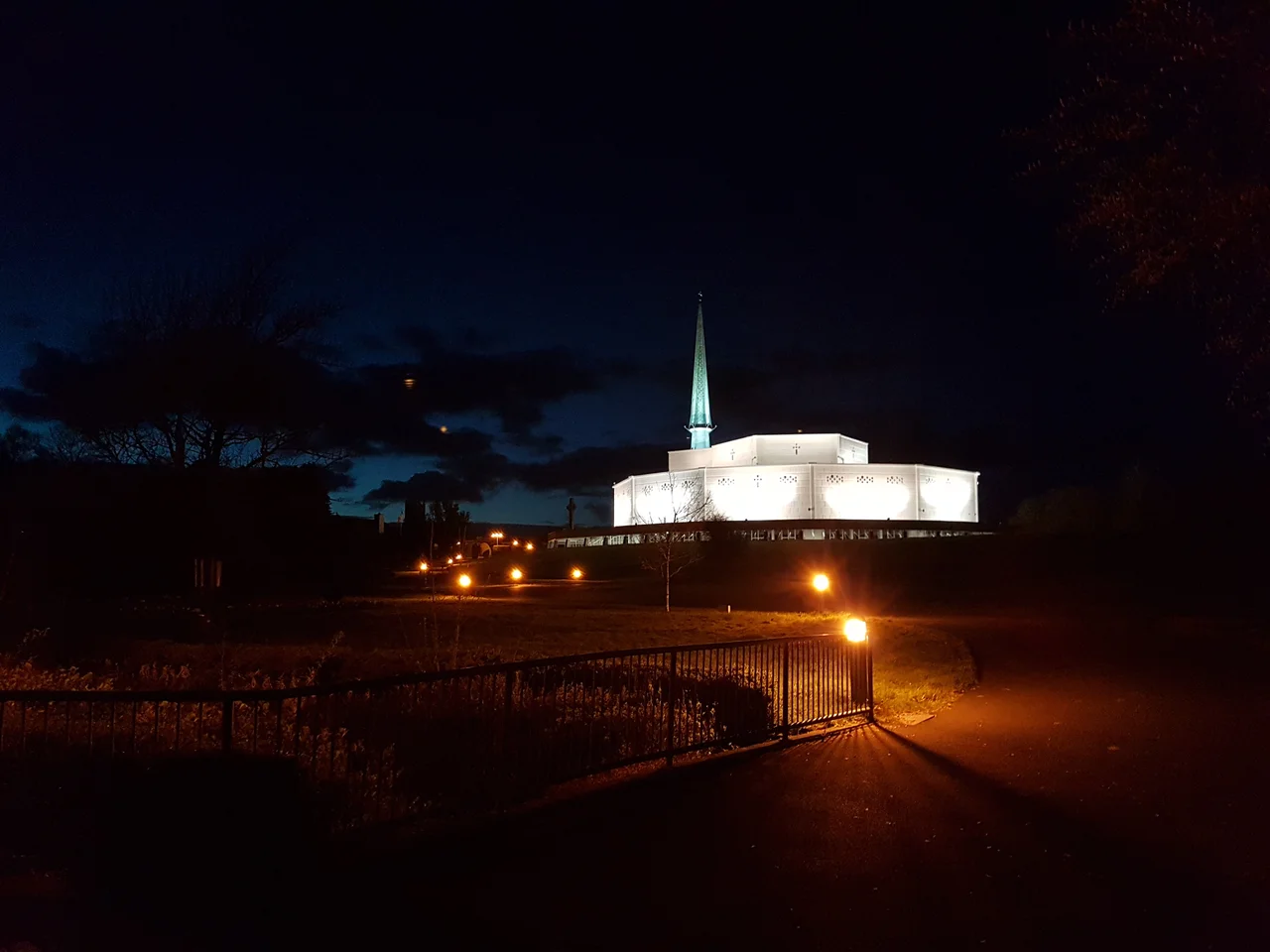

Knock, County Mayo
Knock is just a hill. The Irish word cnoc means exactly that, and historical records as far back as 1625 use it as the name of this small village in east County Mayo, five miles from Claremorris. For most of its existence, Knock was an unremarkable rural settlement with a small parish church, a few hundred people, and the usual round of farming, market days and emigration. Then, on a wet evening in August 1879, fifteen villagers said they saw the Virgin Mary at the gable of the parish church, and over the following century everything about the village reorganised itself around that claim. The Irish name even changed: Knock became Cnoc Mhuire, the Hill of Mary. The village became a pilgrimage town. A priest with an unlikely vision turned it into a place with its own international airport.
What the Village Was Before
Knock is a civil parish in the ancient barony of Costello, with thirty-five of its forty-five townlands in Costello and ten more in the neighbouring barony of Clanmorris. It sits between Claremorris, one of east Mayo's major nineteenth-century market towns, and Ballyhaunis, where the Augustinian friary still stands. The pre-apparition name was sometimes recorded as Knockdrumcalry, Cnoc Droma Chalraighe, meaning the hill of the ridge of the Calraighe - the Calraighe being a pre-Norman Irish people who held this territory long before any of the present field boundaries existed. None of this would have led anyone to predict that the village would become one of the most-visited pilgrimage sites in Europe. Knock was, by every measure that matters historically, ordinary.
The August Evening That Changed Everything
On 21 August 1879, in the rain, fifteen people claimed to see an apparition of the Virgin Mary, Saint Joseph and Saint John the Evangelist on the south gable wall of the Church of Saint John the Baptist. The witnesses ranged from a five-year-old child to a seventy-five-year-old woman. Word travelled fast. Pilgrims began arriving within days. The Catholic Church convened an ecclesiastical commission, which accepted the witnesses' testimony as trustworthy. For most of the next half-century, Knock remained a regional rather than international devotion. But in the twentieth century, the numbers began to grow. Peace pilgrimages during the Second World War helped, as did Pope Pius XII blessing a Knock banner from St Peter's Basilica on All Saints' Day in 1945. By the late twentieth century, a million and a half pilgrims were arriving annually, placing Knock alongside Lourdes and Fatima as one of Europe's great Marian shrines.
Monsignor James Horan
Monsignor James Horan, born in 1911, became parish priest of Knock in 1967 and turned the rest of his life into a kind of construction project. The numbers of pilgrims arriving overwhelmed the small parish church, so Horan oversaw the building of a new basilica - Our Lady, Queen of Ireland - with a capacity for 10,000 worshipers. It was consecrated in 1976. Then he turned his attention to the access problem. Most pilgrims came from abroad, but the nearest airports were Shannon and Dublin, hours of bus journey away. He wanted his pilgrims to land in Mayo. Despite the experts saying the proposed site was too boggy and too foggy for an international airport, Horan got the government to fund one. Ireland West Airport, 19 kilometres north of the village on the N17 near Charlestown, opened on 30 May 1986. Horan, by then 74, died not long after. His funeral was held inside the terminal he had willed into existence.
The Papal Visits
On the centenary of the apparition in 1979, Pope John Paul II flew into Ireland and prayed at Knock. The visit was Horan's victory lap; it placed Knock decisively on the world stage of Catholic pilgrimage. Almost forty years later, on 26 August 2018, Pope Francis came too, visiting the basilica while in Ireland for the ninth World Meeting of Families. Two papal visits in fewer than forty years is something even the great cathedrals of European capitals do not match. The basilica complex on the apparition site now includes the old church (still standing), the Apparition Chapel with life-size statues arranged exactly as the witnesses described them, the great basilica with seating for ten thousand, and a vast surrounding parkland of car parks and pilgrim facilities. The nine-day novena every August is the peak of the year.
A Village That Stayed Small
What is most striking about Knock today is how small the village itself remains. The basilica and the pilgrim infrastructure cover acres of ground. The village - the actual permanent population - is modest. Knock National School, built in 1966, serves the local children. The soccer club, Kiltimagh Knock United F.C., established in 2002, plays out of CMS Park in Cloonlee three kilometres away. There is no GAA club in the parish itself; players go to Aghamore. International skepticism of the original apparition continues - the witnesses were of all ages, some very young, and there is no physical evidence beyond their testimony - but the pilgrims keep coming. The village remains the hill it was always named after, with the Virgin Mary added to the name in 1879 by way of revision. Cnoc Mhuire. The hill of Mary. Still standing where it always stood.
From the Air
Located at 53.79 degrees north, 8.92 degrees west, in east County Mayo. Ireland West Airport (EIKN), which Monsignor James Horan helped build to serve pilgrims, sits 19 km to the north on the N17 near Charlestown. The basilica complex - distinctive circular roof - is unmistakable from the air. Claremorris lies about 8 km west; Ballyhaunis is 15 km east.
Nearby Stories
- Newport, County Mayo 3.7 km away
- Bellanagare Bog 5.5 km away
- Ballygar 13 km away
- Leenane 13 km away
- Creevelea Abbey 13 km away
- St Mary's Cathedral, Tuam 13 km away
- Bangor Erris 16 km away
- Easky 17 km away