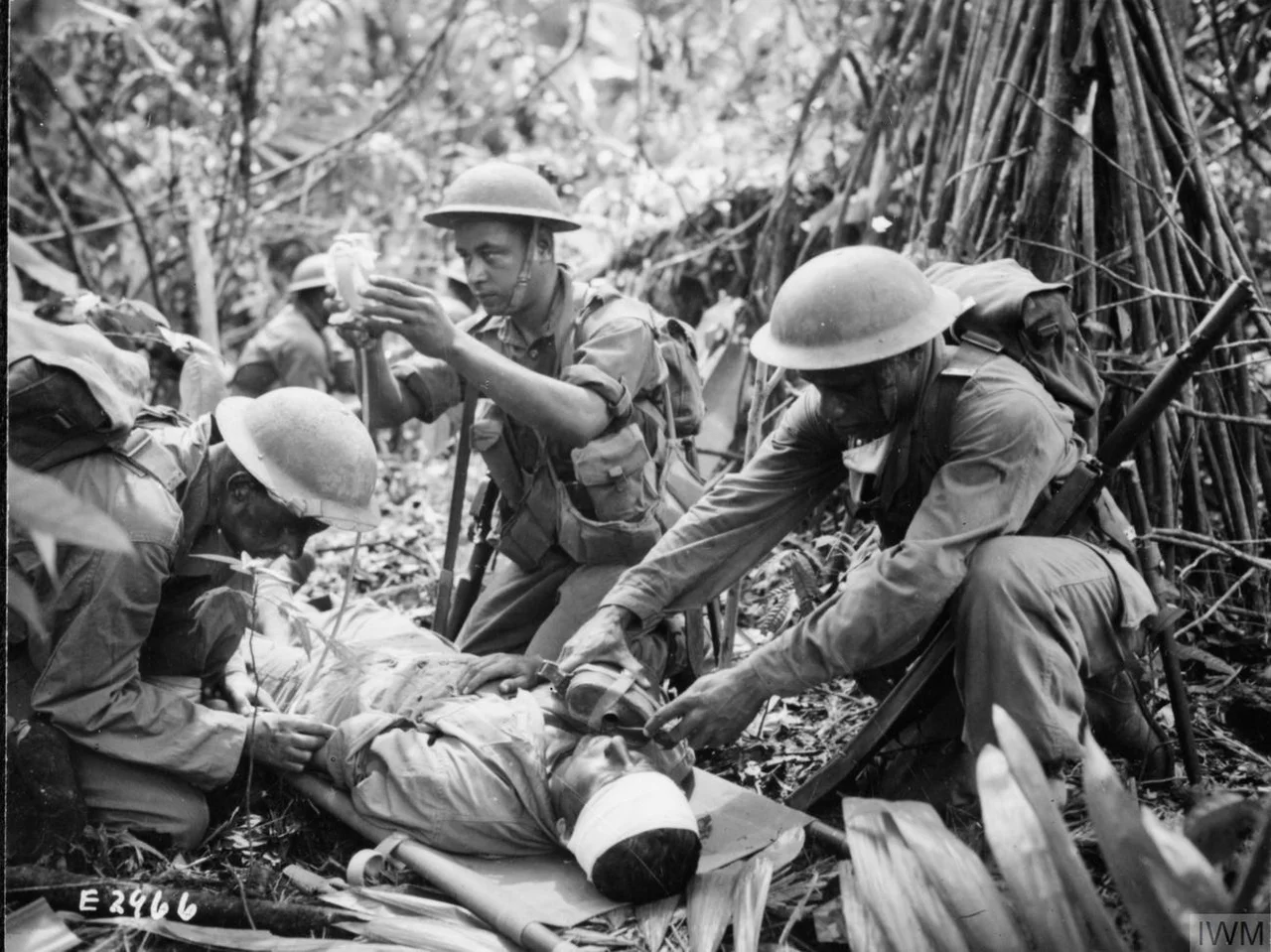

Bougainville Campaign
By November 1943, every senior commander in the Pacific understood a simple equation: as long as Rabaul functioned, the northern Solomons remained Japanese water. The solution was not to storm Rabaul, which would cost tens of thousands of lives, but to strangle it. Bougainville would be the noose. On the first day of that month, the 3rd Marine Division waded ashore at a place called Cape Torokina on the western coast of a volcanic island most Americans had never heard of, and the long slow killing began. What followed was not the war of the Pacific newsreels. There were no beach-wide amphibious spectacles, no decisive fleet actions. There was jungle, rain, ridges with improvised names, and a campaign that nobody back home paid attention to.
The Perimeter
The Americans never tried to take the whole island. They carved out a beachhead on the western coast - seven thousand yards of sand, a circumference of sixteen thousand yards - and held it. Inside the Perimeter, Seabees and New Zealand engineers clawed three airstrips out of swamp. The fighter strip flew its first sorties on 10 December 1943. The inland bomber strip, Piva Uncle, opened on Christmas Day. Piva Yoke followed on 22 January. From these airfields, Allied aircraft could finally reach Rabaul with the accuracy needed to destroy what heavy bombers had only dented. Outside the Perimeter, the Japanese dragged artillery onto ridges overlooking the American lines and tried to shell the airstrips out of existence. The Marines answered by taking the ridges one by one. One hill, three hundred feet long with a narrow crest and reverse-slope bunkers, was so nasty the 21st Marines named it Hellzapoppin Ridge after the Broadway farce. It took air strikes, artillery, and coordinated infantry assaults to finally capture it on 18 December.
The Counterattack Nobody Watched
General Haruyoshi Hyakutake commanded about forty thousand men of the 17th Army on Bougainville, plus another twenty thousand naval troops under Vice Admiral Tomoshige Samejima. His 6th Division under Lieutenant General Masatane Kanda was considered the toughest infantry formation in the Imperial Japanese Army. Hyakutake believed he could throw the Americans into the sea. He was so confident that he planned to accept the surrender of General Oscar Griswold on 17 March 1944 at the Torokina airstrip. The Counterattack opened on 9 March. For three weeks the Japanese hurled themselves at Hill 700, Cannon Hill, the Piva Yoke fighter strip, Hill 260. They captured ground and lost it again. The Americans, dug in and supported by destroyers offshore and the airstrips they were defending, simply refused to break. By the time Hyakutake cancelled the attack, he had lost 5,400 killed and 7,100 wounded. Samuel Eliot Morison, who wrote the definitive naval history of the war, noted that "the struggle for the Perimeter went almost unnoticed outside the Pacific."
Strangling Rabaul
The campaign's strategic purpose came into focus in early 1944. AirSols - Air Command, Solomons - moved its headquarters to Torokina under Major General Ralph Mitchell on 20 November. From Bougainville, Allied bombers flew over Rabaul almost daily. When the Green Islands fell to New Zealand troops on 15 February, the encirclement was complete. Between 20 February and 15 May, Morison calculated, AirSols dropped an average of 85 tons of bombs per day on Rabaul - 7,410 tons in 9,400 sorties. The fortress that had sheltered three hundred thousand tons of Japanese shipping in October 1943 was, by spring 1944, reduced to what Morison called "a third-rate barge depot." The garrison there, more than a hundred thousand strong, was simply left to rot. The same fate awaited the Japanese on Bougainville. Cut off from resupply, their rice ration dropped from 750 grams per soldier per day in April 1944 to 250 grams, and by September there was no ration at all. Troops became farmers. Allied pilots, according to historian Harry Gailey, "took delight in dropping napalm on these garden plots whenever possible."
The Australian Phase
In late 1944 the American XIV Corps was pulled out for the Philippines invasion. Lieutenant General Stanley Savige's Australian II Corps took over - just over thirty thousand men, the bulk of them militia. Unlike the Americans, who had been content to contain the Japanese within a defensive perimeter, Australia wanted to finish the job. Three drives went forward: north into the Bonis Peninsula, into the centre at Pearl Ridge, and the main southern push toward the Japanese concentration at Buin. The central front folded quickly - the Battle of Pearl Ridge on 30 December revealed how far Japanese morale had fallen. In the south, the Australians fought Battle of Slater's Knoll, the Hongorai River, the Mivo. The campaign produced three Victoria Crosses. Corporal Sefanaia Sukanaivalu of Fiji won his posthumously at Mawaraka on 23 June 1944 - the only Fijian so honoured. Private Frank Partridge earned his on 24 July 1945 along the Ratsua front, the only militiaman ever to receive the award and the last Australian VC of the war. Corporal Reg Rattey's came at Slater's Knoll in March 1945.
The Price and the Silence
On 21 August 1945, after the atomic bombs had fallen on Hiroshima and Nagasaki and the Japanese government had announced surrender, combat operations on Bougainville ended. Twenty-three thousand five hundred Japanese troops and labourers laid down arms. Kanda formally surrendered on 8 September. Australian intelligence later estimated that during the American phase, 8,200 Japanese had died in combat and another 16,600 of disease and starvation. The Australian phase added roughly another 18,300 Japanese dead from battle and illness. Australian losses in the final phase came to 516 killed and 1,572 wounded. The people whose island this was paid heavily too. Historian Hank Nelson estimated the Bougainvillean population dropped by a quarter after 1943, from over 52,000 to under 40,000 by 1946 - lost to disease, to displacement, to the war fought around them. The campaign has been argued about ever since. Australian historian Karl James defends it as justifiable given that no one in 1944 knew Japan would surrender the following August. Others point to the thousands of Japanese troops who starved on an island whose strategic role had already been fulfilled.
From the Air
Bougainville Island stretches roughly 180 miles northwest-to-southeast at around 6.0°S, 155.1°E. The Torokina Perimeter sits on the western coast, north of Empress Augusta Bay; the Panguna caldera dominates the central Crown Prince Range inland. From cruising altitude, the island's long spine of mountains and the lighter disturbed ground of Panguna are both visible in clear weather. Nearest operational airports are Buka (IATA BUA) on the northern tip and Aropa (IATA KIE, ICAO AYIQ) near Kieta. Tropical convective cloud is common after midday.
Nearby Stories
- Battle of Slater's Knoll 34 km away
- Japanese cruiser Sendai 41 km away
- Kilu Cave 52 km away
- Battle of Tsimba Ridge 55 km away
- Japanese Seaplane Carrier Nisshin 55 km away
- Japanese submarine Ro-100 89 km away
- Takuu Atoll 180 km away
- Woodlark Island 376 km away