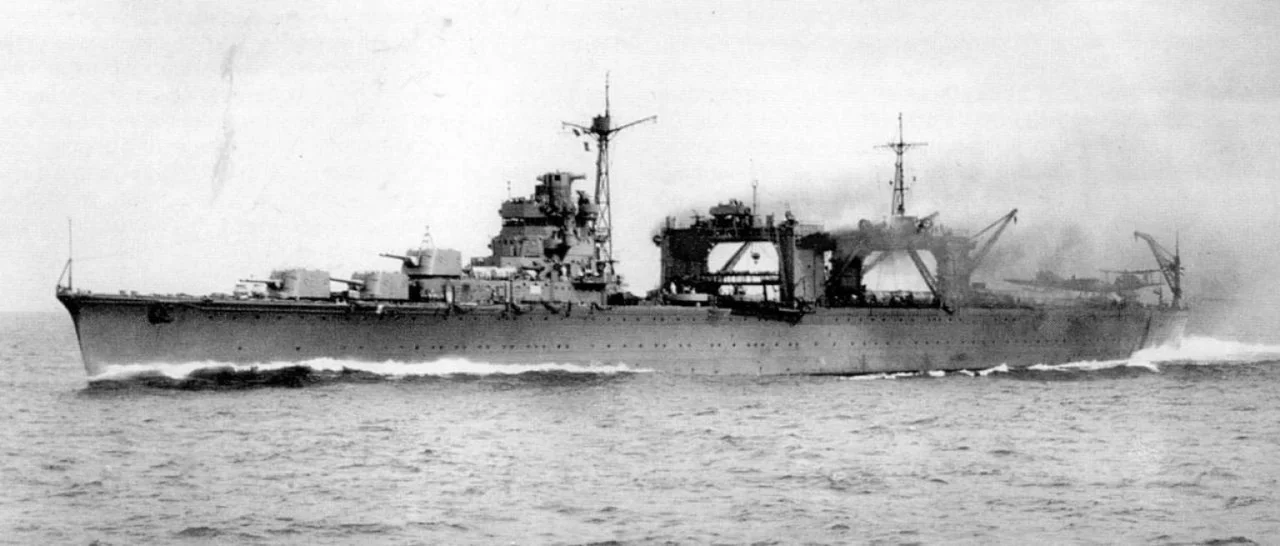

Japanese Seaplane Carrier Nisshin
The Washington Naval Treaty counted aircraft carriers but left seaplane tenders unrestricted, and the Imperial Japanese Navy noticed. Out of that loophole came Nisshin - a ship that looked like a cruiser from the foredeck, hauled floatplanes on her stern, and carried twelve midget submarines in her belly. When she was commissioned at Kure in February 1942, she represented one of the more inventive answers to a treaty designed to contain naval power: build something the treaty never quite imagined. What she could do on paper was impressive. What the Pacific War actually asked of her would be something else entirely.
A Treaty's Unintended Child
Through the 1920s and 1930s, Japan's navy wrestled with limits. The Washington Naval Treaty capped aircraft carriers in tonnage and number. The London Naval Treaty tightened the screw further. But seaplane tenders - ships designed to launch floatplanes that took off from catapults and landed on water - fell outside the categories diplomats had negotiated. The Imperial Japanese Navy, increasingly reliant on naval aviation to scout for its cruiser and destroyer squadrons, built Chitose-class tenders to exploit the gap. Nisshin was the follow-on, ordered under the 3rd Naval Armaments Supplement Programme of 1937 at a moment when Japan's ambitions were outrunning treaty arithmetic. She was laid down at Kure Naval Arsenal on 2 November 1938 and launched thirteen months later, but design changes and the outbreak of the Pacific War delayed her completion until 27 February 1942.
The Ship That Wouldn't Commit
Nisshin's silhouette confused the usual categories. Six 14 cm/50 naval guns in three forward turrets gave her the firepower of a light cruiser. Twenty-four 25 mm anti-aircraft guns in triple mountings bristled from her flanks. Two catapults and cranes on her aft deck launched and recovered up to twelve floatplanes - Kawanishi E7K "Alf" biplanes, Nakajima E8N "Dave" observation craft, Mitsubishi F1M "Pete" fighters. But belowdecks, elevators and passages were built to move something stranger still: twelve Type A Kō-hyōteki-class midget submarines, each about 78 feet long and meant for suicide attacks on harbored enemies. Nine hundred tonnes of aviation fuel sloshed in her tanks. Her 47,000-horsepower engines drove her at 28 knots - fast enough to outrun most escorts, with a range of 11,000 nautical miles that made her invaluable for high-speed reinforcement runs to the farthest corners of Japan's expanding perimeter.
Midway, and a Cancelled Gambit
Nisshin's war began with a mission that never happened. Within weeks of commissioning, she was assigned to Vice Admiral Teruhisa Komatsu's 6th Fleet, training in the Inland Sea alongside the seaplane tender Chiyoda and the auxiliary cruiser Aikoku Maru. During one exercise she recovered a miniature submarine Chiyoda had lost - a small mercy at a training ground that would not be forgiven. Then came June 1942 and the Battle of Midway. Nisshin steamed with the Main Body of the Japanese fleet, her holds packed with twelve midget submarines. The plan was audacious: seize Kure Atoll, 60 nautical miles northwest of Midway, and turn it into a forward seaplane base from which to strangle the American garrison. But the plan assumed the Japanese aircraft carriers would do what they had always done - win. When four carriers burned and sank in a single catastrophic morning, the entire Midway operation collapsed. Nisshin turned back to Hashirajima on 14 June 1942, the midget submarines still sealed in her hull, her first combat mission unspent.
The Long Runs South
What followed was the war Nisshin actually fought - not as the exotic hybrid her designers had imagined, but as a fast transport racing against American air power. From late 1942 through 1943, the Solomons campaign ground on, and ships like Nisshin were what kept Japanese garrisons fed and armed. Her speed and range made her ideal for the runs down the Slot, the waters between the double chain of Solomon Islands where "Tokyo Express" convoys dashed by night to deliver troops and supplies. The missions were dangerous. American aircraft from Henderson Field on Guadalcanal roamed the skies by day, and submarines hunted by night. The firepower of a light cruiser meant little against dive-bombers in clear weather. Nisshin herself was sunk on 22 July 1943 north of Bougainville, struck by air attack while carrying reinforcements - she lies somewhere in the deep water south of Choiseul Island, the 1,200-meter trench that runs through these seas.
An Ending in Deep Water
What makes Nisshin worth remembering is not her battle honors, which were modest, but what she represented: the scramble to build firepower inside the seams of arms control, the willingness to combine incompatible functions on a single hull, the fragility of clever answers in the face of overwhelming air power. She was a Swiss Army knife of a ship in an era when specialization - pure carriers, pure destroyers, pure submarines - was winning the war. The waters around southern Bougainville and the Choiseul coast hold many wrecks from those 1942 and 1943 campaigns. Nisshin rests among them, a hybrid whose kind would never be built again.
From the Air
Nisshin's wreck site lies at approximately 6.58°S, 156.17°E, in the deep water between Bougainville and Choiseul Island, Solomon Islands. Recommended viewing altitude: 6,000-8,000 feet for a view of the strait and surrounding islands. Honiara's Henderson Field (AGGH/HIR) lies about 290 nautical miles to the southeast, and Munda Airport (AGGM) about 150 nautical miles south. The nearest sizable runway is Buka (AYBK) in Bougainville, about 75 nautical miles northwest. Afternoon cumulus builds quickly over these tropical waters, and tropical storm systems pass through between November and April.
Nearby Stories
- Buin, Papua New Guinea 18 km away
- Choiseul Province 25 km away
- Bougainville Copper Limited 27 km away
- Raid on Choiseul 38 km away
- Choiseul Island (Lauru) 49 km away
- Battle of the Treasury Islands 63 km away
- Panguna Mine 86 km away
- Takuu Atoll 176 km away