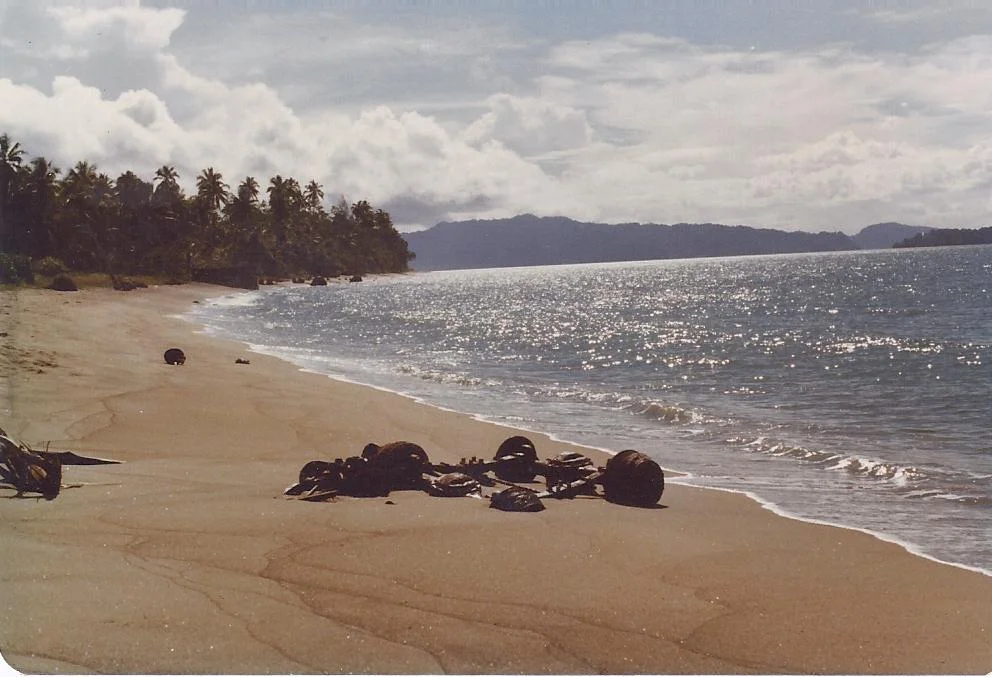

Buin, Papua New Guinea
On 18 April 1943, a Mitsubishi G4M bomber - Allied codename "Betty" - was on final approach to the Japanese airbase at Buin when a flight of American P-38 Lightnings climbed out of nowhere and tore it apart. The bomber's passenger was Admiral Isoroku Yamamoto, commander-in-chief of the Imperial Japanese Navy, architect of the Pearl Harbor attack, on a morale tour of forward bases. Decoded radio signals had given the Americans his itinerary; the P-38s had flown up from Guadalcanal to meet him. The Betty came down in the jungle just north of where the town of Buin now stands. A man who had shaped the war he was losing ended up in the canopy of a place most Americans would struggle to find on a map.
Before Yamamoto
Buin before the war was not even a town, exactly. It was a sea-landing on the south coast, a handful of buildings, and a few Chinese trade stores run by one family that had arrived during the German era and would hold on through five sovereignties. German New Guinea administered Bougainville from 1884 to 1919. In the 1930s, the Viennese anthropologist Richard Thurnwald published studies with titles like Pigs and Currency in Buin, and Harvard's Douglas Oliver spent 1938 and 1939 in neighbouring Siwai. They wrote about kinship, drumming clubs, and matrilineal inheritance - systems that did not much care which flag flew above the district office. When the Imperial Japanese Army arrived in early 1942 and began building airfields, they found a landscape already shaped by people who had adapted to many previous visitors.
Airbase and Target
The Japanese built two airstrips on southern Bougainville - one at Kahili, one at the site that would later become the postwar Buin. Together with Rabaul to the west, these bases gave Japanese airpower reach down the Solomon chain and threatened the Allied supply line to Australia. They also made Bougainville, in American planners' view, a thing that had to be neutralized before Empress Augusta Bay could be taken. Yamamoto's death did not end the Japanese presence; it accelerated its collapse. For the next two and a half years Buin lived through Allied bombing runs and the slow tightening of a ring that the Australians, advancing south from Torokina in 1945, were still drawing shut when the war ended. In the 1970s, families of dead Japanese soldiers returned in organized groups - retrieving bones, cremating remains, visiting the wreck of Yamamoto's Betty. Many lodged at Buin High School and left substantial gifts of books for its library.
A Town the Government Built
After the war, Australian administrators moved Buin inland to a new site a few miles from the old coastal landing. It grew slowly at first. Then in 1972 the Panguna copper mine opened in the mountains to the north, and for the next seventeen years Bougainville Copper Limited generated a huge share of Papua New Guinea's gross national product - from ore dug up in a place most Papuans had never visited. Buin's main street filled with trade stores, a bank, a post office. The Saturday market drew women selling guava and paw-paw, men selling fresh-water crayfish, and fishermen from the Shortland Islands and the Treasury Islands carrying tuna across an international border that, as the locals liked to point out, no one bothered to police. You could hear the Telei language spoken alongside Korokoro Motuna from Siwai and Tok Pisin from everywhere else.
The Civil War
The wealth from Panguna flowed outward; the environmental damage stayed home. Landowners had been inadequately compensated, their rivers poisoned with tailings, their sacred sites leveled. In 1988 a former mine surveyor named Francis Ona led an uprising that shut the mine down and triggered a ten-year civil war in which as many as twenty thousand Bougainvilleans died. Buin, isolated by a blockade, tore up its own airstrip with bulldozers so Papua New Guinean forces could not land there. The town's council buildings were wrecked. Locals fought a guerrilla campaign through bloody years until the Papua New Guinea Defence Force and its allies withdrew in 1997. A peace agreement brokered by New Zealand in 2000 created the Autonomous Region of Bougainville and made Buin the capital of the South Bougainville District. In December 2019, in a non-binding referendum, 98 percent of Bougainvilleans voted for full independence - one of the most lopsided mandates in the history of self-determination referendums.
What Remains
Walk through Buin today and the Saturday market is still there. So is the Roman Catholic parish and the United Church, institutions that arrived in the German era and outlasted three empires. Buin High School still teaches students from across Bougainville and Buka. On beaches south of town, rusted Japanese shells still surface after heavy rains, and somewhere in the bush north of the airstrip the remains of Yamamoto's Betty are still slowly returning to the forest. The climate is tropical rainforest - heavy rain year-round, peaking in the low-sun monsoon, which is backward compared to much of Papua New Guinea. Independence, should the Papua New Guinean parliament ratify it, is scheduled for 1 September 2027. The world's newest country will have, in Buin, a capital that has already been occupied, ambushed, mined, blockaded, and rebuilt.
From the Air
Coordinates 6.75 S, 155.69 E, on the Buin Plain at the southern end of Bougainville Island in the Autonomous Region of Bougainville, Papua New Guinea. Recommended viewing altitude 3,000 to 5,000 feet. Buin Airport (AYIQ) has an unpaved strip; Buka Airport (AYBK) to the north is the main regional gateway. Visual landmarks: the south coast five miles south of town, the volcano country around Lake Loloru to the northeast, and the Shortland Islands visible across the strait to the southeast. Expect frequent heavy rain and low cloud; the region has one of the wettest tropical climates in the Pacific.
Nearby Stories
- Japanese Seaplane Carrier Nisshin 22 km away
- Bougainville Copper Limited 22 km away
- Battle of the Treasury Islands 40 km away
- Battle of Vella Lavella (naval) 54 km away
- Autonomous Region of Bougainville 56 km away
- Bougainville Conflict 86 km away
- Takuu Atoll 218 km away
- Woodlark Island 341 km away