
Autonomous Region of Bougainville
Ninety-seven point seven percent. Those are the numbers that matter. In a non-binding referendum held over two weeks in late 2019, Bougainvilleans were given a straightforward choice - stay in Papua New Guinea with greater autonomy, or leave entirely. Ninety-seven point seven percent of the valid ballots cast chose to leave. It was one of the most lopsided votes in the modern history of self-determination. In March 2025, the Bougainville Independence Leaders Consultation Forum named a date: 1 September 2027. If the Papua New Guinean parliament ratifies the result, Bougainville will become the world's newest country. The negotiations that will get them there - and the question of whether a region of 367,000 people with a cocoa economy can actually stand up a sovereign state - are being worked out between Port Moresby and Buka right now.
Twenty-Nine Thousand Years
Kilu Cave on Buka Island contains human remains and stone tools dating back at least 29,000 years. During the Last Glacial Maximum, so much water was locked up in ice sheets that Buka, Bougainville, and what are now the northern Solomons formed a single landmass - a "Greater Bougainville" reaching almost to Guadalcanal. The first inhabitants were Australo-Melanesians from the Bismarck Archipelago. Around 3,000 years ago, Austronesian seafarers arrived carrying the Lapita culture - pottery, pigs, dogs, chickens, and distant cousins of languages spoken today in Hawaii and Madagascar. Both language families survived. Modern Bougainville has Austronesian languages, non-Austronesian languages sometimes called East Papuan, and a handful of Polynesian outliers in its smaller atolls. Many of those languages exist nowhere else. This is one of the most linguistically dense places on Earth.
A French Name and Five Colonial Flags
Louis Antoine de Bougainville never set foot on the island that now carries his name. In 1768, on a French circumnavigation, he sailed along its east coast, noted it, and kept moving. That passing glance fixed an outsider's name on a place whose people called themselves something else. What followed was a colonial sequence so rapid that the islanders had flags changed over them five times in as many generations. The German Empire annexed the archipelago in 1886 and administered it through German New Guinea. Australia seized the territory in 1914. The 1919 Treaty of Versailles turned it into a League of Nations mandate under Australian administration. In 1942 Japan invaded. In 1943 the Americans landed. In 1945 the Australians took over again. In 1975 Papua New Guinea became independent and inherited Bougainville - whose people had not been asked.
The Mine at Panguna
In 1972, Bougainville Copper Limited - a subsidiary of the British-Australian mining giant Rio Tinto - opened an open-pit copper and gold mine in the mountains at Panguna. For seventeen years it was one of the largest mines in the world. At its peak it generated a large part of Papua New Guinea's gross national product. It also poisoned rivers, displaced villages, and sent most of its revenue overseas. The Bougainvilleans who bore the cost saw very little of the benefit. In 1988, Francis Ona - a former mine surveyor - led the Bougainville Revolutionary Army in an uprising that shut Panguna down. The Papua New Guinea Defence Force was sent in. Australia and New Zealand supported Port Moresby. The resulting civil war lasted nearly a decade and killed an estimated 15,000 to 20,000 Bougainvilleans out of a total population that never exceeded 200,000. The PNGDF withdrew from permanent positions in 1990 but kept fighting. In 1996 the PNG government hired Sandline International, a private military company, to help finish the rebellion - a decision that provoked a constitutional crisis in PNG itself.
Peace and the Vote
New Zealand, of all countries, brokered the end of the fighting in 1997. A full peace agreement was signed in 2001. It created the Autonomous Bougainville Government with its provisional capital at Buka on Buka Island, and - crucially - it guaranteed a future referendum on independence. That referendum came eighteen years later, in late 2019. Former president John Momis oversaw it. Former BRA commander Ishmael Toroama was elected president the following year, becoming a former rebel leader governing a region preparing to leave the country that had tried to subdue him. Bougainville has what many new states lack: a constitution drafted and ready, a working government, a population overwhelmingly united on the end goal. What it does not yet have is an economy that can fund a sovereign budget. PNG Prime Minister James Marape has cautioned against moving too fast; the Bougainvillean response has generally been that they have waited long enough already.
The Country That Will Be
The population of Bougainville is 367,093 as of 2024. Around seventy percent is Roman Catholic, a minority is United Church Protestant, and pre-Christian traditions around lakes and spirits and the souls of the dead remain present. Cocoa and copra have returned to pre-civil-war production levels. Panguna is closed, and opinion on whether it should reopen is deeply divided. The lingua franca is Tok Pisin, but the constitution calls for all Bougainvillean languages to be nurtured. The provisional capital is Buka, though independence may move it back to Arawa, the prewar mining town. A flag already exists - blue, green, black, and red, with a kapkap ornament of traditional Solomon Islands design at the center. If the timeline holds, on 1 September 2027 the flag will go up over a new member of the United Nations. It will have been 263 years since a French admiral sailed past without landing, 29,000 years since the first humans reached Kilu Cave, and eight years since their descendants told the world, by a vote of 97.7 to 2.3, that they were ready to govern themselves.
From the Air
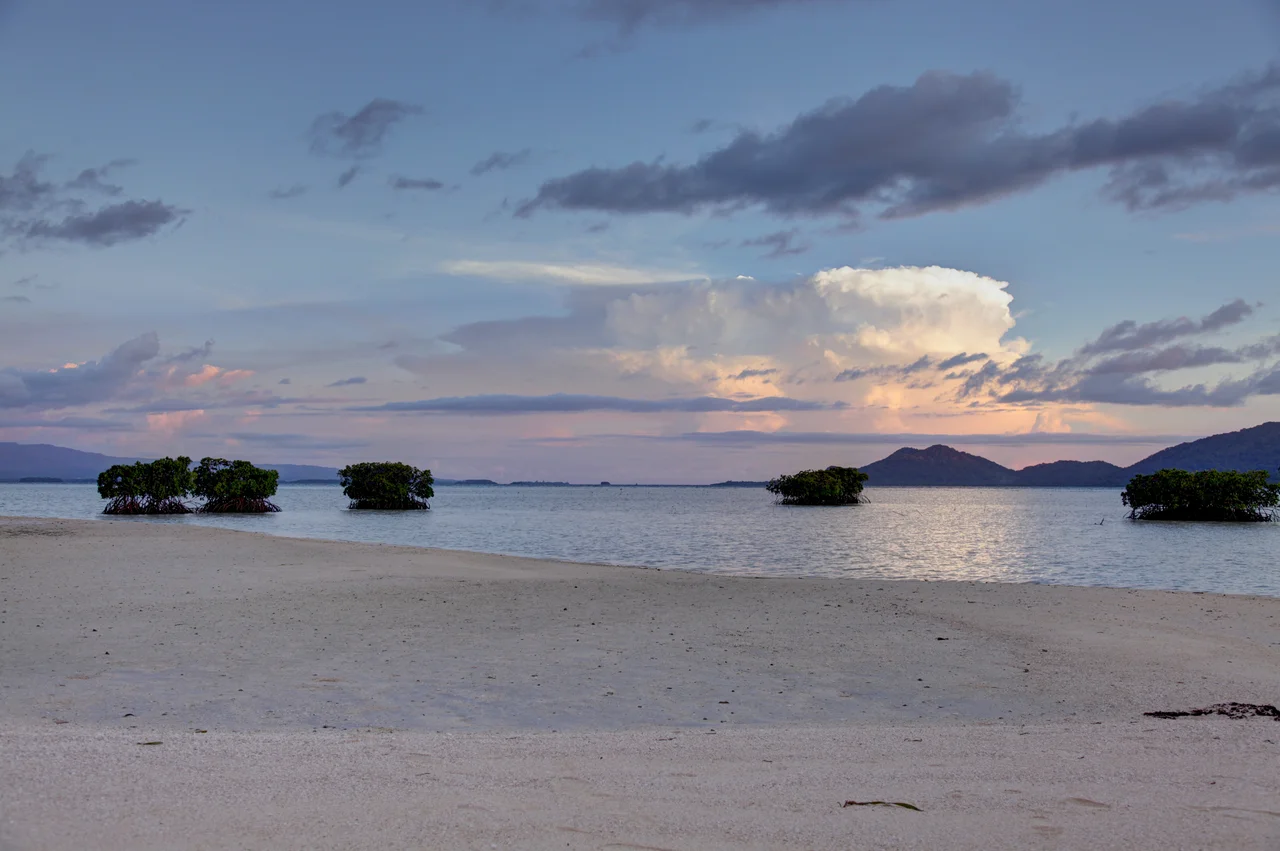
Coordinates approximately 6 S, 155 E. The Autonomous Region of Bougainville covers Bougainville Island, Buka Island, and a scatter of smaller atolls and outliers, lying in the Solomon Islands archipelago but politically part of Papua New Guinea. Recommended viewing altitude 10,000 to 15,000 feet to appreciate the volcanic spine and reef systems. Buka Airport (AYBK) on Buka Island is the main gateway and the provisional capital's airfield; Aropa Airport (AYIQ - Buin) and Arawa are also served. Weather is tropical rainforest with heavy rainfall year-round; trade winds bring the clearest visibility. The Panguna mine scar remains visible from altitude in the central mountains, a reminder of what triggered the civil war.
Nearby Stories
- Japanese cruiser Sendai 11 km away
- Battle of Tsimba Ridge 22 km away
- Panguna Mine 30 km away
- Battle of the Hongorai River 56 km away
- Battle of Slater's Knoll 59 km away
- Operation RY 98 km away
- Takuu Atoll 212 km away
- Woodlark Island 356 km away