
Panguna Mine
From cruising altitude the pit looks like somebody erased part of the island. A roughly circular void in the Crown Prince Range, rust-coloured tailings streaking down the Jaba River toward the west coast, vegetation still absent three decades after the last truck drove out. Panguna is a place the global economy wanted very badly - an estimated billion tonnes of copper ore and twelve million ounces of gold, so rich that in its operating years it generated twelve percent of Papua New Guinea's gross domestic product and over forty-five percent of the country's export revenue. It was, in its time, the largest open-pit copper-gold mine on Earth. It is also the place where the arithmetic finally broke, and an island decided that being poisoned to pay for someone else's independence was not a bargain it would honour.
A Mountain's Worth of Copper
The ore body was discovered in Bougainville's Crown Prince Range in the mid-1960s. Conzinc Rio Tinto of Australia formed a subsidiary, Bougainville Copper Limited, and opened the mine in 1969. Production began in 1972 - the pit, the ore mill, the tailings discharge into the Jaba River all running at industrial scale on a tropical island with no road to its own capital. The Papua New Guinea national government took a twenty percent share of the profits. The Bougainvilleans, whose ancestral lands held the ore, whose water flowed through the tailings, received between half a percent and one and a quarter percent. The mine's revenue helped fund Papua New Guinea's independence from Australia in 1975. That was the deal's logic on paper: a resource colony subsidising the political birth of a nation it barely belonged to.
The Jaba River
Every day the Panguna mill produced copper concentrate and, as waste, enormous quantities of finely ground rock laced with the metals that could not be economically extracted. There was no tailings dam. The waste was discharged directly into tributaries of the Jaba River, which carried it the length of its course to the sea. The river turned grey. Fish disappeared. Villages downstream described birth defects. The Bougainvillean flying fox, a subspecies of fruit bat endemic to the island, went extinct. Meanwhile, at the mine itself, Bougainville Copper had established a system of racial segregation - one set of living quarters, messes and recreation facilities for the white workers flown in from Australia, another, plainly inferior, for the Nasioi and other local workers. These conditions accumulated through the 1970s and into the 1980s as grievances that the existing royalty structure was too small to address. By the end of the 1980s, the grievances had names.
Francis Ona
Francis Ona was a Nasioi man, a Panguna landowner, and for a time an employee of Bougainville Copper. In 1988 he broke with the existing landowner association, arguing it had been co-opted, and demanded compensation on an entirely different scale - ten billion kina, a share of ongoing profits, and environmental remediation. When the demands were refused, the sabotage began. Power lines were cut. Explosives were taken. Bulldozers were set alight. Ona founded the Bougainville Revolutionary Army. The Papua New Guinea Defence Force was sent in to restore order, and the order it imposed produced more recruits for the BRA than the BRA could have recruited on its own. On 15 May 1989 mining operations were formally halted. By 24 March 1990 the last BCL personnel had withdrawn. The mine Ona had worked at, and that his ancestors had lived above, went silent and has remained silent ever since. The war that followed killed more than twenty thousand people - men, women and children, combatants and civilians, on an island of perhaps a quarter-million inhabitants.
The Ghost Town
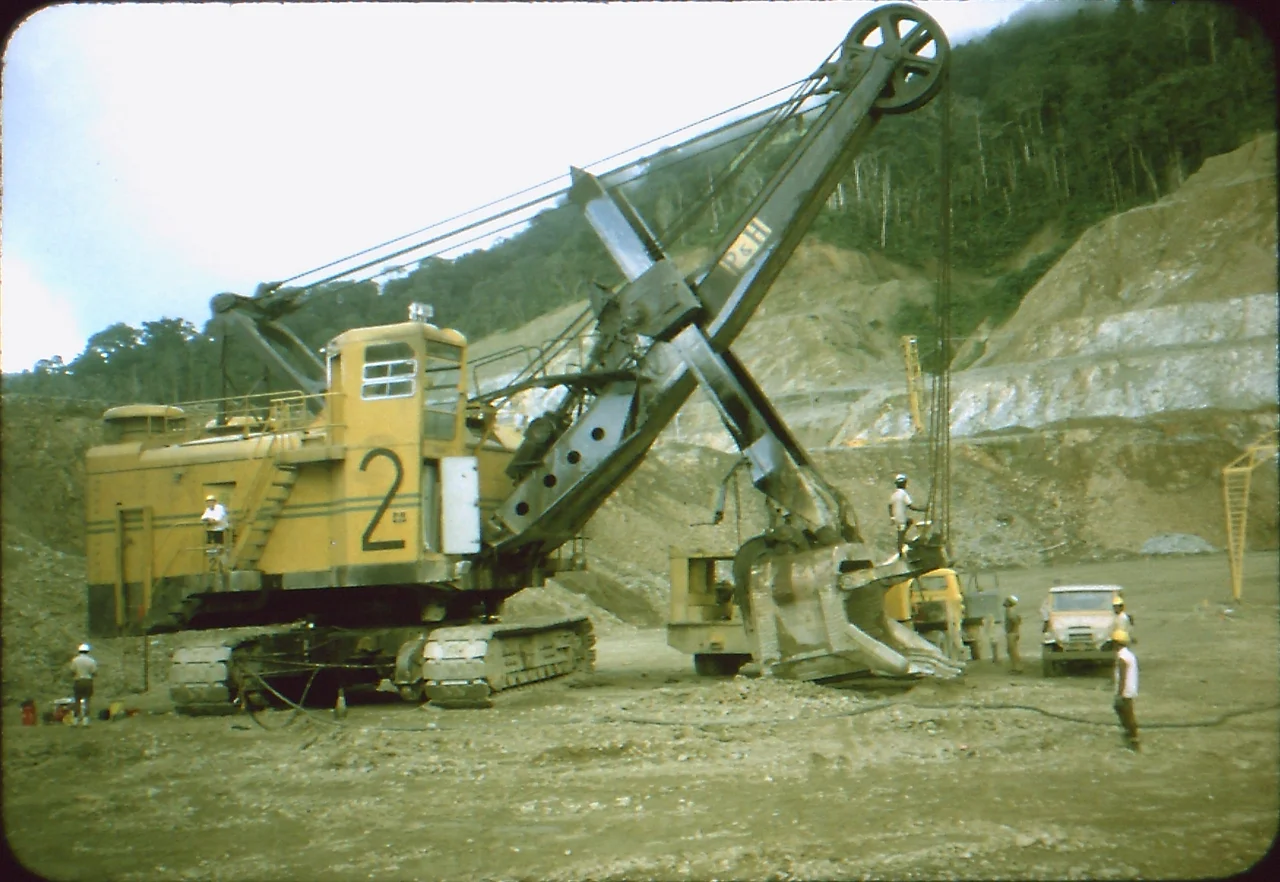
Walk the edge of the pit today and what you see is an enormous circular step-terraced void, its walls striped in the colours of the exposed rock, its floor holding a murky lake. Buildings remain - parts of the ore mill, workshops, housing blocks - in the half-jungled state of places abandoned in a hurry. The dragline shovels left behind were stripped for whatever metal locals could carry. The Jaba River downstream is still running grey in places. In 2020 the Human Rights Law Centre in Melbourne lodged a complaint with the Australian government regarding the environmental and human rights impacts of the mine. Rio Tinto, which in June 2016 transferred its 53.8 percent BCL shareholding free of charge to the Autonomous Bougainville Government and Papua New Guinea, has refused to fund remediation - the company's position is that it complied with the relevant laws at the time it was mining. The heavy metals - copper, zinc, mercury - are still there, regardless of what any law said.
Whether To Open It Again
Bougainville is moving toward independence. In a non-binding referendum in 2019, roughly ninety-eight percent of voters chose independence from Papua New Guinea, and the territory and Port Moresby have been negotiating since. An independent Bougainville will need a revenue base. Panguna's remaining reserves are enormous - some estimates put their value above ninety billion US dollars. Reopening the mine would cost an estimated five to six billion dollars in capital. Every few years the Autonomous Bougainville Government re-opens the conversation; every few years the landowners close it again. Francis Ona died of malaria in 2005, unreconciled. The people who live around Panguna today are the children and grandchildren of those who shut the mine down. They have had thirty-five years to watch the pit fill with water and decide whether the arithmetic works now. So far, it has not.
From the Air
The Panguna pit sits at approximately 6.315°S, 155.495°E in central Bougainville, high in the Crown Prince Range. From altitude, look for the distinct circular excavation with rust-coloured tailings draining west down the Jaba River. The nearest operational airport is Aropa (IATA KIE, ICAO AYIQ) on the east coast near Kieta, roughly 25 km away. Expect tropical convective cloud building over the central mountains from mid-morning; the clearest view is in the first hours after dawn.
Nearby Stories
- Japanese Seaplane Carrier Nisshin 12 km away
- Autonomous Region of Bougainville 27 km away
- Buin, Papua New Guinea 30 km away
- Battle of Tsimba Ridge 49 km away
- Raid on Choiseul 92 km away
- Battle of Porton Plantation 102 km away
- Takuu Atoll 168 km away
- Woodlark Island 384 km away