
Raid on Choiseul
Major General Roy Geiger described it best after the fact: a series of short right jabs designed to throw the enemy off balance and conceal the real power of the left hook to his midriff at Empress Augusta Bay. The right jabs were the Treasury Islands landing and the Raid on Choiseul. The left hook was the 1 November 1943 landing of three Marine regiments at Cape Torokina on Bougainville - the move that would strangle Rabaul. But a jab only works if it looks like a real punch. To make Choiseul look real, Lieutenant Colonel Victor Krulak took 700 men of the 2nd Parachute Battalion onto a jungle island held by several thousand Japanese, and for seven days pretended to be an entire division.
The Deception
By the autumn of 1943, the Allies had taken Guadalcanal and worked their way up the New Georgia chain. The next target was Bougainville - and the Japanese knew it. The question for the defenders was where the landings would fall. Southern Bougainville made more sense in every way. It was closer to Rabaul, it had existing airfields at Buin, it was where the bulk of Japanese forces were already positioned. The Allies decided to land instead on the west coast at Cape Torokina, in a backwater the Japanese had barely garrisoned. To sell the deception, smaller landings would go in around it. One force of New Zealanders would hit the Treasury Islands. A second force - Krulak's paratroopers - would hit Choiseul, a long narrow island about forty-five miles southeast of Bougainville. If the Japanese could be convinced that these were preliminary moves for a main assault on southern Bougainville, they would hold their reserves in the wrong place.
Krulak Lands
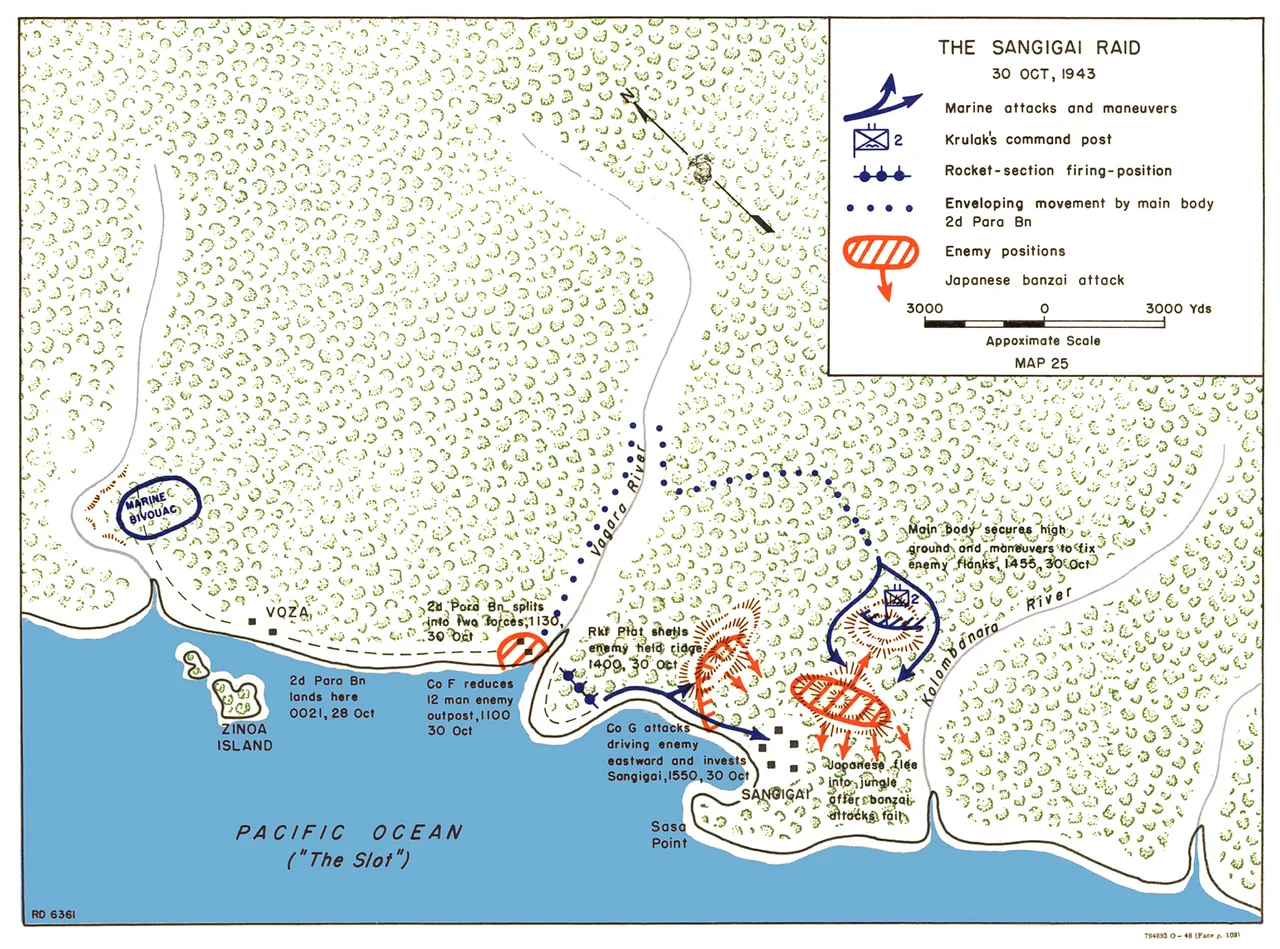
On the night of 27 October 1943, 656 to 725 men of the 2nd Parachute Battalion boarded eight LCM landing craft at Vella Lavella and were transferred to four high-speed transports - McKean, Crosby, Kilty and Ward, converted four-stack destroyers from an earlier war. Escorted by the destroyer USS Conway, the convoy ran north through the darkness. A single Japanese aircraft found them en route and scored a near miss on one of the transports. Just before midnight the ships reached the assembly point about two thousand yards off the abandoned village of Voza on Choiseul's northwest coast. Coral reefs made most of the island impossible to land on; Voza was one of the few places rubber boats and landing craft could reach the beach. An advance reconnaissance party went in on rubber dinghies. Companies F and G followed. The Marines came ashore unopposed on the morning of 28 October. Once his men were on the beach, Krulak immediately transmitted an uncoded radio message - the kind the Japanese could not fail to intercept - announcing that 20,000 Americans had just landed on Choiseul and were about to commence operations.
Sangigai
The local coastwatchers on Choiseul - Charles Waddell and Sub-Lieutenant Carden Seton, both operating with the support of the island's 5,000 Melanesian inhabitants - told Krulak that the nearest significant Japanese force, several hundred men, was at Sangigai to the south. Krulak decided to hit them before they could attack his beachhead. On 30 October, Companies E and F set out at 04:00 with mortars, rockets and machine guns. The plan was to use captured landing craft to move down the coast, but a preliminary air strike of twelve Grumman TBF Avenger torpedo bombers, escorted by 26 fighters, mistakenly strafed the Marines' own landing craft and damaged one. The companies walked instead, led by Seton and his local guides. The airstrike proper hit Sangigai at 06:10. The Marines split into two columns to envelop the village. Thick jungle slowed Krulak's flanking company. Captain Robert Manchester's E Company reached its position along the coast first, shelled a ridge north of the village, and took Sangigai. The Japanese defenders withdrew inland - straight into Company F's waiting fire near the Kolombanara River. For an hour the Marines tried to envelop and the Japanese tried to charge through. Seventy-two Japanese were killed. The Marines lost four killed and twelve wounded. Krulak was among the wounded.
Bigger's Patrol to Guppy Island
On 1 November - the same day the main Bougainville landing was going in at Cape Torokina - Krulak's executive officer Major Warner Bigger took eighty-seven men from Company G north toward Nukiki. The plan was to hit the Japanese concentration at Choiseul Bay with 60mm mortars. Bigger landed near the Warrior River, hid the boats, and pushed inland. The local guides became lost. The patrol spent a nervous night in the jungle while a smaller detachment went back to request another guide. The Japanese closed in overnight. The next morning the smaller party made it back to the boats. Bigger pressed on. When his original target at Choiseul Bay proved too well defended, he switched to his alternate - the Japanese supply and fuel dump on Guppy Island. From the beach, Bigger's men fired 143 mortar rounds into the dump and set it ablaze. As they tried to withdraw, the Japanese landed a force to cut them off. Bigger's men fought off four attacks on the western bank of the Warrior River before air support from Munda covered the extraction. The episode captures what raids actually look like from the inside: a plan, a lost guide, an improvisation, a fight out.
What the Raid Actually Did
On the morning of 4 November, three days after the main Bougainville landing, Krulak withdrew his battalion aboard three LCI landing craft. The whole operation had lasted seven days. Historians disagree about whether the deception worked. John Miller, the official U.S. Army historian, concluded that Japanese records do not clearly show the raid confirming Japanese expectations of a southern Bougainville landing. John Costello has pointed out that after the raid, the Japanese moved thousands of reinforcements to Choiseul - men who might otherwise have gone to Torokina. What is clear is that intelligence captured during the raid helped Allied naval commanders identify Japanese minefields around Cape Torokina and lay new ones where the Japanese thought it was safe. The human cost was modest in the arithmetic of the Pacific War - the Japanese lost heavily, the Marines lost lightly. The cost that went uncalculated was borne by the Choiseul Islanders who had helped the Americans and who were left behind when the Marines departed. Seton stayed on through mid-1944 to continue coastwatching and target-spotting for dive bombers. Most of the locals he worked with did not have that option.
From the Air
Choiseul Island lies in the northern Solomon Islands at approximately 6.88°S, 156.62°E, about forty-five miles southeast of Bougainville. The island runs roughly 75 miles northwest-to-southeast and up to 25 miles wide at its broadest. From altitude the long jungle-covered mountain spine and the coastal fringe are clearly visible in clear weather. Voza, the Marine landing site, is on the northwest coast. Nearest operational airport is Munda (IATA MUA, ICAO AGGM) on New Georgia to the southeast; Taro (IATA TAA) on Choiseul itself is the local strip. Expect tropical convective cloud building from mid-morning.
Nearby Stories
- Japanese submarine Ro-100 19 km away
- Japanese Seaplane Carrier Nisshin 51 km away
- Battle of Vella Lavella (naval) 54 km away
- USS Helena (CL-50) 62 km away
- Battle of the Treasury Islands 62 km away
- Bougainville Copper Limited 77 km away
- Battle of Kolombangara 101 km away
- 1737 Kamchatka Earthquake 6584 km away