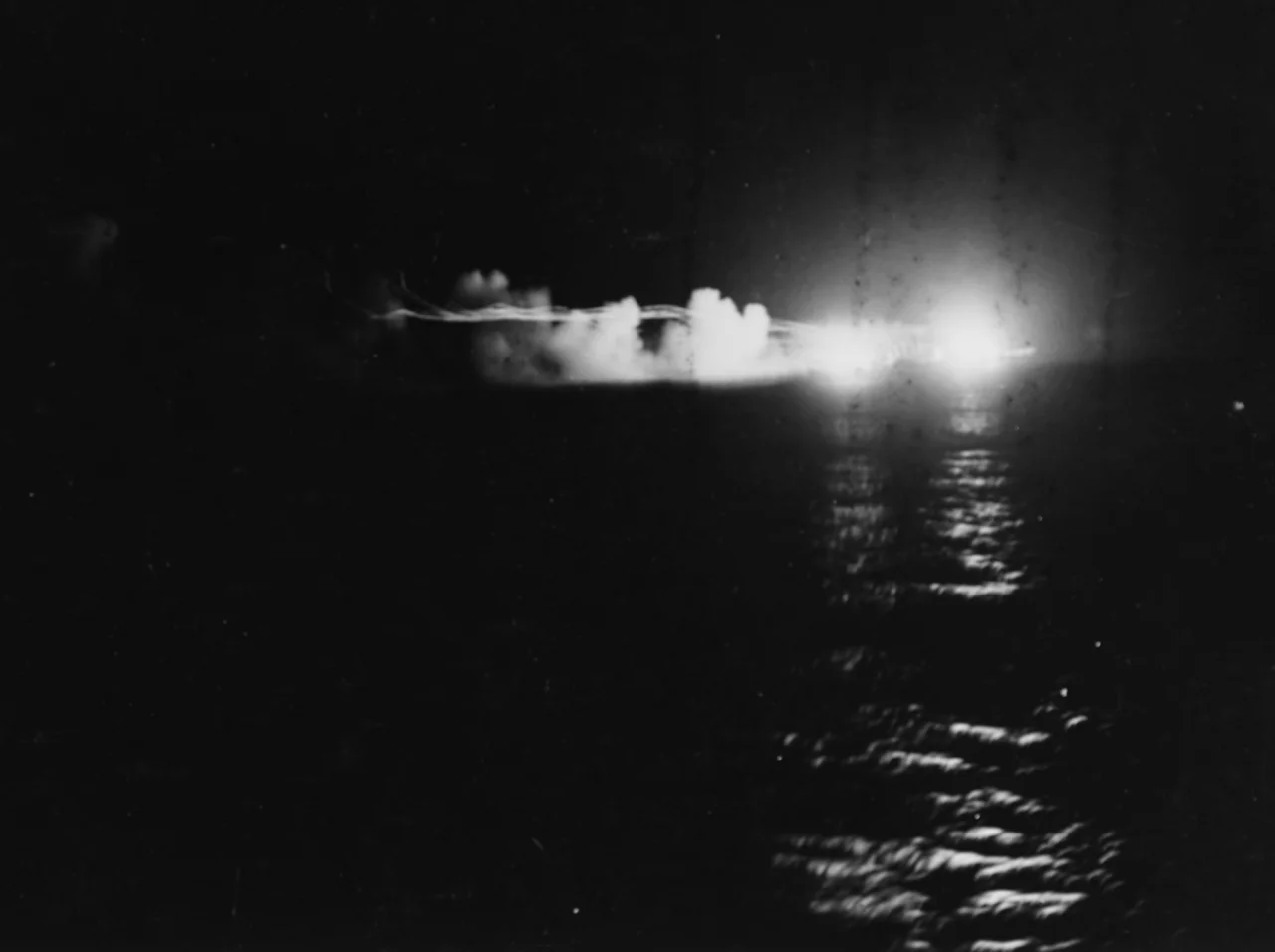
_and_HMNZS_Leander_firing_during_the_Battle_of_Kolombangara,_13_July_1943_(80-G-342763).jpg)
Battle of Kolombangara
"A string of such victories add[ed] up to defeat." That was how the American naval historian Samuel Eliot Morison summarized the Battle of Kolombangara - a Japanese tactical win in which they sank one American destroyer, crippled three Allied light cruisers so badly that two were out of action for months and one was out of the war forever, and still quietly lost. The reason they lost was mathematical. By mid-1943, American shipyards were launching replacement warships faster than the Japanese could sink them. Every night engagement in the central Solomons - even the ones Japanese sailors fought with breathtaking skill - drained a pool that would not be refilled. On the night of 12-13 July 1943, in the waters off Kolombangara's northeastern coast, that arithmetic went to work.
A Reinforcement Run into an Ambush
The setup was by now a familiar rhythm of Solomons warfare. Allied troops had been ashore on New Georgia for about two weeks, grinding toward the Japanese airfield at Munda Point. To slow the American advance, the Imperial Japanese Navy dispatched a Tokyo Express run down "The Slot" - the light cruiser Jintsu, leading five destroyer-transports and escort destroyers, carrying about 1,200 soldiers to land at Vila on Kolombangara. The force was commanded by Rear Admiral Shunji Isaki. Australian coastwatchers hidden in the jungles saw the ships move, and radioed the warning up the chain. Admiral William Halsey dispatched Task Force 18 to intercept: three light cruisers - the American Honolulu and St. Louis and the New Zealand HMNZS Leander - and ten destroyers under Rear Admiral Walden L. Ainsworth. They caught up shortly after 01:00 on 13 July, twenty miles east of Kolombangara's northern tip.
Radar Is Not a Secret
Ainsworth was confident his radar gave him surprise. It did not. The Japanese had no radar of their own, but they had receivers sensitive enough to detect the electromagnetic emissions of Allied sets - and for nearly two hours before the battle, they had been tracking the Americans by tracking the pulses the Americans were broadcasting. Isaki's flagship Jintsu turned on her searchlight and opened fire at about 01:08. The three Allied cruisers returned fire immediately, concentrating 2,630 rounds on the Japanese cruiser under the direction of a spotting aircraft overhead. Jintsu lost steerage, came to a dead stop, was hit by torpedoes, broke in two, and sank at 01:45. Nearly her entire crew went down with her, including Isaki. It looked, in that moment, like another American victory.
The Long Lance Finds Its Range
But before Jintsu died, her escort destroyers had fired their torpedoes - and Japanese Type 93 torpedoes, fueled by pure oxygen, reached further and ran faster than anything the Allies carried. The Allied ships began to spot wakes in the water. In the confusion, thick gunsmoke and garbled communications caused ships to turn wide to avoid colliding. Leander, the slowest vessel in the formation and now the New Zealand Navy's only cruiser in the Pacific, took a torpedo that disabled her so severely she never returned to the war. She limped out of the fight escorted by Radford and Jenkins. Then Ainsworth made a harder mistake. His escort destroyers had quietly slipped into a rain squall to reload their torpedo tubes - they did it in eighteen minutes, a remarkable feat of seamanship. When Ainsworth pursued what he thought were retreating destroyers, he turned his cruisers directly into the path of a second salvo. St. Louis and Honolulu both took torpedoes in their bows. The American destroyer Gwin was hit amidships, crippled, and had to be scuttled at 09:30. Sixty-one men died on her.
Ships That Came Home in Pieces
In cold numbers, the Japanese had won. Jintsu and 482 of her crew were lost, but the four destroyer-transports peeled away along the coast, slipped through the Vella Gulf, and landed all 1,200 reinforcements at Sandfly Harbor on Kolombangara's western shore. They finished unloading at 03:40 and returned to Buin. The Allied force limped away with a destroyer sunk and three cruisers out of action. Honolulu and St. Louis would be in dry dock for months. Leander's damage was so severe she would not return to combat in the entire war. It was the second bad night in a row for the Allies - the Battle of Kula Gulf, just a week earlier, had also cost them a light cruiser. But the Americans could afford it. The Japanese could not. Every cruiser in Isaki's order of battle had been launched years before; every replacement would have to be drawn from a shrinking industrial base. The naval historian Paul Dull called Kolombangara one of a "series of Pyrrhic victories" for Japan.
The Lesson, Written in Steel
Admiral Chester Nimitz, reading the battle reports, drew his own conclusion: cruisers were too vulnerable in the narrow, reef-studded waters of the Solomons. Going forward, American destroyers and PT boats would carry the night fight. Less than a month later, at the nearby Battle of Vella Gulf, six American destroyers - fighting independently, with new centimetric radar and finally-reliable torpedoes - would sink three Japanese destroyers in a single minute without taking a scratch. The lesson of Kolombangara had landed. Meanwhile, the Japanese losses at Jintsu forced them to start moving reinforcements in slow, flat-bottomed Daihatsu barges that could be hunted one by one. Between late September and early October 1943, the U.S. Navy claimed to have sunk 46 such barges, killing thousands of soldiers in small, unrecorded actions. Then the Japanese began evacuating Kolombangara entirely. The island - today a volcanic cone rising 1,770 meters from the sea, circled by quiet villages and reef-lined beaches - kept its Japanese pillboxes and wrecked landing craft for decades. Some are still there, rusting in the jungle above the gulf where so much sank so fast.
From the Air
The Battle of Kolombangara was fought off the northeastern coast of Kolombangara island, roughly centered at 7.83 degrees south, 157.35 degrees east, in the Solomon Islands. Kolombangara itself is a near-perfect volcanic cone rising to about 1,770 meters and is one of the most distinctive landmarks in the central Solomons - visible from 40 nautical miles away in clear weather. Recommended viewing altitude is 5,000 to 8,000 feet to frame the battle site with New Georgia to the south and Kolombangara's peak to the west. Nearest airport is Munda (AGGM) on New Georgia, about 25 nautical miles south. Tropical conditions prevail year-round; mornings are typically the clearest.
Nearby Stories
- Battle off Horaniu 16 km away
- Battle of Arundel Island 25 km away
- Battle of Vella Lavella (naval) 63 km away
- Choiseul Island (Lauru) 74 km away
- Woodlark Island 457 km away
- Païta 1808 km away
- Maré Island 1868 km away
- 1737 Kamchatka Earthquake 6680 km away