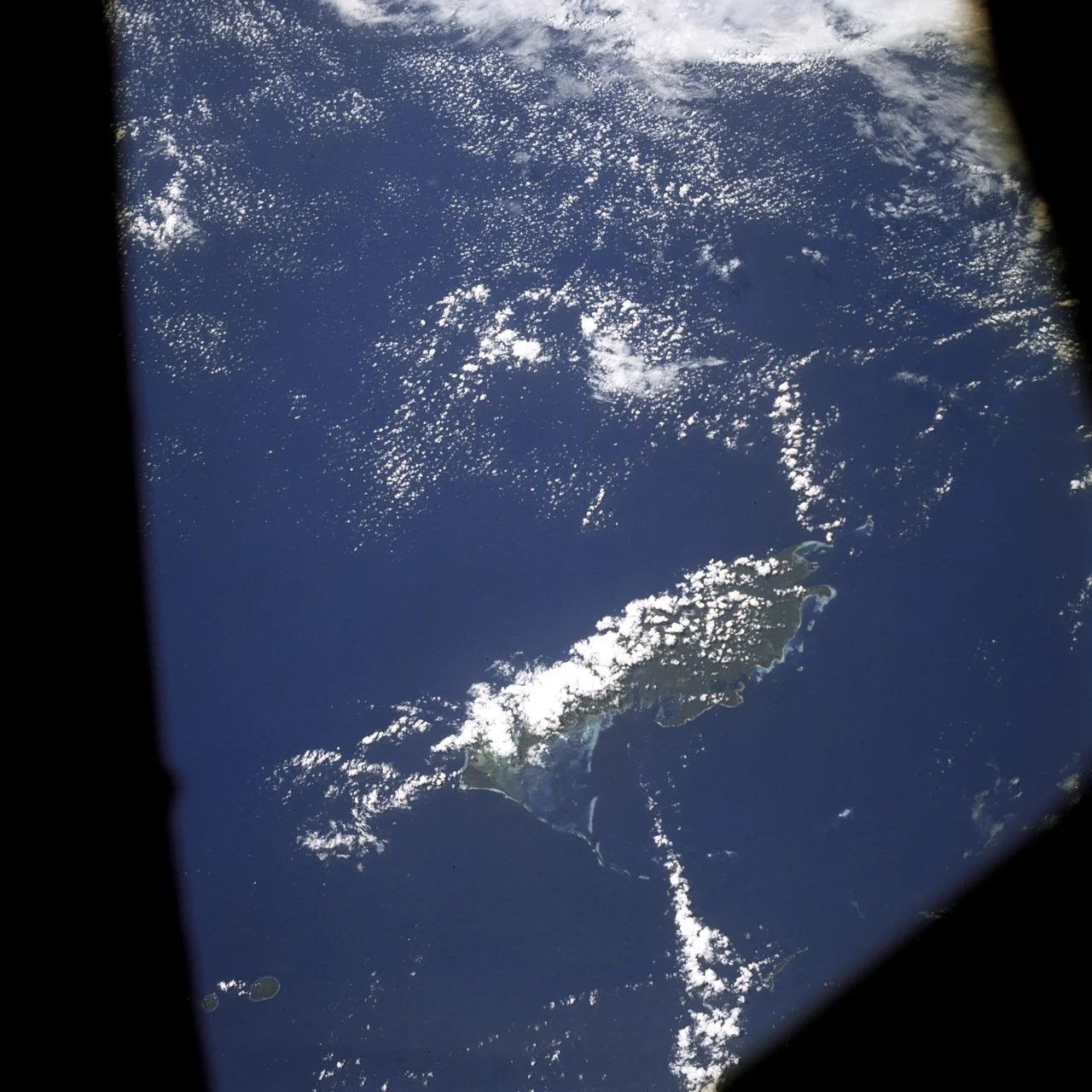

Woodlark Island
Woodlark Island is the name on the British charts. The people who live there call it Muyua. The British name came from an Australian whaling ship that passed through in the 1830s; the local name is at least three thousand years older than the whalers, reaching back to the Austronesian voyagers who first landed here. In the long view, Woodlark is a place where outside forces have arrived, reshaped things for a decade or two, and departed again - leaving behind place names, mine workings, airfield ruins, and a population that in 1915 had fallen to around a third of what it was at first European contact.
The Whalers and the Missionaries
The whalers came for water and wood, and occasionally to recruit crew. Some islanders signed on and saw the world. Others encountered the whalers differently: in 1841 the survivors of the whaling ship Mary, wrecked on the nearby Lachlan Islands, sailed their boat to Woodlark and were killed by islanders - all but one. The last recorded whaler to call, the American vessel Adeline Gibbs, came through in October 1873, and by then the whaling trade had begun its long decline. In 1852 an Italian Catholic missionary order, the Pontifical Institute for Foreign Missions, landed five priests and two brothers on the island. The mission went poorly. In 1855 an islander named Avicoar killed Giovanni Battista Mazzucconi - one of the few Woodlark names from this era that Western histories have recorded. Mazzucconi was beatified by Pope John Paul II in 1983. The man who killed him has no plaque.
The Gold Rush of 1895
In 1895, two traders named Richard Ede and Charles Lobb - operating from a post on the Laughlan Islands - found gold on Woodlark. The news reached Queensland and steamers began arriving every fortnight with fresh gold seekers from Australia. By 1896 and 1897 the island held four hundred white miners and sixteen hundred Papuan laborers, all of them digging, crushing ore, and processing alluvial gravel in the humid interior. The take for those two years was twenty thousand ounces of gold. Pre-World War II total production, including alluvial work that continued long after the initial rush tapered off, is estimated at about 220,000 ounces. The mine workings cluster around Kulumadau in the interior, and modern prospectors have been returning intermittently ever since. The Bureau of Mineral Resources drilled diamonds there in 1962 and 1963, and the Australian company Kula Gold has spent much of the 21st century working up a new mine development - on ground that has never really been left alone.
The War and the Airbase
On 30 June 1943, the same day U.S. Marines landed on Rendova and began the New Georgia campaign, the U.S. 112th Cavalry Regiment came ashore on Woodlark. Operation Chronicle was designed to secure forward airfields for the push up the Solomon Islands chain. Within a few months the Seabees of the 60th Naval Construction Battalion had carved a major bomber base out of the jungle at Guasopa Bay, on the south coast. Woodlark Airfield operated through the later stages of the Pacific war and was handed over to civilian use afterward as Guasopa Airport. The airstrip is still there, cut back by the jungle but identifiable from the air, and the bomb dumps and fuel tank sites survive as overgrown clearings. Today fewer than two hundred people live in Guasopa, which the 1990 census quaintly classed as a 'large rural non-village' - a post-colonial settlement in a place that was forest before the Seabees came through.
The Gharial and the Palm Oil That Almost Was
In the deeper past, Woodlark was stranger than anyone alive now remembers. An extinct crocodilian known informally as the Murua Gharial - Gavialis papuensis, a late-surviving gryposuchine - lived in these waters during the Pleistocene or early Holocene, the last known truly marine crocodilian on earth. Its remains have been found alongside those of sirenians and sea turtles. Like the giant tortoises and flightless birds of other Pacific islands, it was almost certainly hunted to extinction by the first humans to arrive. More recent threats have been economic. In 2007 a Malaysian company called Vitroplant proposed to clear seventy percent of the island for palm oil. The islanders said no. The project was scrapped - a rare instance of a Pacific community successfully turning back a plantation scheme - and the endemic species of the Woodlark jungle survived. Among them: a distinct ground boa subspecies, an inoffensive worm-eating snake called Toxicocalamus longissimus, and the Woodlark cuscus. There are no medically significant venomous snakes on the island.
Six Thousand Muyuw Speakers
The language of Woodlark is Muyuw, part of the Kilivila-Louisiades branch of Austronesian. Estimates put the current population at around six thousand, scattered across the eastern, central, and southern traditional regions of the island, with the largest concentration at Kulumadau and the largest true village at Kaulay. The anthropologist Fred Damon of the University of Virginia, who lived on Woodlark in the mid-1970s, reckoned that between 1850 and 1920 the island had lost up to two-thirds of its people - from an estimated 2,200 at first European contact down to between 700 and 900 by 1915. The diseases of the whalers, the gold rush, and the missionaries all did their work. The population has rebounded, but slowly. One primary school serves the island. For high school, children have to board in Alotau - a boat ride of twenty hours across open ocean - because Woodlark cannot yet support a secondary school of its own.
From the Air
Woodlark lies at 9.13 degrees South, 152.77 degrees East, about 250 kilometers east of the Papua New Guinean mainland in the Solomon Sea. Guasopa Airport (AYGP) on the south coast - the old World War II airbase - remains the main airstrip, with charter service sufficient to reach the island. Gurney Airport at Alotau (AYGN) is the nearest regional hub. From altitude the island shows a long, narrow, densely forested profile with visible clearings around Kulumadau and Guasopa. Reefs and small islets extend well to the north and east. Weather can build quickly; plan approaches around morning convection.
Nearby Stories
- Operation Chronicle 124 km away
- Misima Island 150 km away
- Normanby Island (Papua New Guinea) 155 km away
- Trobriand Islands 158 km away
- Japanese Submarine Ro-103 226 km away
- Battle of the Treasury Islands 295 km away
- Japanese cruiser Sendai 341 km away
- Wreck Reefs 1447 km away