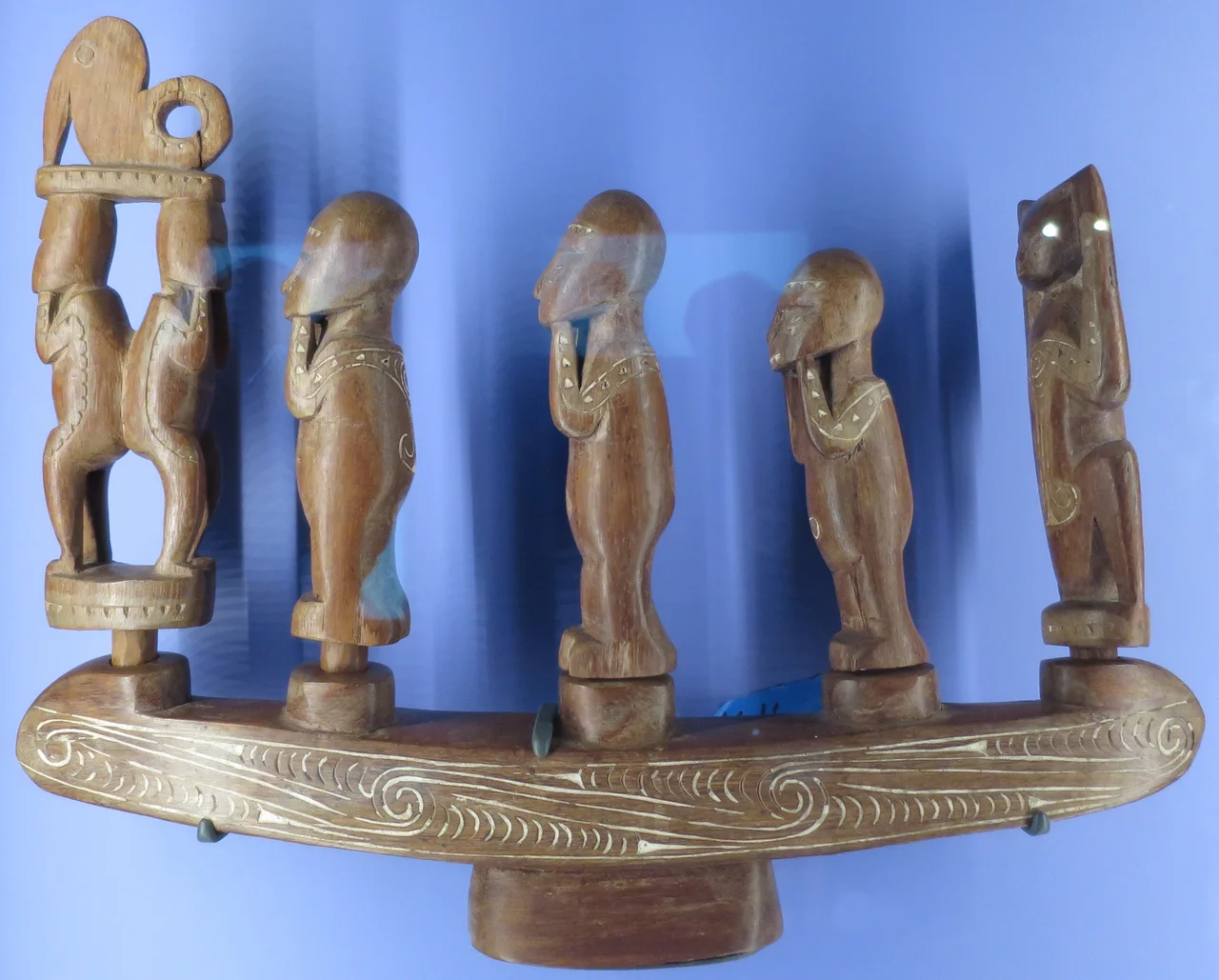

Trobriand Islands
The year begins when someone spots the worm. It is a palolo worm, a small marine annelid, and when it rises to spawn in the right lunar phase the Trobriand Islanders know that Milamala has arrived - the festival that marks the new calendar, the harvest, the months of dancing and visiting and courtship. The calendar itself is unusual: twelve or thirteen lunar cycles, of which only ten are fixed; the remaining months are what the Trobrianders call free time, unnamed and unspoken for. Time in this language has only one tense. A people of about 60,000 live across four main coral atolls - Kiriwina, Kaileuna, Vakuta, and Kitava - speaking Kilivila and organizing their society along principles that confounded European observers from the moment they arrived and continue to fascinate anyone who spends time here.
An Archipelago of Flat Coral
The islands sit 450 square kilometers of coral atoll off the eastern coast of New Guinea, scattered across Milne Bay Province's northern waters. Kiriwina is the largest - 43 kilometers long, narrow, with sixty-odd villages and roughly 12,000 people. Kaileuna, Vakuta, and Kitava each hold hundreds. The islands are nearly flat - some elevation on Kiriwina, almost none on the others - and what grows here grows with effort: yams, taro, coconut palm, mango, breadfruit, the gardens that Trobriand cultivation has made into a high art. Rain falls frequently. The humidity is constant. The rainforest of Kiriwina has been recognized as an important tropical ecoregion, home to plants and animals found nowhere else. The reefs surrounding the islands are dense with life, carrying the Coral Triangle's fingerprint. You can walk the circumference of a Trobriand village in fifteen minutes and still not be finished looking at what is happening in its gardens.
Houses That Belong to Women
A Trobriand family is organized around its women. Inheritance, descent, and clan membership all pass through the mother's line, which means that a child belongs to the mother's dala - the matrilineage - rather than the father's. A man lives with his wife's family after marriage, and his greatest obligations often run not to his own children but to his sister's children, the next generation of his own matrilineage. Land, too, passes through the female line. Yams, which are the central prestige crop, are grown by men but given to their sisters' households, and the size and quality of these yam gifts is a public measure of a man's standing. Women's wealth moves on its own tracks: women manufacture and exchange banana-fiber bundles and skirts whose accumulation marks a family's prestige and is crucial to the funerary ceremonies that return a person's identity to the matrilineage at death. The anthropologist Annette Weiner, writing in the 1970s, spent years documenting this parallel women's economy after decades of earlier researchers had overlooked it. The Trobriand social order, she argued, made sense only when you stopped assuming that what men did was the whole story.
The Kula Ring
Every year, men from the Trobriands sail outrigger canoes across hundreds of kilometers of open sea to trade shell valuables with partners on other islands. Red shell-disc necklaces called soulava move clockwise around a great ring that takes in the D'Entrecasteaux Islands, Woodlark, the Amphletts, the Louisiades. White armshells called mwali move the opposite direction. The valuables are not currency - they cannot be used to buy anything, and most of them are not even particularly beautiful. They are records of exchange. A famous mwali carries the names of everyone who has ever held it. Receiving one obliges you to pass it along within a set period, to a partner chosen by long-standing relationship, never keeping it as property. Bronislaw Malinowski, the Polish anthropologist who lived in the Trobriands during the First World War because the war had stranded him there, wrote the Kula into the foundational text of modern ethnographic fieldwork - Argonauts of the Western Pacific, published in 1922. His later books on Trobriand gardening, magic, and sexual life (controversial in their own time and titled in ways that reflected his era's language) drew a generation of anthropologists to these shores. The Kula still functions today. The canoes still sail. The partnerships still run.
The Outsiders Who Came
The French ship Esperance passed through the islands in 1793 under Antoine Bruni d'Entrecasteaux, who named them for his first lieutenant, Denis de Trobriand. Whalers called through in the 1850s and 1860s for water and firewood. In 1894 the Methodist minister Samuel Fellows and his wife Sarah moved to Kiriwina - the first Europeans to settle among the Trobrianders. Australian colonial officers followed a decade later, traders a little after that, and in the 1930s the Sacred Heart Catholic Mission added itself to the mix. In 1943, Allied troops landed on Kiriwina as part of Operation Cartwheel and built an airstrip on the northern end of the island. The Japanese never came. The airstrip is still there at Losuia, still carrying scheduled flights from Port Moresby. Trobriand society absorbed these arrivals without dissolving. The matrilineage persisted. The Kula kept sailing. The yams kept being given. A chief named Pulayasi Daniel now lives in the place where Malinowski's tent once stood in 1915, with a plaque that calls the anthropologist a friend of the Trobriand people in Polish and English - installed by Polish sailors who brought it across the Pacific by yacht.
The Present Tense of Time
Trobriand life is neither frozen nor performed for outsiders - it is a living society working through the twenty-first century on its own terms. Since 1975, when Papua New Guinea gained independence, the population has expanded, cleared more land for gardens, and entered the cash economy through trade stores and occasional tourism. HIV arrived in 2001, and public health workers have struggled to slow its spread. In October 2022, intergroup fighting between the Kulumata and Kuboma communities broke out on Kiriwina after a death during a football match - an eruption of older tensions that left at least 30 people dead and shocked observers who had come to think of the island as the exception to the region's cycles of clan conflict. And still the cycles of the lunar calendar turn. The palolo worm rises when it rises. Milamala begins when the elders say it has begun. Yams are harvested, canoes are carved, daughters inherit, women's mourning bundles are woven and exchanged, and the Kula moves along its ancient sea roads, because the people doing all of this have never stopped doing it.
From the Air
Located at 8.64 degrees south, 150.85 degrees east, off the northeast coast of mainland Papua New Guinea in the Solomon Sea. The Trobriand archipelago - Kiriwina, Kaileuna, Vakuta, Kitava and smaller islets - forms a low scattered cluster distinctive for the near-total absence of elevation. Recommended viewing altitude 5,000 to 8,000 feet to appreciate the coral atoll structure and the reef patterns surrounding each island. Losuia Airport (ICAO AYKI) on northern Kiriwina is the main strip, a direct descendant of the WWII landing field. Port Moresby (ICAO AYPY) is 250 nautical miles southwest. Afternoon convective buildup is common; the clearest views of the reef systems come in early morning before cumulus development.
Nearby Stories
- Japanese Submarine Ro-103 29 km away
- Battle of Goodenough Island 47 km away
- Goodenough Island 77 km away
- D'Entrecasteaux Islands 83 km away
- Woodlark Island 138 km away
- Misima Island 257 km away
- Battle of the Bismarck Sea 278 km away
- Battle of Wide Bay-Open Bay 378 km away