
Battle of Goodenough Island
They had been stranded for two months. Three hundred and fifty men of the 5th Sasebo Special Naval Landing Force had come ashore at Goodenough Island on 24 August 1942 to rest their crews during a daylight pause on the way to attack Milne Bay. Nine Australian Kittyhawks caught them with their seven landing craft pulled up on the beach, destroyed every craft, their radio, and most of their stores. Eight Japanese were killed. The survivors became a problem for which the Japanese Navy could find no easy solution and for which the Australians, eventually, found a cold one. By October there were 285 of them left on the island, suffering from malaria, resupplied intermittently by submarine, waiting for a rescue that could not come. Six hundred and eighty kilometres from Port Moresby, seventeen hundred nautical miles from Rabaul, the survivors held a slice of beach and inland track on one of the D'Entrecasteaux Islands. The Allies decided they needed Goodenough Island. The stranded men were going to have to be cleared.
The Island and the Plan
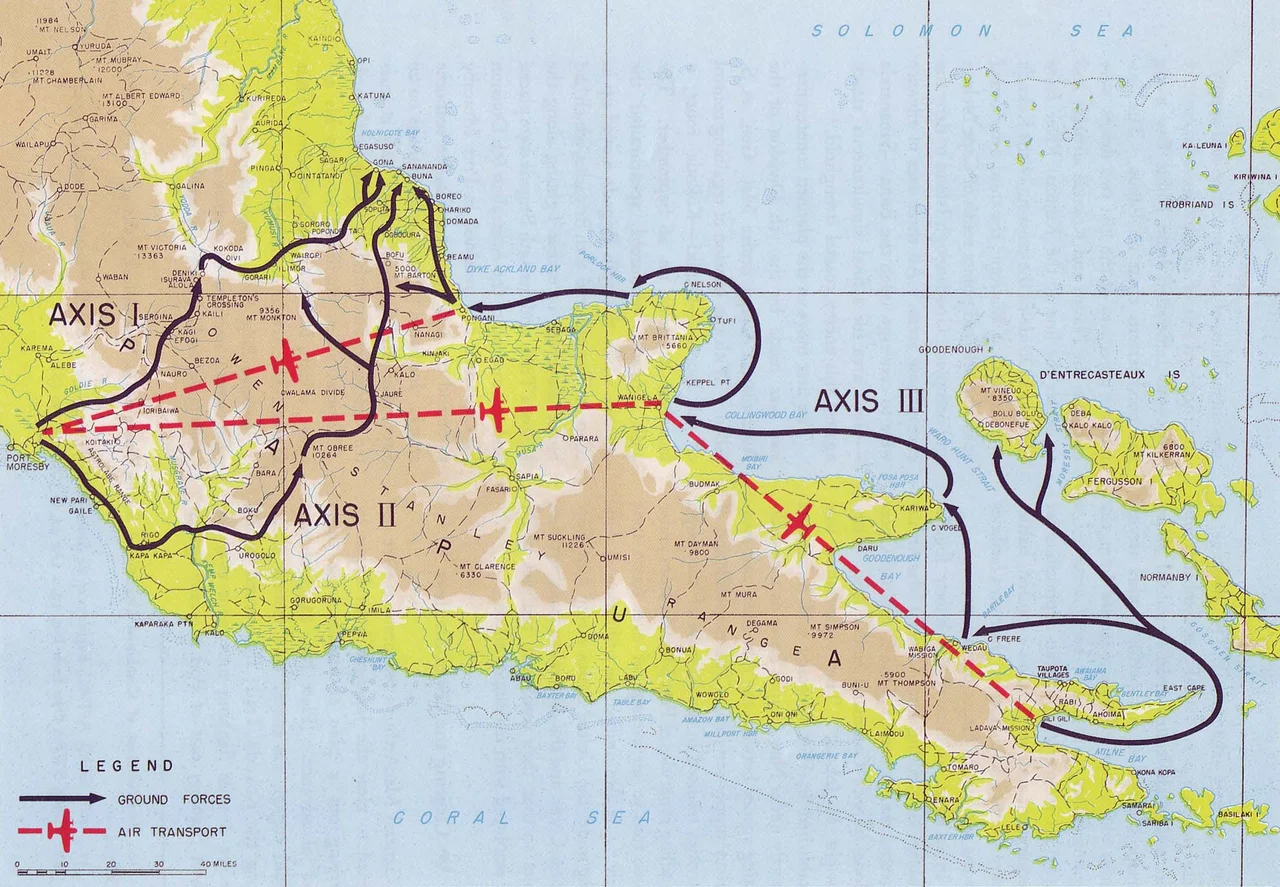
Goodenough Island is the northernmost of the D'Entrecasteaux group, a roughly oval landmass twenty-one miles by thirteen that rises sharply to Mount Vineuo at 2,536 metres in its centre. Its western side is jungle and rainforest. Its northeastern side opens into grassy plains of kunai and kangaroo grass - suitable, as an American survey would eventually establish, for airfield construction. The best anchorages lie at Mud Bay in the southeast, Taleba Bay in the southwest, and Beli Beli Bay on the east coast. In October 1942 it had no roads, no motorized transport, and no adequately charted interior. The Allies wanted it because any aircraft or ship moving between Milne Bay and Buna had to pass within sight of it, and because its flat northeastern plains could take an emergency airstrip. On 1 October General Douglas MacArthur issued orders to clear the island. The operation was codenamed Drake. The 2/12th Infantry Battalion - Queensland and Tasmanian men who had just finished fighting at Milne Bay - was handed the job.
Waiting Out the Destroyers
The plight of the stranded Japanese force had not gone unnoticed by their own high command. On 10 September two destroyers sailed from Rabaul to try a rescue. Allied aircraft found them before they could reach the island. Task Force 44 cruisers were detached to intercept; they missed the destroyers, but five B-17 Flying Fortresses did not. The destroyer Isokaze escaped with a near miss. The destroyer Yayoi took a direct hit on the stern that set her on fire, and she sank. Her survivors swam for Normanby Island, where they found themselves in essentially the same predicament as their compatriots on Goodenough. Over the following weeks a series of operations picked up some of them - Isokaze returned to the area in September with another destroyer and recovered ten men from a drifting launch; ten more were spotted by patrol aircraft and rescued on 26 September. The submarine I-1 got through to Goodenough Island on 3 October and landed rations, ammunition, medical supplies, a radio, and a spare landing craft, taking 71 sick and wounded back to Rabaul along with the bodies of 13 dead. I-1 tried again on 13 October with more supplies and a second landing craft, but an Allied aircraft dropped a flare and the submarine withdrew. Two days later the stranded Japanese received a radio message warning that an Allied invasion was imminent. They had been warned, but they could not leave.
Drake Force Lands
Lieutenant Colonel Arthur Arnold commanded Drake Force - the 2/12th Battalion with attachments, around 640 men. They boarded the destroyers HMAS Stuart and Arunta at Milne Bay on 22 October. Arnold's plan was a pincer: 520 men under his own command would land at Mud Bay in the southeast, and a smaller force of 120 under Major Keith Gategood would land at Taleba Bay, six miles away across the island's southern tip. The Japanese, outnumbered roughly two to one and dug into positions near Kilia Mission in the island's southeast, would be caught between the two forces. The Australians had three ketches named Matoma, Maclaren King, and Tieryo; two powered whaleboats; and three Japanese landing craft they had captured in the Battle of Milne Bay. They had rations for ten days. The landings began around 23:00 on 22 October. A violent thunderstorm broke as the Mud Bay force moved ashore and set out on the march to Kilia. The rain came down hard. The track to Kilia was steep and unmarked. By 08:30 on 23 October, eight hundred metres short of Kilia, Arnold's force crossed a creek at the base of a steep hill and met the Japanese.
Hand Grenades Down a Hill
The Japanese commander held his fire until the Australians were almost on top of his position, then opened up with machine guns and mortars. The men who had already crossed the creek found hand grenades being rolled down the hill on top of them. Those still behind the creek were pinned flat by plunging fire. Arnold pulled back and set up a defensive line for the night, beating off a small Japanese probe. On the far side of the island, Gategood's force captured a Japanese machine-gun position at dawn and pushed south. A Japanese counterattack at 09:00 hit them hard, inflicting heavy casualties. Lieutenant Clifford Hoskings silenced a Japanese machine gun in that fight and was later awarded the Military Cross. But Gategood's radio could not raise Arnold - the petrol generator at Mud Bay that powered the sets had broken down - and with six killed, ten wounded, and three missing, Gategood withdrew back across the island to Mud Bay by 24 October. Arnold attacked Kilia alone the next day. The promised air support failed to arrive. Japanese aircraft strafed instead, hitting the ketch Maclaren King in Mud Bay with wounded Australians on board. Arnold's flanking company got lost in the jungle. The frontal assault stalled. On the night of 25 October, without telling the Australians, the Japanese boarded their two remaining landing craft and slipped across to Fergusson Island. The light cruiser Tenryu took 261 of them off the following day.
Amoeba
The fighting had cost the Australians 13 killed and 19 wounded. Japanese casualties were harder to count - they had recovered and buried their own dead - but the estimate was 20 killed and 15 wounded in the battle itself. One Japanese soldier, Shigeki Yokota, evaded capture on the island until July 1943, nine months later. Around six hundred local Goodenough Islanders had been evacuated to Fergusson Island by the Australian New Guinea Administrative Unit during the fighting; they returned when the shooting stopped. What happened next on Goodenough proved more important than the battle itself. Two American survey officers had landed with Drake Force to scout airbase sites. They found them at Vivigani and Wataluma. Over the following year the island - codenamed Amoeba - was transformed into a major Allied base. A 4,000-foot emergency strip went in first. By mid-1943 there was a 5,100-foot fighter strip sealed with bitumen, and by October a 6,000-foot bomber strip. Three RAAF fighter squadrons moved in. No. 73 Wing took charge. Headquarters for Alamo Force - the Sixth U.S. Army - opened on the island on 15 August 1943, directing the landings at Arawe, Cape Gloucester, and Saidor. A 750-bed station hospital and a 1,000-bed general hospital were built. Sixty thousand Allied troops staged through before the base closed at the end of 1944.
The Documents in the Tin
There is one more piece to the story, which happened after the main battle and deserves telling. In March 1943, in the aftermath of the Battle of the Bismarck Sea, groups of Japanese troops and sailors were once again shipwrecked on Goodenough Island. The Australian 47th Infantry Battalion, newly arrived as garrison, spent a week patrolling the shoreline and interior looking for survivors. Between 8 and 14 March they found and killed 72 Japanese, captured 42, and located another nine dead on a raft. One patrol under Captain Joseph Pascoe killed eight Japanese who had landed in two flat-bottomed boats. Going through the boats, the Australians found a set of sealed tins. Inside one tin was a document that, when the Allied Translator and Interpreter Section worked through it, turned out to be a complete copy of the Japanese Army List - every officer, every unit, every posting. It gave Allied intelligence, for the first time, a complete order of battle of the Imperial Japanese Army, including units never previously identified. Copies were rushed to every theatre of the Pacific war. A patrol on an island most Westerners had never heard of, killing eight men in a chance encounter, had just handed the Allies a document whose intelligence value was almost literally unmeasurable. That is the kind of war Goodenough Island ended up being part of.
From the Air
The battle area is centered near 9.34S, 150.27E at the southern end of Goodenough Island, northernmost of the D'Entrecasteaux Islands, 170 km by sea from Milne Bay. Mud Bay (southeast) and Taleba Bay (southwest) were the 1942 landing sites. Vivigani Airfield (the wartime airbase on the northeastern plain) is now the island's primary strip. The island rises sharply inland to Mount Vineuo, 2,536 metres. Approach from Milne Bay is across the 30-km-wide Ward Hunt Strait to the south. Convective afternoon weather routine; morning clear air gives the best view of the oval-shaped island and the grass plains that drew the American airfield surveyors in 1942.
Nearby Stories
- Tufi 50 km away
- Normanby Island (Papua New Guinea) 50 km away
- Ss Peter and Paul Cathedral, Dogura 52 km away
- Trobriand Islands 56 km away
- Operation Chronicle 93 km away
- Japanese Submarine Ro-103 103 km away
- Kokoda Track 150 km away
- Kapa Kapa Trail 247 km away