
Battle of the Treasury Islands
The operation was codenamed Goodtime. That kind of black humor was typical of the Pacific war's planners, who knew exactly what they were asking infantry to do. Mono and Stirling - the two little islands the Allies called the Treasuries - were worth taking for a single strategic reason: they were not the real target. Somewhere to the north, the bigger landing at Cape Torokina on Bougainville was about to open the final phase of the Solomons campaign. The New Zealanders and their American supporters would land at Mono and draw Japanese attention the wrong way. At 06:06 on 27 October 1943, in driving rain, two infantry battalions climbed into landing craft and went ashore.
Two Islands in the Middle of Everything
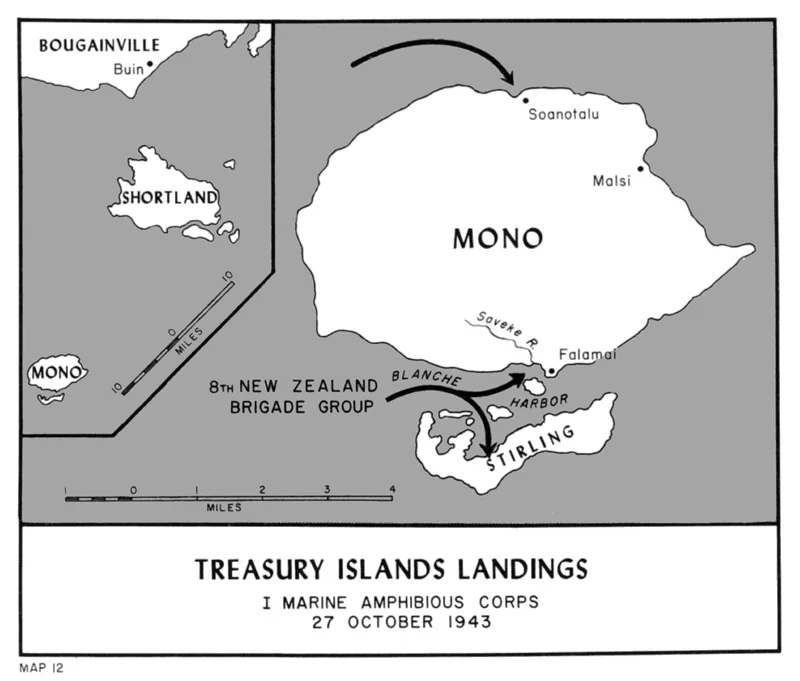
The Treasuries sit 300 miles northwest of Guadalcanal, tucked 18 miles south of the Shortlands - close enough to Japanese airfields that the roar of engines could reach them on a still morning. Mono is the larger island, mountainous and jungled; Stirling is its flatter neighbor across Blanche Harbour, a sheltered anchorage deep enough to hold ocean shipping. To a planner's eye, Blanche Harbour was a natural staging ground, and Mono's high ridges could host a radar station that would see Japanese aircraft coming from Rabaul. But the deeper point was the distraction. Under Operation Cartwheel, General MacArthur's campaign to neutralize Rabaul by bypassing the strongest defenses, the Treasuries were a feint - one that would sacrifice real lives to protect the bigger landing. The New Zealand 8th Infantry Brigade Group, commanded by Brigadier Robert Row, drew the assignment.
Rain and First Light
The assault wave numbered 3,795 men. They had rehearsed off Florida Island, but nothing cleans the nerves off an amphibious landing, and the heavy rain that morning cut visibility to yards. Seven fast destroyer-transports disgorged their smaller landing craft west of Cummings Point on Stirling. Destroyers bombarded the beaches, to little effect - the Japanese garrison was too dispersed to be hurt much by shellfire. The 29th and 36th Battalions landed around Falamai on the southern coast of Mono, two miles from the harbour's western entrance. A detachment of the 34th went ashore on Stirling and found it almost empty. Another 200 men from the 34th slipped around the north side of Mono and landed at Soanotalu to secure the planned radar site. The Japanese were caught off-guard. Their aircraft could not scramble before the troops were on the beach. For the New Zealanders, the first hour was easier than they had any right to expect.
The Fight Inland
Resistance came later, and piecemeal. The Japanese defenders - soldiers of a small garrison with no naval support - fell back into the caves of Mono's northern coast and the high ground above Falamai. Over eleven days, New Zealand patrols worked through the jungle to clear them. The force at Soanotalu fought off several attacks between 29 October and 2 November, including one by a company-sized element in which about 40 Japanese were killed. On the other islands in the group, small detachments raided New Zealand positions and then melted back into the bush. A single dramatic moment stood out among the construction units: when the Seabees of Company A, 87th Naval Construction Battalion came ashore on the first day, one driver raised the blade on his bulldozer and used it as a shield while advancing on a Japanese machine gun nest. By 12 November, the islands were declared clear, though holdouts were still being sighted in the jungle into January 1944. Allied casualties totaled 226 - 40 New Zealanders killed, 145 wounded; 12 Americans killed, 29 wounded.
What Planners Call a Success
The distraction worked. Japanese air units focused on the Treasuries and on a simultaneous raid on Choiseul, and the landing at Cape Torokina on 1 November got its critical first days without the air storm that might otherwise have fallen. Late on 27 October, 25 Japanese dive bombers did attack the American destroyers supporting the Treasuries landing - Cony was hit aft twice, killing eight of her crew and wounding ten, and had to be towed back to Tulagi. But no serious naval counterstroke came. The British flag was raised over the ruins of Falamai on 1 November. Civil administration was restored to the islanders, whose homes had been ground fine between two foreign armies. The men on both sides of the line died for a diversion - which is not to say they died for nothing, but which is worth saying plainly. Feints require real blood to be believed.
After the War
What came next was the engineering. The 87th Naval Construction Battalion built 21 miles of road, a PT boat base on Stirling, and an airstrip 5,600 by 200 feet that was later extended to 7,000. Wharves rose on timber crib piers to accept ocean-going ships. A 100-bed hospital opened. The airbase hosted medium bombers of the USAAF's 42nd Bombardment Group and Marine squadron VMB-413 as they worked over Rabaul through 1944. And then - as always happens to these places - the war moved on. Base development was considered complete by July 1944. Some of the facilities were shipped to Leyte to support the Philippines campaign. The base closed in June 1945. The islands reverted to the quiet they had known before, carrying their dead in the jungle and their runways in the coral. Today Mono and Stirling are part of Western Province, Solomon Islands - small communities where an old airstrip occasionally becomes visible in satellite imagery, and a war memorial at Falamai names the New Zealanders who did not come home.
From the Air
The Treasury Islands (Mono and Stirling) lie at approximately 7.4°S, 155.6°E, between Vella Lavella and the Shortland Islands. Recommended viewing altitude: FL120-FL200 gives a clear view of Blanche Harbour between the two islands and the old Stirling airstrip, still faintly visible as a long straight cut through the coral. Nearest airports: Ballalae (AGBA) on the Shortlands and Munda (AGGM) on New Georgia. Tropical weather with frequent heavy rain can reduce visibility; morning flights generally offer the clearest passage.
Nearby Stories
- Battle of Vella Lavella (naval) 16 km away
- Battle of the Hongorai River 46 km away
- Raid on Choiseul 68 km away
- Battle of Vella Gulf 82 km away
- Autonomous Region of Bougainville 134 km away
- Gizo, Solomon Islands 147 km away
- Bougainville Conflict 164 km away
- Woodlark Island 294 km away