.jpg)
Battle of Vella Gulf
Sixty-three seconds. That is how long it took six American destroyers to sink three Japanese warships in the narrow waters between Vella Lavella and Kolombangara. For more than a year, the U.S. Navy had been learning a humiliating lesson in the Solomon Islands: the Imperial Japanese Navy owned the night. Japanese lookouts saw in the dark. Japanese torpedoes, fueled by pure oxygen, arrived without warning and from impossibly far away. Japanese commanders turned the confusion of night actions into a weapon. Then, on the night of 6 August 1943, something changed. The Americans finally had radar that could see what their eyes could not. They had torpedoes that finally worked. And for the first time in the campaign, they had the freedom to fight the way their ship type was designed to fight.
The Slot and the Tokyo Express
By the summer of 1943, the Solomon Islands chain had become a slow-motion meat grinder. After Guadalcanal fell the previous year, the Americans were crawling northwest up "The Slot" - the stretch of water that splits the island chain in half - trying to capture the Japanese airfield at Munda. The Japanese answered with the Tokyo Express: fast destroyers racing down at night, dumping troops and supplies at the port of Vila on Kolombangara's southern tip, and vanishing back north before dawn. Three successful runs had already been completed that summer. On the night of 6 August, the Japanese sent a fourth, carrying about 950 soldiers crammed onto four destroyers under Captain Kaju Sugiura. One officer, Captain Tameichi Hara of Destroyer Division 27, had argued bitterly against the plan. Repeating the same approach route four times, he warned, was courting disaster. He was overruled.
Six Ships Off the Leash
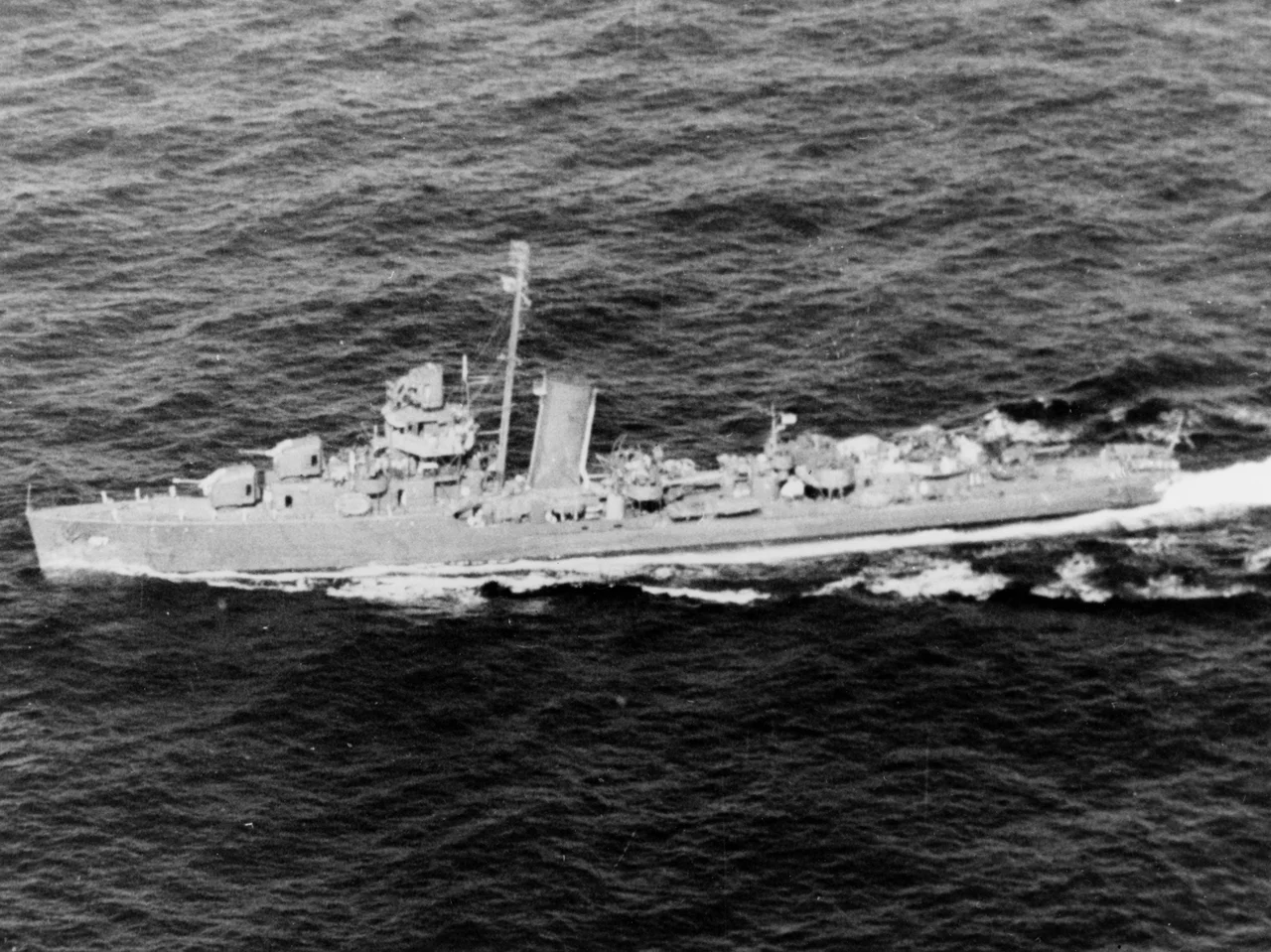
Waiting in the dark was Task Group 31.2 under Commander Frederick Moosbrugger - six destroyers whose crews were, by one telling detail, in unusually high spirits. For most of the war, American destroyers had been chained to cruiser task forces, forced to stay close and absorb the enemy's torpedoes while the big guns did the work. This night was different. This night they would hunt as destroyers were meant to hunt. Moosbrugger split his six ships into two divisions. Destroyer Division 12 (Dunlap, Craven, and Maury), with their full pre-war torpedo batteries intact, would launch a surprise attack from the shadow of Kolombangara's mountains. Destroyer Division 15 (Lang, Sterett, and Stack), which had traded some torpedo tubes for extra 40mm guns, would follow up with gunfire. The plan depended on two things that had not been true before: American radar that could pick out ships against a mountain, and American Mark 15 torpedoes that would actually detonate when they hit.
Sixty-Three Seconds
The new SG centimetric radar found the Japanese column at 23:33. The Japanese, who still did not carry radar of any kind and whose older meter-band sets could not distinguish ships from the island behind them, saw nothing. Dunlap, Craven, and Maury crept in from the east with the dark mass of Kolombangara behind them, a perfect acoustic and visual shadow. At 23:34, they fired twenty-four torpedoes in sixty-three seconds and swung hard to starboard, running for cover at full speed. Not a gun had been fired. Not a searchlight had been lit. For more than four minutes the torpedoes ran through the black water. Then the night lit up. Hagikaze, Arashi, and Kawakaze were all struck; all three burst into flames. Only Shigure survived, saved by the last twist of bad American luck made good: the torpedo that hit her was a dud that passed clean through her rudder and kept going. She fled into the darkness, firing her own eight torpedoes as she went. Every one of them missed.
The Men in the Water
What followed was both a lopsided victory and a grim scene. Three Japanese destroyers sank in rapid succession. The only American casualty was a gun loader crushed by accident. But in the water floated hundreds of Japanese soldiers and sailors - 685 soldiers drowned, 356 sailors lost on Hagikaze and Arashi, 169 on Kawakaze. When American ships lowered lines and offered rescue, most of the men refused. Of those who survived, about 300 reached Vella Lavella on their own. They were later ferried across to Kolombangara, to the same garrison they had been trying to reinforce. The airfield at Munda fell that same day.
A Doctrine Reborn
Vella Gulf was the first time in the Pacific war that Japanese destroyers had been beaten in a night surface action. Lieutenant Commanders Clifton Iverson of Dunlap and Frank Gardner Gould of Sterett received Navy Crosses for the night's work. More consequential than any medal was the tactical lesson finally written in ink: American destroyers, freed from cruiser doctrine and armed with good radar and good torpedoes, could win the night. The waters themselves remember. Vella Gulf lies between green, mountainous islands in one of the most photogenic corners of Melanesia, but three Japanese destroyers and more than a thousand men rest somewhere below. Two U.S. Navy ships have since carried the battle's name: the escort carrier USS Vella Gulf, briefly in service after the war, and the guided-missile cruiser USS Vella Gulf, decommissioned in 2022 after nearly thirty years.
From the Air
Vella Gulf sits between Vella Lavella to the west and Kolombangara to the east, roughly centered at 7.9 degrees south, 156.82 degrees east. The gulf is about 15 nautical miles wide at its narrowest, framed by Kolombangara's 1,770-meter volcanic cone - the classic landmark pilots use to orient themselves in the central Solomons. Recommended viewing altitude is 4,000 to 6,000 feet to see both flanking islands and the full length of the gulf. Nearest airports are Munda (AGGM) on New Georgia to the south and Barakoma airstrip on Vella Lavella's southern coast. Tropical haze and sudden rain squalls are common year-round; mornings generally offer the clearest visibility.
Nearby Stories
- Gizo, Solomon Islands 14 km away
- Battle of Vella Lavella (naval) 24 km away
- Choiseul Province 62 km away
- Battle of the Treasury Islands 109 km away
- Woodlark Island 420 km away
- Païta 1828 km away
- Maré Island 1889 km away
- 1737 Kamchatka Earthquake 6681 km away