
Battle of Vella Lavella (naval)
It was the last time Japanese warships would win a fight at sea. On the night of 6 October 1943, in the dark water northwest of Vella Lavella island, three American destroyers charged into nine Japanese destroyers before their own reinforcements could catch up. All three came out battered - one sunk, two crippled. One Japanese destroyer went down with them. The tactical score was a Japanese win. The strategic reality was that while the destroyers were trading torpedoes, twenty small Japanese auxiliary vessels were quietly pulling 589 trapped soldiers off the island's northwestern shore and ferrying them home. The Japanese had come to fight a diversion, and the diversion had worked. After that night, the Imperial Japanese Navy would never again win a surface action in the Pacific.
The Garrison in the Corner
To understand why the Japanese fought this battle at all, you have to understand the geography. The central Solomon Islands campaign had gone badly for them through the summer of 1943. They had lost Munda. They had lost three destroyers at the Battle of Vella Gulf in August. In mid-August, American and New Zealand troops had landed on Vella Lavella itself, bypassing the heavily garrisoned island of Kolombangara entirely and squeezing the Japanese on Vella Lavella into a tiny pocket on the northwestern shore around Marquana Bay. By early October, about 600 Japanese soldiers were trapped there, surrounded by troops from the New Zealand 14th Brigade. The only way out was by sea, and the only window was one night. Captain Shigoroku Nakayama pulled together whatever could float from the harbors at Buin: some twenty subchasers, barges, and other small vessels. To buy them time, Captain Matsuji Ijuin would bring six full destroyers and three older destroyer-transports down from Rabaul and pick a fight with whoever the Americans sent.
Walker Does Not Wait
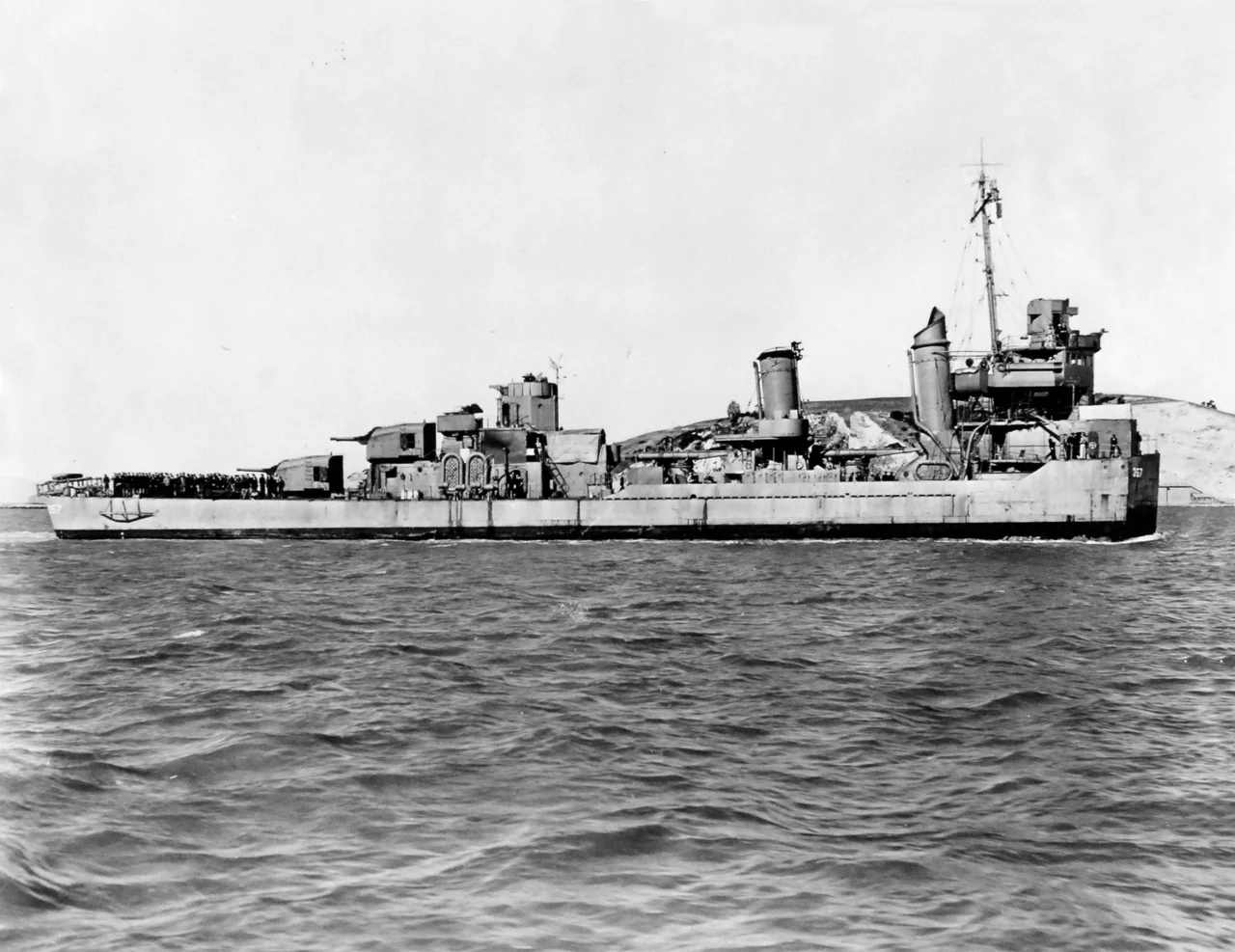
American Admiral Theodore Stark Wilkinson, commanding the amphibious forces in the area, saw the Japanese movement on his plot and immediately dispatched two groups of three destroyers each to intercept. The first group, under Captain Frank R. Walker, approached from Vella Gulf in the ships USS Selfridge, Chevalier, and O'Bannon. A second group of three destroyers under Captain Larson was still racing from the south, fifteen minutes behind. At 22:30 on 6 October, Japanese lookouts spotted Walker's three ships approaching. Walker could have waited. He chose not to. With the reasoning of a commander who believed the destroyer transports might slip away in any hesitation, he attacked immediately. Both sides launched torpedoes just before 23:00. Then the American torpedoes and guns found the lead Japanese destroyer, Yugumo. She was struck repeatedly, lost steering while charging in, fired her own torpedoes, and was finished with a torpedo hit at 23:10. But one of the torpedoes she had launched before dying had already reached Chevalier.
Two Ships Locked Together
The Japanese torpedo hit Chevalier in the forward magazine. The explosion nearly blew her apart. O'Bannon, following close behind in the American line, collided with the crippled Chevalier and for some time the two ships were locked together in the dark - a tangle of twisted steel, both crews fighting to separate. Selfridge attacked on alone, firing at the Japanese destroyers Shigure and Samidare. At 23:06 she took her own torpedo hit and went dead in the water. Three American destroyers were now disabled or damaged. The Japanese still outnumbered the Americans six destroyers to none that were still fighting. What followed was a strange echo of confusion. Ijuin's patrol aircraft, circling above, mistook the approaching reinforcements under Larson for American cruisers. Thinking he was about to face a much larger force, Ijuin ordered his destroyers to turn for home and signaled the destroyer-transports to withdraw. It was the wrong call, but it was the call that ended the action.
The Work Behind the Fight
While gunsmoke was still hanging over the battle site, the real Japanese mission was going forward in silence. Nakayama's collection of small vessels crept into Marquana Bay at around 01:10. American attention was focused on the damaged destroyers. Larson's arriving division picked up a brief radar contact on Yugumo as she sank, then began rescue operations. Wounded men were cross-loaded from Chevalier, which had become unsalvageable. Around 03:00, the destroyer La Vallette fired a torpedo into Chevalier's magazine and then shattered her bow with depth charges. Selfridge and O'Bannon, though both badly damaged, stayed afloat and were eventually towed out for repairs. Two hours after they entered the bay, Nakayama's barges and auxiliaries withdrew. They had taken 589 trapped soldiers off an island the New Zealanders had all but surrounded. The operation worked.
The Last Victory
A ship for a ship - the scoreboard said Japan had won. But the numbers behind the numbers told a different story. Over the three-month campaign that ended that night, the Allies had lost six ships; the Japanese had lost seventeen. American industry would replace Chevalier many times over before the war ended. Japanese shipyards could not replace Yugumo at any rate that mattered. The capture of the central Solomons was complete. What the historian Ian Toll has written into the record of the Pacific War is that the naval action off Vella Lavella was the last Japanese surface-fleet victory of the entire conflict. Every night battle after this one would go to the Allies, because the arithmetic of steel and industry had finally caught up. Today Vella Lavella is a quiet island of about 9,000 people, known for the wreckage of downed aircraft in its jungles, for the scuttled American Liberty ship USS John Penn visible at low tide near Logha, and for the memory of a coastwatcher network that pulled more than a hundred USS Helena survivors to safety three months earlier. The waters off Marquana Bay hold the wreck of Yugumo somewhere in the dark, and the quiet fact that no Japanese flag would fly over a naval victory again.
From the Air
The Battle of Vella Lavella was fought northwest of Vella Lavella island, roughly centered at 7.5 degrees south, 156.23 degrees east, in the western Solomon Islands. Vella Lavella itself is volcanic, rising to about 800 meters, with prominent Marquana Bay on its northwestern shore as a navigational reference. Recommended viewing altitude is 3,000 to 5,000 feet to frame the battle site with Vella Lavella to the southeast and the open waters of The Slot to the north. Nearest airport is Barakoma airstrip on Vella Lavella's southern coast; Munda airport (AGGM) on New Georgia is about 45 nautical miles southeast. Tropical haze and late-afternoon buildups are typical; mornings generally offer the clearest air.
Nearby Stories
- Japanese destroyer Arashi 17 km away
- Battle of the Treasury Islands 22 km away
- Choiseul Province 30 km away
- Japanese cruiser Jintsu 38 km away
- Battle of the Hongorai River 49 km away
- Raid on Choiseul 53 km away
- Battle of Vella Gulf 63 km away
- Woodlark Island 362 km away