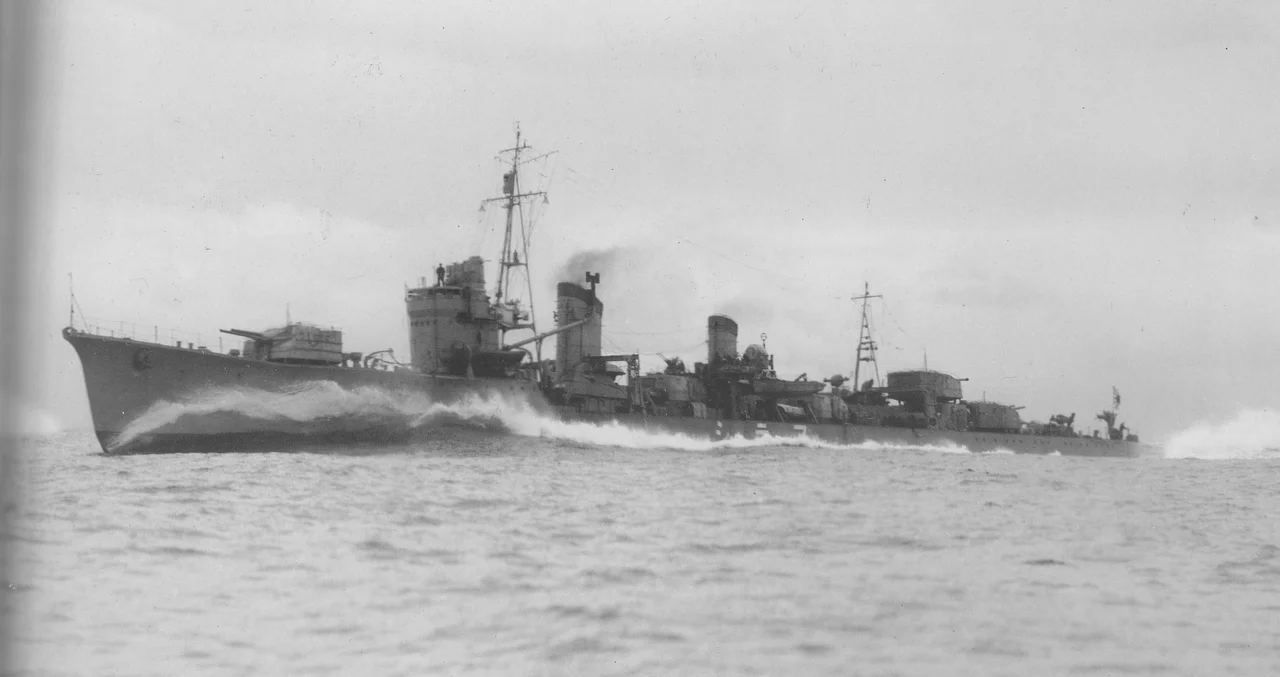

Japanese destroyer Arashi
On the morning of 4 June 1942, the Japanese destroyer Arashi was alone in the wrong place for the wrong reasons. Her captain had been chasing an American submarine. The submarine had escaped into the deep. Arashi now had to race north at flank speed to catch up with Admiral Nagumo's carrier fleet before it disappeared over the horizon. She cut a white arrow across the Pacific. Twenty thousand feet above, Lieutenant Commander Wade McClusky of USS Enterprise was flying a fuel-critical search pattern with thirty-one Dauntless dive bombers, running out of sky, about to turn back. Then he saw the wake. It pointed exactly where he needed to go. Within ninety minutes, three of Japan's four fleet carriers at Midway were burning wrecks. Arashi, unaware that her hurry had just won the battle of the Pacific for the other side, rejoined the fleet and watched it die.
A Kagero-Class Destroyer
Arashi was a Kagero-class destroyer, commissioned in 1941 - part of the backbone fleet the Imperial Japanese Navy had built to contest control of the central Pacific. She was 118.5 meters long, could reach 35 knots, and carried a crew of 240 officers and enlisted men. Her main battery was six 127mm guns in three twin turrets. But her real weapon, the one that defined Japanese destroyer doctrine, lived in two quadruple launchers amidships: the Type 93 torpedo. Fueled by pure oxygen instead of compressed air, the Type 93 - which would earn the nickname "Long Lance" from its American victims - could run more than 20 miles at 36 knots and carried a warhead twice the size of anything the Allies had. A Kagero carried eight of them in tubes and eight more as reloads. Arashi never used hers at Midway. The chance never came.
The Wake That Lost an Empire
The details of that morning have been picked over by historians for decades. At about 09:55 on 4 June, Arashi was still on the edge of the Japanese formation, having broken off a prolonged attempt to depth-charge the submarine USS Nautilus. She now poured on speed to rejoin Nagumo. McClusky's dive bombers had searched the empty square of ocean where the Japanese were supposed to be, found nothing, and were roughly 15 minutes from having to turn for home. McClusky, improvising, spotted Arashi's high-speed wake and made one of the most consequential judgment calls in naval history: he followed it. Arashi led him straight to the Kido Butai. The Dauntlesses arrived unopposed overhead and in six minutes fatally damaged Akagi, Kaga, and Soryu. Hiryu lived a few hours longer before meeting the same fate. All four of Japan's fleet carriers at Midway were lost. The strategic initiative of the Pacific War turned on that afternoon, and on one destroyer's wake.
The Killing of Ensign Osmus
The Midway story has another chapter, a darker one. Arashi's crew pulled an American airman from the water that same day: Ensign Wesley Osmus, a torpedo bomber pilot from VT-3 off USS Yorktown. Osmus was the last plane in his formation's attack and was shot down early in the approach. After interrogation, according to witnesses later interviewed by U.S. Naval investigators, Osmus was taken to the stern of Arashi, struck in the back of the neck with a fire axe, and pushed overboard. He was twenty-three years old, from Chicago. After the war, investigators attempted to bring charges against Arashi's captain, Commander Watanabe Yasumasa. They learned he had been killed in action on another destroyer in December 1943. The case was set aside. Osmus has a memorial but no grave. He is one of the thousands of small, specific human losses that disappear into the math of the Pacific War.
A Year of Running
The fourteen months that followed Midway turned Arashi into a workhorse. She escorted the carrier Zuiho to Wake Island, patrolled the Aleutians, shuttled between Truk and Rabaul, and ran troop transports into Milne Bay and Guadalcanal. In December 1942, when her consort destroyer Teruzuki was sunk by American PT boats off Guadalcanal, Arashi pulled 140 survivors from the water. In early 1943 she helped cover the Japanese evacuation of Guadalcanal - a retreat, though the navy did not yet call it one. By August 1943 she was running the Tokyo Express into the Solomons, trying to keep reinforcements flowing to garrisons that had become strategic dead weight. On the night of 1-2 August 1943, she was part of the destroyer division that rammed and sank an American PT boat in Blackett Strait. The boat was PT-109. Her commander was a 26-year-old Navy lieutenant named John F. Kennedy.
The Night in Vella Gulf
Four days later, Arashi was back on the same transport route, this time with Hagikaze, Kawakaze, and Shigure under Captain Sugiura. Weather had closed in over Vella Gulf. Visibility was down to about 200 yards. What the Japanese did not know was that three American destroyers - Dunlap, Craven, and Maury - were waiting in the shadow of Kolombangara, guided by radar the Japanese could not detect. Twenty-four American torpedoes dropped into the water at 23:34 on 6 August 1943. The first hits ripped Kawakaze's engine room apart. Arashi took two torpedoes and began to settle rapidly by the stern. Hagikaze was hit almost simultaneously and caught fire. With her ship sinking and her main guns powerless, Arashi's surviving gunners fired what machine guns they could. The American destroyers then opened with their main batteries. Shells found Arashi's magazines. She exploded and sank within minutes. Of her crew, 178 died in the water - the same number lost on Hagikaze. The wreck sits on the floor of Vella Gulf, a quiet counterweight to the wake she once drew at Midway.
From the Air
Arashi's wreck lies at approximately 7.83 degrees south, 156.92 degrees east, in the central Vella Gulf between Vella Lavella and Kolombangara, Solomon Islands. The gulf is framed by Kolombangara's conspicuous 1,770-meter volcanic cone to the east - an unmistakable landmark from the cockpit. Recommended viewing altitude is 3,000 to 5,000 feet to appreciate the scale of the gulf and the encircling islands. Munda airport (AGGM) on New Georgia, about 30 nautical miles south, is the nearest hard-surface runway. Tropical conditions dominate year-round; late afternoon buildups and sudden rain squalls are the rule.
Nearby Stories
- Gizo, Solomon Islands 14 km away
- Battle of Vella Lavella (naval) 24 km away
- Choiseul Province 62 km away
- Battle of the Treasury Islands 109 km away
- Woodlark Island 420 km away
- Païta 1828 km away
- Maré Island 1889 km away
- 1737 Kamchatka Earthquake 6681 km away