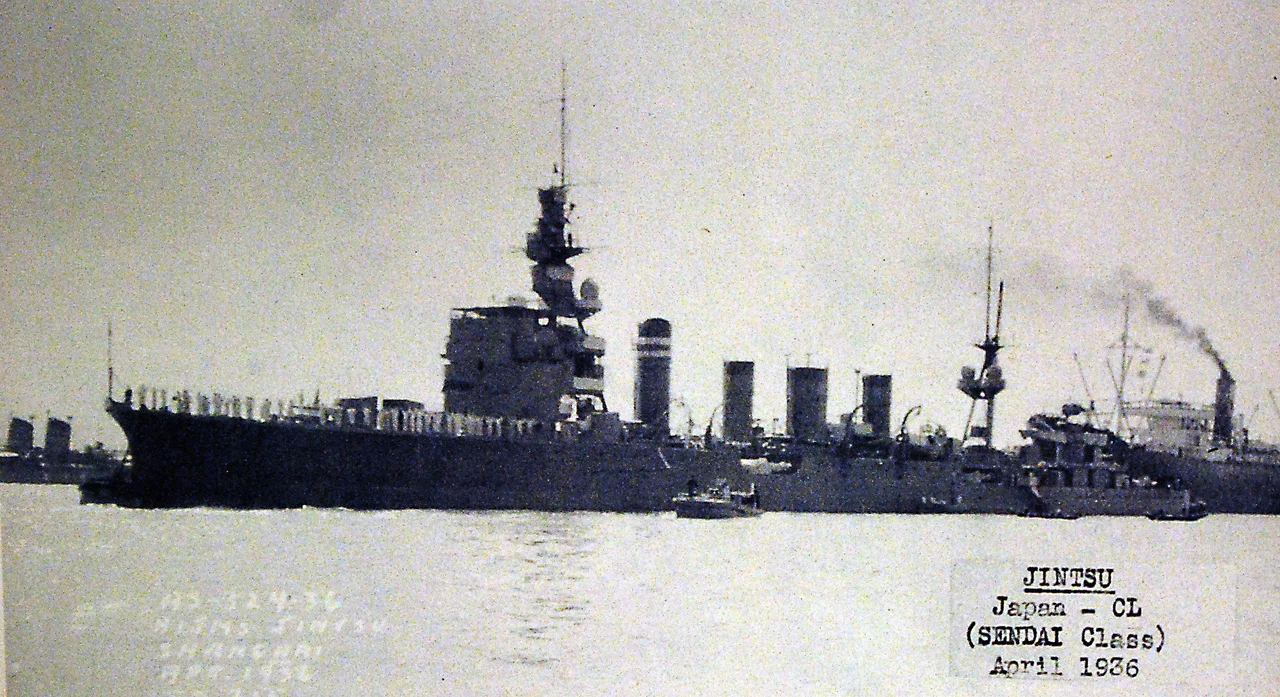

Japanese cruiser Jintsu
Captain Keiji Mizushiro killed himself on 24 August 1927 because the ship under his command had just killed seventeen men. During a night exercise off Jizosaki Lighthouse in Shimane Prefecture, the light cruiser Jintsu rammed and sank a Japanese destroyer. Mizushiro's suicide - an expression of an honor code that would thread through the decades that followed - was the first real entry on his ship's long record. Jintsu would spend the next sixteen years sailing with the Imperial Japanese Navy through the invasion of China, the invasion of the Philippines, the Battle of the Java Sea, Midway, the Eastern Solomons, and the long bloodletting of the Solomon Islands campaigns. She would serve as a flagship for admirals, launch torpedoes at Allied fleets, and finally die on a moonless night in July 1943 when she switched on her searchlights and showed American gunners exactly where to shoot.
Named for a River
Jintsu was laid down at Kawasaki Shipyards in Kobe on 4 August 1922, launched on 8 December 1923, and completed on 21 July 1925. She was named for the Jinzu River, which runs through Gifu and Toyama prefectures in central Japan - a naming convention that gave Imperial Japanese warships a sense of place, rooting a mobile instrument of war in a specific valley back home. She was a Sendai-class light cruiser, the second of her class, intended to serve as the flagship of a destroyer flotilla. Her silhouette had four funnels and a raked bow. Seven 14-centimeter guns in shielded mounts ran along her deck. Two 8-centimeter anti-aircraft guns stood exposed. Four twin Type 8 torpedo tubes sat in pairs along her sides - sixteen torpedoes in all, eight in the tubes and eight as reloads. The armor was thin - six centimeters of belt, three of deck - because speed mattered more than protection. She could make 35 knots, and for a ship built as a destroyer leader, that speed was the point.
China, Philippines, Java Sea
After the collision that ended Captain Mizushiro, Jintsu was rebuilt at Maizuru with a flared bow replacing her raked one, and then went to work. In 1928 she covered Japanese landings during the Jinan incident in Shandong, then based out of Qingdao. From 1929 to 1937 she patrolled the China coast, and after 1937 supported landings in the Second Sino-Japanese War. Her captains rotated through - Raizo Tanaka briefly commanded her for two weeks in December 1938 before going on to become one of the most feared destroyer commanders in the Pacific. On 26 November 1941, Jintsu became the flagship of Rear Admiral Tanaka and Destroyer Squadron 2, based out of Palau. She escorted troops of the IJA 16th Infantry Division and Kure No. 1 Special Naval Landing Force to Davao, Legaspi, and Jolo during the invasion of the Philippines. Then came the Battle of the Java Sea on 27 February 1942, where Jintsu's floatplanes helped mark Allied positions and her torpedoes joined a mass launch of 72 Long Lances - a salvo that famously hit nothing, even though the Allied fleet was destroyed anyway by other units.
The Tokyo Express
After Midway - where Jintsu escorted transports that got bombed but never sank - she was reassigned in July 1942 to the newly formed Japanese 8th Fleet under Vice Admiral Gunichi Mikawa, based on the Solomons problem. On 16 August she left Truk commanding a major reinforcement for Guadalcanal, and what followed was a drama of conflicting orders. Tanaka received contradictory signals from different headquarters - turn north, turn west, land troops tomorrow. He tried to comply with both and could contact neither. On 23 August a PBY Catalina spotted his convoy. The Battle of the Eastern Solomons unfolded over the following two days. Jintsu rendezvoused with the aircraft carrier Ryujo, which launched strikes against Henderson Field and was sunk in return. On 25 August, six Marine Corps SBD Dauntless dive-bombers attacked Jintsu's convoy 150 nautical miles north of Guadalcanal. A 500-pound bomb hit Jintsu directly, starting fires and flooding her forward magazines. Twenty-four crewmen died. Admiral Tanaka was wounded and shifted his flag to a destroyer. Jintsu limped to Shortland Island, then Truk, then Japan for over a month of repairs that did not finish until 8 January 1943.
The Searchlight That Killed Her
On 13 July 1943, Jintsu was the flagship of Rear Admiral Shunji Isaki, running what the Japanese called a transport mission and the Americans called the Tokyo Express. She had departed Rabaul at 0330 with a force of destroyers and destroyer-transports carrying 1,200 troops to reinforce Kolombangara. Her radar picked up an Allied fleet before anyone on either side made visual contact. The Allies had three cruisers and a screen of destroyers. Admiral Isaki ordered a night torpedo attack. His ships launched 31 Type 93 Long Lance torpedoes into the darkness - and then, to help guide them, Jintsu switched on her searchlights. The illumination was an invitation. Radar-directed 6-inch shells from the three Allied cruisers - at least ten of them - tore into Jintsu almost at once, setting her ablaze. The barrage killed Admiral Isaki and Captain Sato outright. Shortly after, a torpedo struck her starboard side in the aft engine room. Jintsu broke in two. At 23:48 on 13 July 1943, the ship that had steamed through fifteen years of Japanese naval history sank in the waters near Kolombangara. The Long Lances Isaki had launched found their marks - Captain Zenjiro Shimai of the destroyer Yukikaze took over, sank the American destroyer Gwin, and damaged the cruisers Leander and St. Louis. It was the last action of the Battle of Kolombangara. Four hundred and eighty-two men of Jintsu's crew did not return. Twenty-one were rescued by the destroyer Yukikaze, and a few more were picked up by the Americans.
Found Again
Jintsu was removed from the Japanese navy list on 10 September 1943 - a bureaucratic farewell two months after the sea had already taken her. For seventy-six years she lay lost. Then on 26 April 2019, the research vessel Petrel, part of the late Paul Allen's deep-ocean exploration project, announced it had found her. She rests in 900 meters of water near the mouth of Kula Gulf. Her bow section lies on its port side. The stern stands upright on the seafloor. Petrel's cameras confirmed the Type 92 quadruple torpedo mounts that had been fitted in 1941 to let her carry the oxygen-fueled Type 93 Long Lance - the same weapons Isaki had fired on the night she was lost. The wreck is a marker for 482 men who never came home, and for Admiral Isaki and Captain Sato killed at their stations, and for an Imperial Japanese Navy that had been built to win a short decisive war and instead found itself fighting a long grinding one in these equatorial waters, where American radar reached further than Japanese searchlights could follow.
From the Air
Jintsu's wreck site lies near the mouth of Kula Gulf at approximately 7.63 degrees south, 157.10 degrees east, in 900 meters of water. Recommended viewing altitude 3,000 to 6,000 feet to take in the surrounding waters between Kolombangara and Vella Lavella. Munda Airport (AGGM) on New Georgia is the nearest major airstrip, about 25 nautical miles to the southeast. Barakoma (AGOK) on Vella Lavella lies approximately 30 nautical miles west. Honiara International (AGGH) on Guadalcanal is about 195 nautical miles southeast. Kula Gulf sees typical Solomon tropical weather - scattered cumulus, possible afternoon rain.
Nearby Stories
- Battle of Kula Gulf 12 km away
- Battle of Vella Lavella (naval) 29 km away
- Choiseul Province 43 km away
- Japanese submarine Ro-100 81 km away
- Woodlark Island 426 km away
- Païta 1845 km away
- Maré Island 1906 km away
- 1737 Kamchatka Earthquake 6661 km away