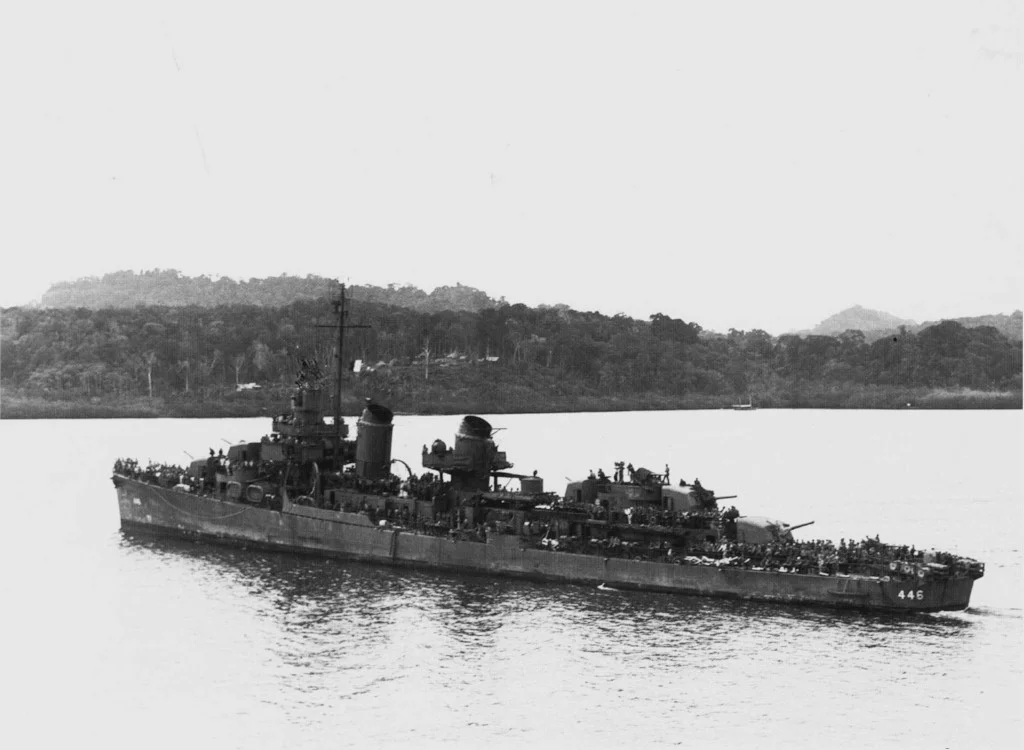
_steaming_into_Tulagi_Harbour_with_468_survivors_form_USS_Helena_(CL-50)_on_6_July_1943.jpg)
Battle of Kula Gulf
The Helena was firing blind into the dark when the flashless powder ran out. For three nights the American light cruiser had been pounding Japanese positions across the Solomons, and her magazines of specialized smokeless powder - the kind that would not betray her muzzle with bright bursts of flame - were empty. Into the early hours of 6 July 1943, in the narrow dark water of Kula Gulf off the eastern shore of Kolombangara, the Helena opened up on a Japanese destroyer column with ordinary powder. Each salvo threw fountains of orange flame into the night, perfect aiming marks for the Japanese torpedomen. Within minutes two Long Lance torpedoes found her port side, and the cruiser was fatally wounded.
Why the Gulf Mattered
The Allies had come ashore on Rendova just a week earlier, the opening move of the New Georgia campaign to capture the Japanese airfield at Munda. But Munda could not be taken if the Japanese kept pouring reinforcements across from Kolombangara. The whole strategic equation rested on a simple geographic fact: the narrow water between the two islands, the Kula Gulf, was both the front door for any Japanese resupply run and the killing ground where the U.S. Navy could stop those runs. On the night of 5 July, while U.S. Marines landed at Rice Anchorage to cut the northern supply trail, Rear Admiral Walden L. Ainsworth's Task Group 36.1 was pulling back to resupply when Admiral William Halsey's orders arrived: another Tokyo Express was coming down the Slot from Bougainville, ten Japanese destroyers carrying 2,600 troops toward Vila on Kolombangara's southern tip.
The Destroyer Strong
They had already paid a price that night. In the early morning hours of 5 July, the destroyer USS Strong was hit by a Type 93 torpedo fired from 11 nautical miles away by a group of four Japanese destroyers - a range so extreme that American sailors did not initially believe a torpedo could have come from that distance. The Strong broke apart. Forty-six men died. Another 241 were pulled from the water by the destroyer Chevalier while O'Bannon returned fire. The Long Lance torpedo, capable of running 20,000 yards at 45 knots with 1,000 pounds of explosive in its warhead, was the weapon no American planner had expected and no American cruiser or destroyer could easily survive.
Contact Off Visu Visu Point
Ainsworth's task group, three light cruisers and four destroyers, rounded Visu Visu Point just after midnight on 6 July. An hour later, a few hundred yards off the east coast of Kolombangara and northeast of Waugh Rock, they found Admiral Teruo Akiyama's force in the darkness. The Japanese had divided into units: three destroyers of the support column trailing four destroyers of the 11th Transport Division, with three more destroyers already unloading troops at Vila about 8.5 nautical miles ahead. The American gunners opened fire. Helena's flashless-powder problem immediately turned her into a beacon. Two of Akiyama's destroyers fired torpedoes. The Helena was struck three times, her bow blown off, the rest settling as flame and smoke rolled across the gulf.
Two Destroyers Return
Most of the Japanese transport destroyers completed their unloading at Vila. The Nagatsuki ran aground and was abandoned in the morning, later destroyed by American aircraft. Niizuki, carrying Admiral Akiyama himself, was sunk with most of her crew. Amagiri and the others withdrew through Blackett Strait or back through the gulf, with Mochizuki trading fire with the U.S. destroyer Nicholas around 0615 before disappearing behind a smoke screen. The raid was technically a failure for the Japanese - they lost two destroyers and the admiral commanding them - but they had still managed to land 1,600 troops at Vila. More would follow in the days after. What the Americans did next defined the engagement's legacy. The destroyers Radford and Nicholas turned back into the gulf to look for Helena's men in the water, and while they worked, they had to re-engage Japanese destroyers three separate times. They rescued over 750 sailors from the burning oil. Both crews received the Presidential Unit Citation.
Amagiri's Second Mark
One Japanese destroyer escaped from Kula Gulf that night and kept its appointment with history. The Amagiri, heavily damaged but still afloat, withdrew past Kolombangara and returned to the fight. Four weeks later, on 2 August 1943, in the Blackett Strait southwest of Kolombangara, the Amagiri ran down and cut in half a small American torpedo boat whose commander was a 26-year-old lieutenant named John F. Kennedy. The collision killed torpedoman Andrew Jackson Kirksey and motor machinist Harold William Marney. It also set in motion a rescue and a legend that would eventually carry Kennedy to the White House. The escort carrier USS Kula Gulf, commissioned in 1945 and in service intermittently until 1969, was named for this July night - the night the Helena lit herself up with her own gunpowder, and American destroyers went back into fire to save her crew.
From the Air
The Battle of Kula Gulf was fought at approximately 7.97 S, 157.07 E in the water between New Georgia and Kolombangara in the Solomon Islands. The gulf runs roughly north-south, about 10 nm wide at the narrowest, bounded by Visu Visu Point on New Georgia's northwest coast and the eastern flank of Kolombangara's 1,770-meter volcanic cone. Best viewing altitude 4,000-6,000 feet to take in both islands and the body of water between them. Nearest airport is Munda International (AGGM) about 25 nm south; tropical squalls and restricted night visibility common.
Nearby Stories
- Japanese cruiser Jintsu 18 km away
- 2007 Solomon Islands Earthquake 24 km away
- Battle of Vella Lavella (naval) 35 km away
- Battle of the Treasury Islands 119 km away
- Woodlark Island 415 km away
- Païta 1811 km away
- Maré Island 1874 km away
- 1737 Kamchatka Earthquake 6701 km away