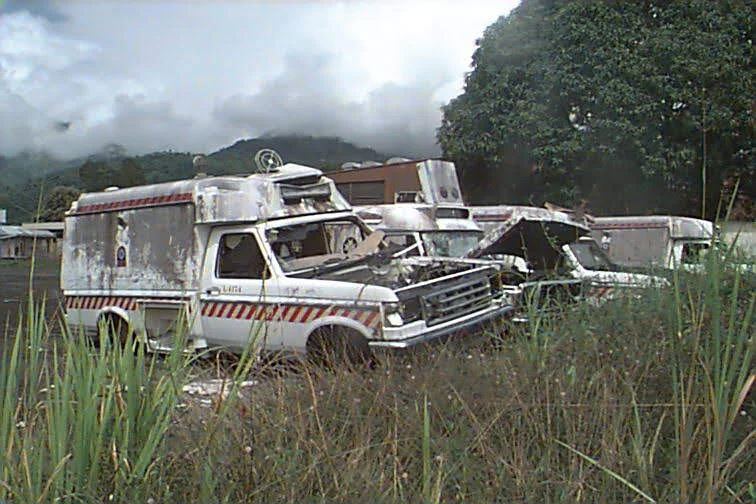

Bougainville Conflict
Francis Ona was a former Panguna mine surveyor who knew every truck route, every pit wall, every water pipe. In late 1988, he turned that knowledge against the mine itself. The explosions that destroyed Panguna's power pylons that November were not the opening act of some imported ideology. They were a Nasioi landowner's answer to decades of watching his ancestors' mountain disappear into open pit while the copper flowed out and the tailings flowed into the Jaba River. The conflict that followed would kill as many as 20,000 Bougainvilleans - perhaps an eighth of the indigenous population - before peace arrived a decade later.
The Mountain and the Mine
Panguna was no ordinary mine. When it opened in 1972, it was the largest open-cut mine on the planet, gouged out of the Crown Prince Range by the Australian company Conzinc Rio Tinto. At its peak it generated more than 45 percent of Papua New Guinea's export revenue - a single hole in Bougainville paying for much of a country that sat a thousand kilometers away across the sea. The Nasioi landowners who held customary title to that ground had never really consented. Australian colonial administrators negotiated the leases before PNG independence, paying royalties that amounted to a fraction of a percent. Thousands of migrant workers arrived, most from the PNG mainland. Bougainvilleans called them redskins, a reference to lighter skin tones that also carried the weight of being strangers on ancestral land. The Jaba River downstream from the mine turned the color of rust. Villages that had fished it for generations found the fish gone.
A War No One Expected
When Ona and his cousins blew the pylons in November 1988, the PNG government sent riot squads. The riot squads burned villages. The burned villages produced fighters. By early 1990, the Bougainville Revolutionary Army had pushed the Papua New Guinea Defence Force off the main island, and Ona declared independence. What followed was not the clean secessionist war the BRA's leaders imagined. The blockade PNG imposed - enforced with Australian-supplied UH-1 helicopters that were fitted with illegal machine guns in violation of their aid terms - cut off medicines, fuel, and salt. Bougainvilleans improvised. They built small hydroelectric plants from scavenged parts. They pressed coconut oil to run vehicles. They harvested bush medicine when pharmacies emptied. The Australian documentarians who later called it the Coconut Revolution were not exaggerating the ingenuity. But they sometimes missed the dying - the thousands who perished not from bullets but from untreated malaria, from complications of childbirth without a midwife, from wounds that would have been trivial with antibiotics.
Splintering
The BRA was never one thing. Its core came from the Nasioi clan around Panguna, but Bougainville has multiple peoples - Rotokas, Halia, Nagovisi, Siwai, Torau - speaking languages from three unrelated families, each with its own land and its own view of the war. On Buka Island to the north, a Halia-led militia drove the BRA out in 1990 and allied with PNG forces. Other villages formed Resistance units to fight armed BRA members who, cut loose from any real command structure, had become raskol gangs burning and robbing under the revolutionary flag. By the mid-1990s, 70 to 80 local feuds were layered on top of the war with PNG. Francis Ona retreated deeper into the interior. The more moderate Joseph Kabui and military commander Sam Kauona tried to negotiate. In 1996, Theodore Miriung - a former Panguna landowners' lawyer trying to broker compromise as premier of a transitional government - was assassinated. An investigation implicated members of the PNGDF and its allied resistance militias.
The Mercenaries and the Mutiny
By 1997, PNG Prime Minister Julius Chan was desperate. His army controlled maybe 40 percent of the island. A September 1996 BRA attack at Kangu Beach had killed twelve of his soldiers in a single engagement. In January, he signed a 36-million-dollar contract with Sandline International, a London-based private military company that in turn employed South African veterans of Executive Outcomes. The plan was to helicopter commandos into the interior and retake Panguna. When the Australian press broke the story, the plan unraveled spectacularly. PNG's own military commander, Brigadier General Jerry Singirok, went on national radio and ordered the mercenaries detained. Crowds surrounded Parliament in Port Moresby. Chan resigned. In Bougainville, the fighters who had outlasted a decade of blockade watched a government fall without firing a shot.
Peace and the Long Horizon
New Zealand, perhaps unexpectedly, brokered what Australia could not. Talks at Burnham military camp outside Christchurch in 1997 produced a truce. An unarmed Truce Monitoring Group arrived - soldiers from New Zealand, Fiji, Vanuatu, and eventually Australia walking the bush in their own uniforms without weapons, a gesture Bougainvilleans remembered. The Lincoln Agreement followed in January 1998. Ona refused to sign, declared himself king of a small kingdom around the abandoned mine, and lived there until malaria killed him in 2005. That same year Joseph Kabui won election as the first president of the Autonomous Bougainville Government. In December 2019, in a non-binding referendum, 98.31 percent of Bougainvilleans voted for independence. A 2021 agreement between the PNG and Bougainville governments set 2027 as the target date, pending PNG parliamentary approval. The mine remains closed. The Jaba River still runs orange in places. Reconciliation ceremonies at the clan level - the slow, essential work that no peace agreement could do - continue.
From the Air
Located at 6.00S, 155.00E in the Autonomous Region of Bougainville. From altitude, the jungle-covered Crown Prince Range appears as green folds with the pale scar of the abandoned Panguna mine visible in clear weather. Nearest airports: Aropa Airport (AYIQ) serving Arawa, Buka Airport (AYBK) in the north. Tropical climate, frequent afternoon cumulus buildups, wet season November through April.
Nearby Stories
- Japanese cruiser Sendai 11 km away
- Battle of Tsimba Ridge 22 km away
- Panguna Mine 30 km away
- Battle of the Hongorai River 56 km away
- Battle of Slater's Knoll 59 km away
- Operation RY 98 km away
- Takuu Atoll 212 km away
- Woodlark Island 356 km away