
Takuu Atoll
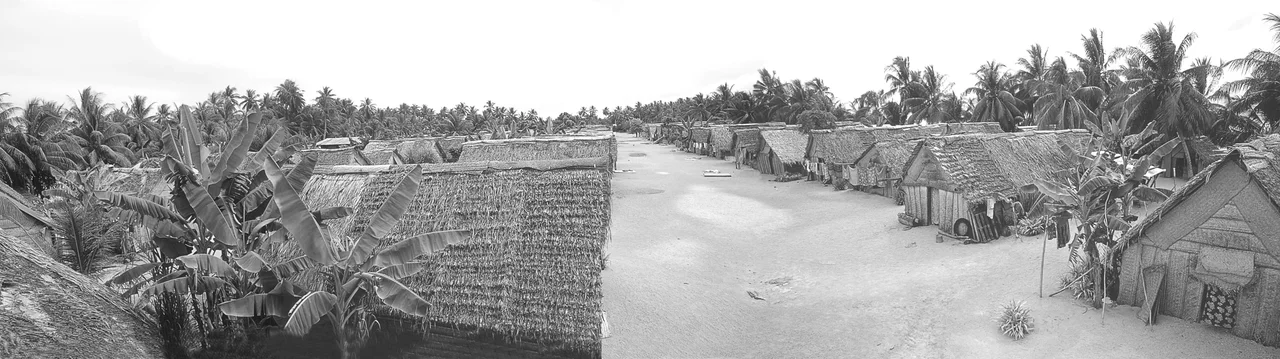
Dance performances fill twenty or thirty hours a week on Takuu. That is not a tourist show. That is ordinary life on an atoll of roughly 400 people, where the traditional thatched houses stand so close their eaves nearly touch, where the main street doubles as a marae for ceremony, and where many of the songs being sung were composed before anyone on Takuu had heard of a European ship. The people here are Polynesian, marooned in Melanesian waters 250 kilometers northeast of Kieta on Bougainville, part of a small group of Polynesian outlier cultures who sailed west of their own triangle and stayed. Richard Moyle, a New Zealand ethnomusicologist, spent seventeen years of his life listening. What he heard, he has said, is a community whose music and identity are one continuous thing. And he has predicted that climate change will, in time, extinguish the atoll's ability to sustain that life.
A Polynesian Village, Far From the Triangle
The Polynesian Triangle stretches from Hawaii to New Zealand to Rapa Nui, and most of what the world calls Polynesian culture lives within that vast ocean diamond. A handful of communities, however, sailed beyond it - the Polynesian outliers - and made homes in what cartographers later labeled Melanesian or Micronesian waters. Takuu is one of them. Also known historically as Tauu, Nukutoa, Mortlock Island, or Marqueen Island, the atoll lies off the east coast of Bougainville, a scatter of about thirteen islets on the eastern arc and one island to the northwest. Takuu Island is the largest. Nukutoa, a small neighbor, is where most people actually live. The whole atoll rides about a meter above the high tide mark - three feet of coral sand between the community and the sea.
Why the Missionaries Waited
For decades the Ariki - the chief of Takuu - refused to let Christian missionaries land. The ban held for twenty-five years, and during that quarter-century only four outside researchers were permitted to stay on the islands. It was an unusual choice in the Pacific, and a deliberate one. The Ariki understood that the songs, the ceremonies, and the spiritual sites needed protection from the well-meaning erasures that had flattened other Polynesian cultures. The ban lifted only recently, when young Takuu who had studied on the Papua New Guinea mainland returned home and began establishing the first churches on Nukutoa. The result is a community that meets modernity on its own terms - a place where indigenous religious practice survived a century in which most similar atolls converted, and where a traveler can still hear songs whose lyrics predate Captain Cook.
The Music That Remembers
Many of the songs on Takuu describe voyages between islands, names of ancestors, the details of journeys most of the world would consider lost. The language itself belongs to the Ellicean branch, connecting Takuu to Nukuoro, Kapingamarangi, Luangiua, and Sikaiana - cousins scattered across hundreds of miles of ocean. Because Takuu was isolated, the songs were isolated with it, and they accumulated. They survived while similar repertoires elsewhere were replaced by hymns. Richard Moyle's seventeen years of recording and transcription produced an archive the community now shares with its diaspora. In 2010, filmmakers Briar March and Lyn Collie released There Once Was an Island: Te Henua a Nnoho, a documentary made over two visits to the atoll that captured, among much else, the sound of that music layered over the sound of waves breaking too close to the doors.
When the Tide Comes In
The 2008 tidal surge arrived at high tide and ran for three days. Kitchens were washed away. Houses flooded. Several churches were destroyed. The service boat, the thin thread connecting Takuu to the outside world, could not reach the atoll for weeks afterward. This was not the first nor the last such event, but it was among the most frightening. The freshwater table has been going brackish for years now; taro gardens that fed generations die when saltwater reaches their roots. A cyclone in early 2006 had already softened the community's margins. In 2001, the community came close to starvation when the supply ship was laid up for six months of repairs. Scientists Scott Smithers and John Hunter, who visited in late 2008, concluded that the atoll itself is not subsiding from tectonics - it is the sea that is rising to meet it, and the storms that are arriving with more force, and the people who are caught in between.
Leaving and Staying
Around 2010, regular shipping to Takuu effectively ended, and the population began to collapse. Relatives already settled in Buka and on the Papua New Guinea mainland chartered open boats to bring family off the atoll when they could. By 2019, the estimated resident population had fallen to about 150. Moyle's warning - that Takuu can probably continue to exist as a physical place but may no longer function as a community - captures something the numbers do not. A culture that has held its music and language together against centuries of outside pressure now faces a different kind of dispersal: not conquest, not missionization, but the steady withdrawal of the conditions that made the place livable. The Takuu diaspora carries its songs with it, and its marae is mobile now, and the question is whether what gets sung in Buka is still a Takuu song or something new with Takuu memory inside it. The answer, whatever it turns out to be, is being worked out by the singers themselves.
From the Air
Located at 4.76 degrees S, 156.99 degrees E, roughly 250 km northeast of Kieta on the east coast of Bougainville Island. From cruise altitude the atoll shows as a thin scatter of islets on a pale lagoon, far from any land mass - a Polynesian outlier in the open Pacific. Best viewed at 4,000 to 6,000 feet; the islands are only about a meter above high tide and difficult to spot against the sea. Nearest airport is Buka Airport (AYBK) on Buka Island, roughly 330 km to the west. Tropical convective weather dominates; afternoon cumulus can obscure the atoll. Morning approaches offer best visibility.
Nearby Stories
- Carteret Islands 117 km away
- Japanese Seaplane Carrier Nisshin 168 km away
- Raid on Choiseul 202 km away
- Battle of the Green Islands 253 km away
- Duke of York Islands 503 km away
- Païta 2121 km away
- Maré Island 2170 km away
- 1737 Kamchatka Earthquake 6349 km away