
Battle of Arundel Island
What was supposed to be a mopping-up operation turned into the worst fighting of the New Georgia campaign. The commander of the 43rd Infantry Division would say so himself. The Americans came ashore on Arundel Island on 27 August 1943 expecting a garrison of 200 tired defenders. They left twenty-five days later after reinforcing a single regiment into eight battalions - with Marine tanks, 155mm howitzers, chemical mortars, and a 345-man Japanese body count behind them. The island the planners thought was almost empty had absorbed nearly a month of intensifying combat, and the Japanese on it had bought time for a larger withdrawal from Kolombangara that would, in turn, buy time for the defense of Rabaul and Bougainville. The value of Arundel was not the island itself. It was the dates on the calendar.
A Map of Choke Points
Arundel lies off the western coast of New Georgia, separated from it by Hathorn Sound and the Diamond Narrows - a water passage narrow enough that artillery on one side can reach the other. North of Arundel across the Blackett Strait sits Kolombangara, a cloud-wrapped volcanic cone that held the main Japanese concentration in the New Georgia group. To the west is Wana Wana, and beyond that Gizo in the Vella Gulf. The planners at XIV Corps wanted Arundel for a simple reason: guns on Arundel could shell Kolombangara's airfield at Villa. But the reverse was also true, and the Japanese high command - having given up on a counterattack against Munda after the Battle of Vella Gulf cost them three destroyers - decided to fortify Arundel instead. Two hundred men of the 229th Infantry Regiment were there when the Americans landed. Many more would arrive in barges under moonlight over the following weeks.
The 172nd Goes In
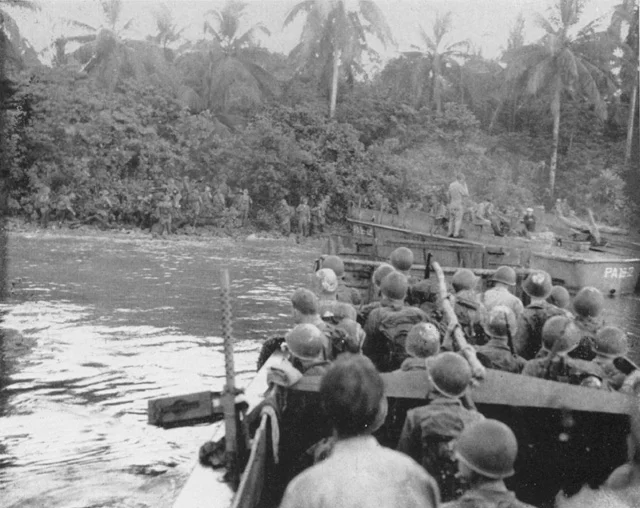
The 172nd Infantry Regiment landed unopposed on Arundel's southeastern tip on 27 August 1943, three battalions wading through mangrove and reef. Once ashore, the regiment split and pushed two columns north - one up the eastern coast toward Stima Lagoon, one up the western coast toward Bustling Point. The jungle slowed them worse than any enemy. Vines, heat, malaria, fatigue. The first contact came on 1 September, south of Stima Lagoon. The defending Japanese fought the way all competent jungle defenders fought: from maximum range when possible, in harassing raids when not, and they melted away before anyone could pin them. But they had been reinforced. The planners had miscalculated. By 5 September, the 2nd Battalion was attacking fortified positions - mines, booby traps, dug-in machine guns - and the 3rd Battalion had to be landed to help. Then the 173rd Infantry Regiment was fed in, regiment that was already understrength and running fevers. Then the 169th. Then the 27th, detached from the 25th Infantry Division. The operation was swelling beyond anyone's original estimate.
Tanks in the Mangroves
The turning point was armor. Thirteen Marine tanks - a platoon from each of the 9th, 10th, and 11th Defense Battalions - came ashore with Colonel Douglas Sugg on 15 September to break the deadlock. On the night of 16-17 September, five tanks from the 11th Defense Battalion moved into position behind the 27th on the west coast, using the noise of a heavy downpour to cover their engines. At dawn they rolled out in two waves, destroyed a strongpoint, and pushed the front line 500 yards forward without losing a tank. The next day, two tanks were destroyed by Japanese 37mm guns when they got separated from their infantry - the crews were pulled out alive by riflemen who recovered from their surprise and laid covering fire. On 19 September, all three defense battalions put eleven tanks into the final attack on the Stima Peninsula pocket. Japanese defenders ran at them with magnetic mines, trying to stick charges to their hulls. Infantry shot them down. Snipers harassed the Japanese antitank crews. The attack worked. By 20-21 September, the Japanese barge-evacuated their survivors from Gizo and Arundel back to Kolombangara, covered by one last artillery barrage from across the Blackett Strait. Some who tried to swim across drowned and washed up on the shore.
The Cost of a Delay
The official numbers: 44 Americans killed and 256 wounded. 345 Japanese killed and 500 wounded. Among the dead were the Japanese regimental commander, Colonel Satoshi Tomonari, and two of his battalion commanders, killed by American artillery fire as they tried to cross from Kolombangara on the night of 14-15 September. Before they died, their reinforcements launched a frenzied counterattack that stopped the American advance again. This kind of fighting - attritional, bloody, over small terrain features in a dripping jungle - was what the New Georgia campaign had become. The 43rd Division's commander would describe it as the most bitter of the campaign. And the Japanese who survived did what they had been sent there to do: they bought time. That time let 12,000 troops evacuate Kolombangara by barge over five nights starting 28-29 September. It let the garrison of Vella Lavella slip away on 6-7 October. It let the defenders of Bougainville and Rabaul dig deeper. Many of the men evacuated from Kolombangara would fight again on Bougainville a month later.
What the Island Carries Now
Arundel today is quiet. The mangroves have reclaimed most of the fighting ground. The Stima Peninsula and Bustling Point - names that meant something terrible in 1943 - appear on no tourist map. The coral reefs around the island are what draws outsiders now, divers staging from nearby Gizo to explore the clear waters of the Blackett Strait and Kula Gulf. The war is visible only occasionally - a rusted bunker, a mortar round bedded in a reef, old landing strips showing through the green. The people who live here remember the war in oral history, in family stories, in the occasional bone-yard find. The island that almost no one had heard of before the war, and almost no one remembers afterward, was for three weeks in 1943 one of the most painful places on earth. That kind of history does not announce itself from altitude. But it stays in the ground.
From the Air
Arundel Island sits at approximately 8.2°S, 157.13°E, between New Georgia and Kolombangara in the central Solomon Islands. Recommended viewing altitude: FL120-FL180 gives a clear view of the narrow Diamond Narrows separating Arundel from New Georgia, with the volcanic cone of Kolombangara looming to the north and Gizo visible to the west. Nearest airports: Munda (AGGM) on New Georgia and Nusatupe (AGGN) near Gizo. Tropical rainforest climate means heavy afternoon cloud buildup; morning flights generally offer the clearest overflight of the channel system.
Nearby Stories
- 2007 Solomon Islands Earthquake 4.9 km away
- Japanese destroyer Arashi 11 km away
- Battle of Vella Lavella (naval) 51 km away
- Battle of the Treasury Islands 131 km away
- Woodlark Island 411 km away
- Païta 1794 km away
- Maré Island 1858 km away
- 1737 Kamchatka Earthquake 6720 km away