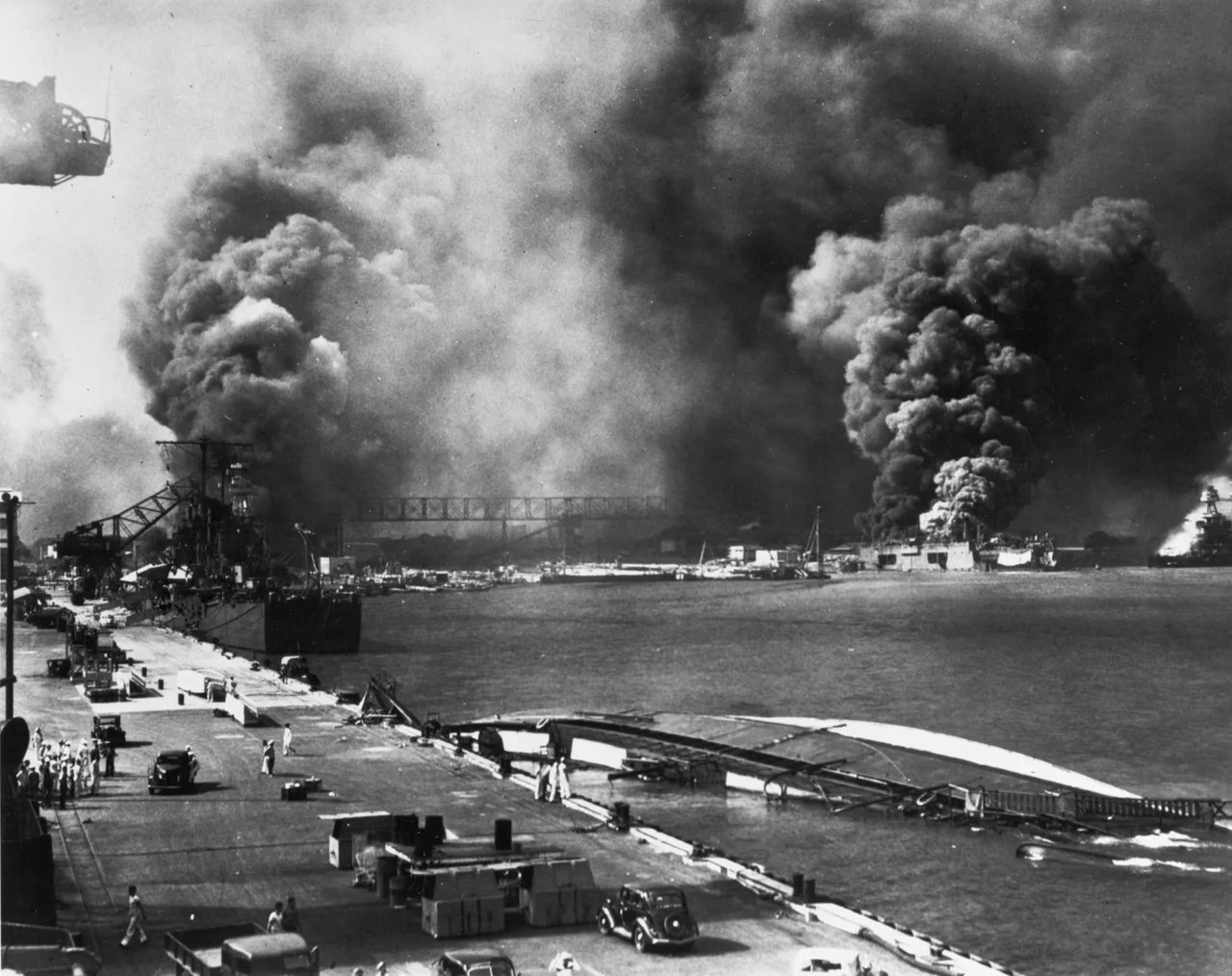
_capsized_at_Pearl_Harbor,_7_December_1941_(80-G-474789).jpg)
USS Helena (CL-50)
The bow of USS Helena kept pointing at the sky after the rest of the ship had gone. At 02:05 on 6 July 1943, three Japanese Long Lance torpedoes struck the American light cruiser on her port side within two minutes. The first blew off her bow. The second and third broke her keel below the armor belt. The ship collapsed in the middle and sank, but the severed bow section filled slowly with water and bobbed upright in the dark like a headstone, some of the crew still clinging to it. A U.S. Navy destroyer crept in before dawn and confirmed the identity through its sheer vertical geometry. By then, the survivors were already scattered across miles of Kula Gulf in the dark. The next nine days of their lives would turn into one of the great rescue sagas of the Pacific War.
A Ship Designed for Speed
Helena was the last of the Brooklyn-class light cruisers, commissioned in September 1939. She was 607 feet long, carried a crew of around 1,200, and mounted fifteen six-inch guns in five triple turrets - a wall of rapid-fire steel that could outshoot almost anything her size. Her designers had made a calculated bet when the London Naval Treaty capped cruiser tonnage: a smaller gun firing faster might do more damage than a larger one firing slower. Helena would prove them right three times over. She joined the Pacific Fleet in late 1940 and by December 1941 was in Pearl Harbor, tied up at a berth normally used by the battleship USS Pennsylvania - which happened to be in dry dock that week.
Pearl Harbor and the Wrong Silhouette
Three minutes into the Japanese attack on 7 December 1941, a torpedo bomber took aim at what its pilot believed was Pennsylvania in her usual berth. The silhouette he saw was actually Helena with the minelayer Oglala tied alongside, backlit by the morning sun. The torpedo passed beneath Oglala and exploded against Helena's starboard hull nearly amidships. The blast flooded the starboard engine and boiler rooms and cut the wiring to the main and secondary guns. Within two minutes, Helena's backup generator was running and her guns were firing again. By the time the attack ended, she had fired roughly 375 five-inch shells, 3,000 rounds from her 1.1-inch guns, and 5,000 from her .50-caliber machine guns, credited with six aircraft shot down. Thirty-one of her crew were killed. She limped to Mare Island in January 1942, was reconstructed with new radar and a fresh anti-aircraft battery, and returned to the war in July.
Cape Esperance and Guadalcanal
In the Solomon Islands, Helena's fast-shooting six-inch batteries became her signature. On the night of 11-12 October 1942, at the Battle of Cape Esperance, her radar operators found a Japanese bombardment force under Rear Admiral Aritomo Goto who did not realize the Americans were there. When Helena opened fire - with permission so hasty it may have been misheard - the other Allied ships followed. Goto was mortally wounded in the opening salvos. The Japanese cruiser Furutaka took so many hits her torpedo tubes exploded. Fubuki was battered into sinking. A month later, in the chaotic first night of the Naval Battle of Guadalcanal, Helena's guns again helped overwhelm a Japanese force that included the fast battleship Hiei. Both Rear Admiral Daniel Callaghan and Rear Admiral Norman Scott died in that action - Scott by friendly fire from San Francisco. Helena came through with five minor hits and one man killed. In January 1943, she bombarded the Japanese airfield at Munda Point and became the first warship in history to use a new technology in combat: five-inch shells with VT proximity fuses, an innovation that would later define the anti-aircraft defense of the fleet.
Kula Gulf, 02:03 to 02:05
The New Georgia campaign began on 30 June 1943. Six days later, Helena was back in Kula Gulf under Rear Admiral Walden Ainsworth, hunting a Japanese destroyer force trying to land reinforcements. At 01:57 on 6 July, the three American cruisers opened rapid fire and tore the Japanese flagship Niizuki apart in a few minutes. But Helena had used up her flashless powder the night before; her muzzle flashes in this fight marked her position for every Japanese lookout within miles. At about 02:03, Ainsworth ordered a turn to starboard to engage a second group of destroyers. What he did not know was that Suzukaze and Tanikaze had already fired sixteen Long Lance torpedoes. Three of them found Helena, arriving in the space of two minutes. The first tore away her bow. The second and third broke her keel in the machinery spaces, below her armor belt. Captain Charles Cecil gave the order to abandon ship; he and a signalman tried to flash a distress message with a hand lamp that could not be seen. The center third of the ship sank first. The bow and stern filled slower, rose up, and stood vertical in the dark water. One hundred and sixty-eight men were killed in the sinking.
Nine Days on the Edge of the Solomons
Radford and Nicholas pulled 735 men from the water that first night, breaking off twice to fight off Japanese destroyers who had returned to search for their own flagship. Captain Cecil, who survived the sinking, took charge of four whaleboats and led a flotilla of 88 survivors to Menakasapa on New Georgia, where the destroyer USS Gwin picked them up the next morning. But roughly 165 men were still missing. Some had climbed onto the floating bow. Some were drifting in rafts; others were just in the water with their life jackets. They endured two days of sun without shelter, cold without warmth, and currents that carried them steadily west. On 8 July, they reached the coral reef around Vella Lavella - an island still occupied by Japanese troops. Solomon Islanders met them at the water's edge, pulled them through the surf, and put them in contact with an Australian coastwatcher station hidden inland. One hundred and four of the men were hidden in the house of a Chinese merchant in the interior. Fifty more were concealed at a second location; another eleven at a third. Coastwatchers moved the men under Japanese patrols for a week. On the night of 15-16 July, two American destroyer-transports escorted by eight destroyers threaded through the Vella Gulf in darkness. Higgins boats ferried the survivors - along with the Chinese merchant families, a downed American pilot, and a captured Japanese airman - out to the ships. All reached safety.
Found in 2018
Of Helena's crew of nearly 1,200, 168 died. The other thousand came home in pieces and waves, some within hours and some only after days in enemy-held jungle hidden by islanders willing to risk their lives. The ship received seven battle stars and the Navy Unit Commendation - the first Navy ship awarded that honor. A memorial in Helena, Montana, now holds artifacts from both cruisers that bore the city's name. In April 2018, the research vessel Petrel, operated by the late Microsoft co-founder Paul Allen, located Helena's wreck about 860 meters down on the floor of the Kula Gulf. The hull number on the stern - CL-50 - was still legible in the beam of the expedition's lights, 75 years after the Long Lances found her.
From the Air
USS Helena rests at approximately 7.77 degrees south, 157.18 degrees east, on the floor of Kula Gulf north of Kolombangara in the Solomon Islands, at a depth of roughly 860 meters. Kula Gulf is framed to the west by the volcanic cone of Kolombangara (1,770 meters) and to the east by New Georgia - both striking landmarks for navigation. Recommended viewing altitude is 4,000 to 6,000 feet to see the gulf, the encircling islands, and the approach routes used by both fleets. Nearest airport is Munda (AGGM) on New Georgia, about 20 nautical miles south. Tropical haze and sudden squalls are common; mornings typically offer the best visibility in these waters.
Nearby Stories
- Battle off Horaniu 16 km away
- Battle of Arundel Island 25 km away
- Battle of Vella Lavella (naval) 63 km away
- Choiseul Island (Lauru) 74 km away
- Woodlark Island 457 km away
- Païta 1808 km away
- Maré Island 1868 km away
- 1737 Kamchatka Earthquake 6680 km away