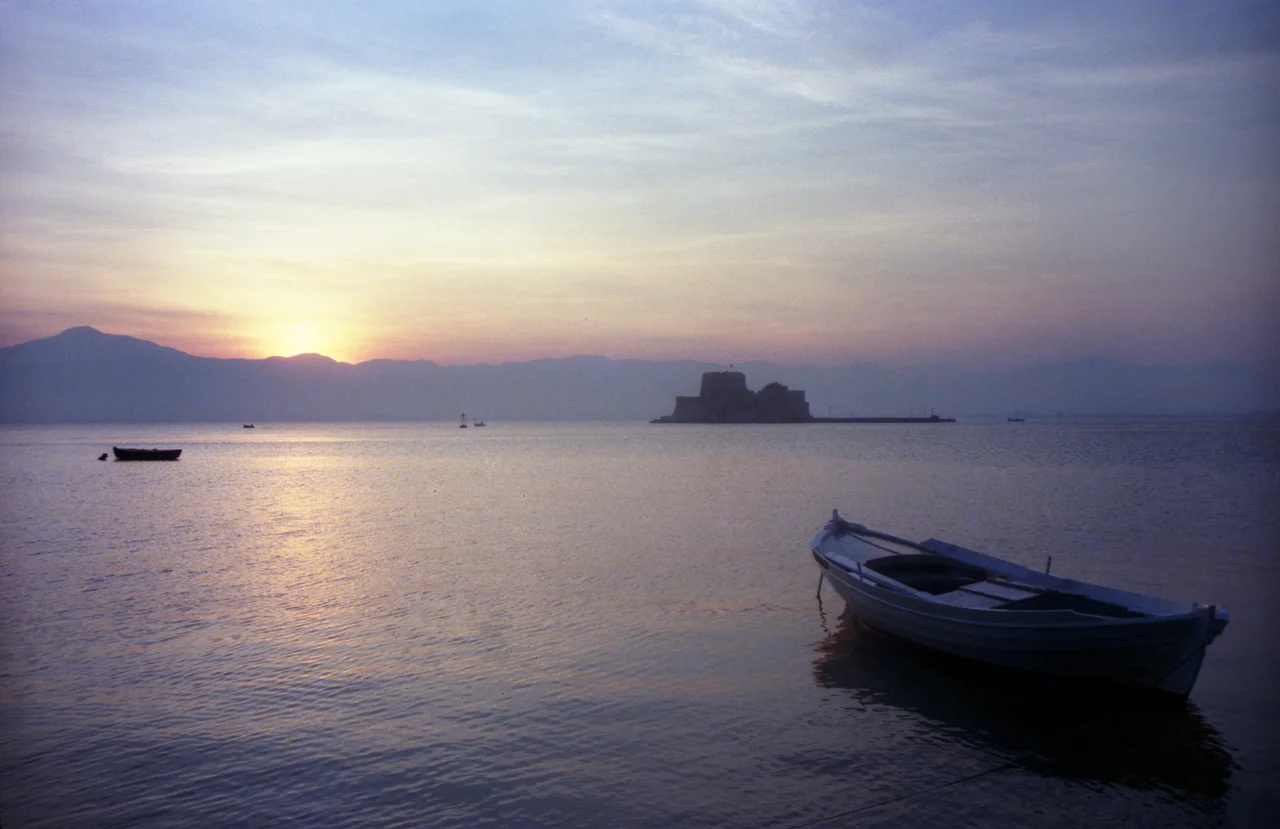

Bourtzi Castle
For most of its existence, the little island fortress in Nafplio harbour has been a place people were sent to rather than a place they chose to go. Soldiers garrisoned it. An executioner was housed there — a man whose professional value to the town made him an unwelcome neighbor on the mainland. Later it became a hotel, the kind of place where guests could sleep surrounded by cannon mounts and centuries of confined history. Today Bourtzi sits in the harbour as it always has, compact and photogenic, the most-photographed feature of one of Greece's most photogenic towns, its stones carrying more weight than its modest size suggests.
Built to Close a Harbour
The fortress was built in 1471 by Antonio Gambello, an Italian architect from Bergamo, though the construction was completed by an engineer named Brancaleone after the Ottomans temporarily took Nafplio under Mahmut Pasha. The Venetians, recovering the city in 1473, equipped the islet with cannons and turned it into a permanent defensive installation. By 1502 they had refined the design further: the fortifications on the southwest side were converted into an independent rampart, and an artificial mound of boulders was built out from the islet and connected to the city by a chain strung across the harbour mouth. The chain was the point — it could be raised to prevent any hostile ship from entering. Nafplio's harbour, and with it the city's security, depended on this small piece of rock and iron working together across the water.
The Executioner's Island
After the Treaty of Karlowitz in 1699 returned the region to Venetian control, the islet was further reinforced with a sturdy tower and additional cannon bastions. By this period, Bourtzi had acquired its most unusual peacetime role: it became the official residence of Nafplio's public executioner. The logic was practical. The executioner's profession made him a social pariah, someone the townspeople needed professionally but preferred not to live beside. The island solved the problem neatly — he was close enough to be called upon, isolated enough to avoid friction. It was an arrangement that suited the town rather better than it suited him, one imagines. This piece of Bourtzi's history tends to be mentioned in guidebooks with a certain relish, and it does add an unexpected human dimension to what is otherwise a story of military engineering.
Revolution and Bombardment
During the Greek War of Independence, which began in 1821, Bourtzi's military role reasserted itself. Two hundred armed Greek soldiers captured the fortress, and from its gun positions they bombarded the Ottoman-held city of Nafplio across the water, simultaneously intercepting an English ship attempting to resupply the besieged Turkish garrison. The castle thus played a direct operational role in the revolution that would eventually produce the modern Greek state. Nafplio itself fell to Greek forces in 1822, and for a brief period — before the capital moved to Athens in 1834 — it served as the seat of the first Greek government. Bourtzi, having helped make that history possible, reverted to quieter uses.
Hotel, Landmark, Reflection
In the twentieth century, Bourtzi had a career as a hotel — an improbable but apparently successful transformation of a medieval gun emplacement into overnight accommodation. That venture has since ended, and today the castle functions primarily as a tourist attraction and cultural venue. Boats run to it from the Nafplio waterfront, a short crossing across the deep harbour water. From the battlements, the views back toward the old town are striking: the tight cluster of Venetian and neoclassical buildings, the great Palamidi fortress looming on the cliffs above, the mountains of the Peloponnese behind. The name itself comes from the Ottoman Turkish word burc, meaning tower. The Venetians called it Kastelli; the Ottomans renamed it; the Greeks kept the Ottoman name. That sequence — Venetian, Ottoman, Greek — is the compressed history of the entire Peloponnese in miniature.
From the Air
Bourtzi Castle sits at 37.570°N, 22.791°E in the harbour of Nafplio, on a small islet clearly visible from the air as a distinct fortified structure surrounded by water. Nafplio itself occupies a compact peninsula projecting into the Argolic Gulf — one of the most visually distinctive townscapes in the Peloponnese when seen from above. The Palamidi fortress rises steeply on the cliffs directly above the old town, and the Bourtzi islet sits roughly 400 metres offshore to the northwest of the town waterfront. The nearest major airport is Athens International Eleftherios Venizelos (LGAV), approximately 130 km to the northeast. Approach from the south over the Argolic Gulf gives the best view of the harbour configuration, with Bourtzi clearly identifiable as the fortified island guarding the harbour entrance.
Nearby Stories
- Kastanitsa 2.3 km away
- Heroon at Nemea 3.4 km away
- Psari, Trikolonoi, Arcadia 4.2 km away
- Siege of Gardiki-Arcadia 8 km away
- Cleitor 12 km away
- Troezen 15 km away
- Cave of Euripides 24 km away
- SS Heraklion 94 km away