
Boyle
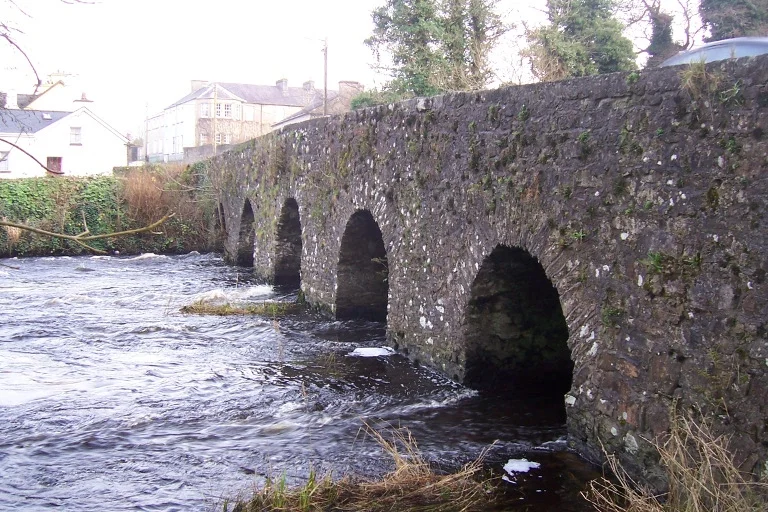
Boyle sits in a soft bowl of country between two lakes, at the foot of the low blue-grey wall of the Curlew Mountains. The Boyle River runs through the middle of the town, under the five-arched span of Abbeytown Bridge - one of the oldest surviving stone bridges in Ireland, late twelfth century, still carrying a five-ton load eight centuries after the Cistercians laid it. Boyle is a small place, population just under three thousand, but it has the architectural density of somewhere much larger. There is a great ruined Cistercian abbey at one end of Main Street and a great Georgian mansion at the other; in 1881 the town directory recorded twenty-five pubs, sixteen of which doubled as groceries, and forty grocery shops, and twelve bakeries. It also produced an actress who would become Tarzan's Jane, and a redheaded comedian who would become a film star.
The Cistercians and the Sheela
Boyle Abbey was founded in the twelfth century under the patronage of the local ruling family - the MacDermotts, kings of Moylurg, whose castle on a rock in Lough Key is just up the road. Monks were colonised here from Mellifont in 1161 and they began building almost at once. The chancel and transepts came first; the east window's lancets arrived in the thirteenth century; the western three arches of the south arcade with their leafed and figured capitals went up after 1205. The abbey was finally consecrated in 1218 - over half a century to finish, which is fast by Cistercian standards. What survives is unusually intact: the great square tower, the surviving arcades of the nave, the gatehouse rebuilt in the sixteenth century which now houses the exhibition. Hidden in plain sight above one of the central Romanesque arches is a small carved Sheela na gig - a stone figure of a woman exposing her vulva, the function and meaning of which is still argued about. In 1235 the abbey was sacked by Richard de Burgo's army during the conquest of Connacht. In 1659 the Cromwellians sacked it again. It is now a national monument.
King House and the Family with 365 Windows
At the other end of Main Street stands King House, an early Georgian mansion built between 1720 and 1740 for Sir Henry King MP - whose family, the Earls of Kingston, were among the wealthiest in Ireland. The architect was William Halfpenny, an assistant to Edward Lovett Pearce. Unusually for an Irish 'big house', King House sits in the centre of the town rather than in a country demesne; even more unusually, its floors are vaulted - a precaution, the Reverend Daniel Beaufort guessed, after an earlier seventeenth-century house on the site had burnt. The Kings moved out in 1810 to a far grander pile two miles up the road called Rockingham, designed by the architect of Regent Street, John Nash, with 365 windows and a domed front. King House became a military barracks, home for a century to the Connaught Rangers and then, after 1922, to the new Irish National Army, who renamed it Dockery Barracks for a commanding officer killed in the Civil War. The county council bought it in 1987, restored it across three storeys and a basement, and reopened it as a museum. Rockingham, by contrast, was 'suspiciously destroyed by fire' in 1957, declared unsafe in 1970, and finally demolished. The underground servant tunnels are still walkable. The viewing tower built in its place in 1973 looks down on what is now Lough Key Forest Park.
The Town That Voted for the Rising
In 1917 Boyle made a small piece of national history. The North Roscommon by-election - the first by-election in Ireland since the Easter Rising of 1916 - was won by Count George Noble Plunkett standing for Sinn Fein, the first Sinn Fein candidate ever elected to Parliament. Plunkett's son, the poet Joseph Mary Plunkett, had been one of the seven signatories of the Proclamation of the Republic and had been executed by firing squad in Kilmainham Gaol the previous May. The young Michael Collins campaigned in person for Plunkett's candidacy, as did the renegade priest Michael O'Flanagan, later President of Sinn Fein. A plaque on the courthouse on The Crescent commemorates the election. The result told Britain something it had not yet quite believed: that the executions of 1916 had transformed Irish opinion. Two years later Sinn Fein would win seventy-three of one hundred and five Irish seats in the general election and refuse to take them, setting up the first Dail Eireann instead.
Tarzan's Jane and Moone Boy
Boyle has been quietly generous with talent. Maureen O'Sullivan was born here in 1911 - she became Hollywood's most famous Jane opposite Johnny Weissmuller's Tarzan in six films through the 1930s and 40s, and was later mother to Mia Farrow. The conductor Michael Bowles grew up here, the suffragette and women's rights campaigner Margaret Cousins was born here, the novelist John McGahern grew up just outside the town and set scenes from The Dark in the dining room of the old Royal Hotel overlooking the river. The folk singer John Reilly lived here until his death in 1969, the source for Christy Moore of folk standards including The Well Below the Valley and Lord Baker. And in the present generation, Chris O'Dowd - the actor from Bridesmaids and the IT Crowd - was born and raised in Boyle, and brought his autobiographical sitcom Moone Boy back to film here in 2012 and 2013. The five-arch bridge over the Boyle River is still doing its work. The abbey still attracts thousands every summer. The town park - locally called the Pleasure Grounds - still has the empty plinth where a statue of William of Orange stood until locals pulled it down in 1945.
From the Air
Located at 53.972 degrees north, 8.30 degrees west, in northwest County Roscommon at the foot of the Curlew Mountains. The town lies between Lough Gara to the west and Lough Key to the east, both visible water-features useful for navigation. The N4 Dublin-Sligo road skirts the town to the east. Best viewed at 2,000-4,000 feet. Nearest airports: Ireland West Knock (EIKN) about 40 km west, Sligo (EISG) about 40 km north.
Nearby Stories
- Tulsk 1 km away
- Holywell ambush 5.8 km away
- Enniskillen Royal Grammar School 6.5 km away
- Aclare 7.6 km away
- Bawnboy 7.8 km away
- Clonfin Ambush 10 km away
- Benbulbin 14 km away
- RMS Empress of Britain (1930) 125 km away