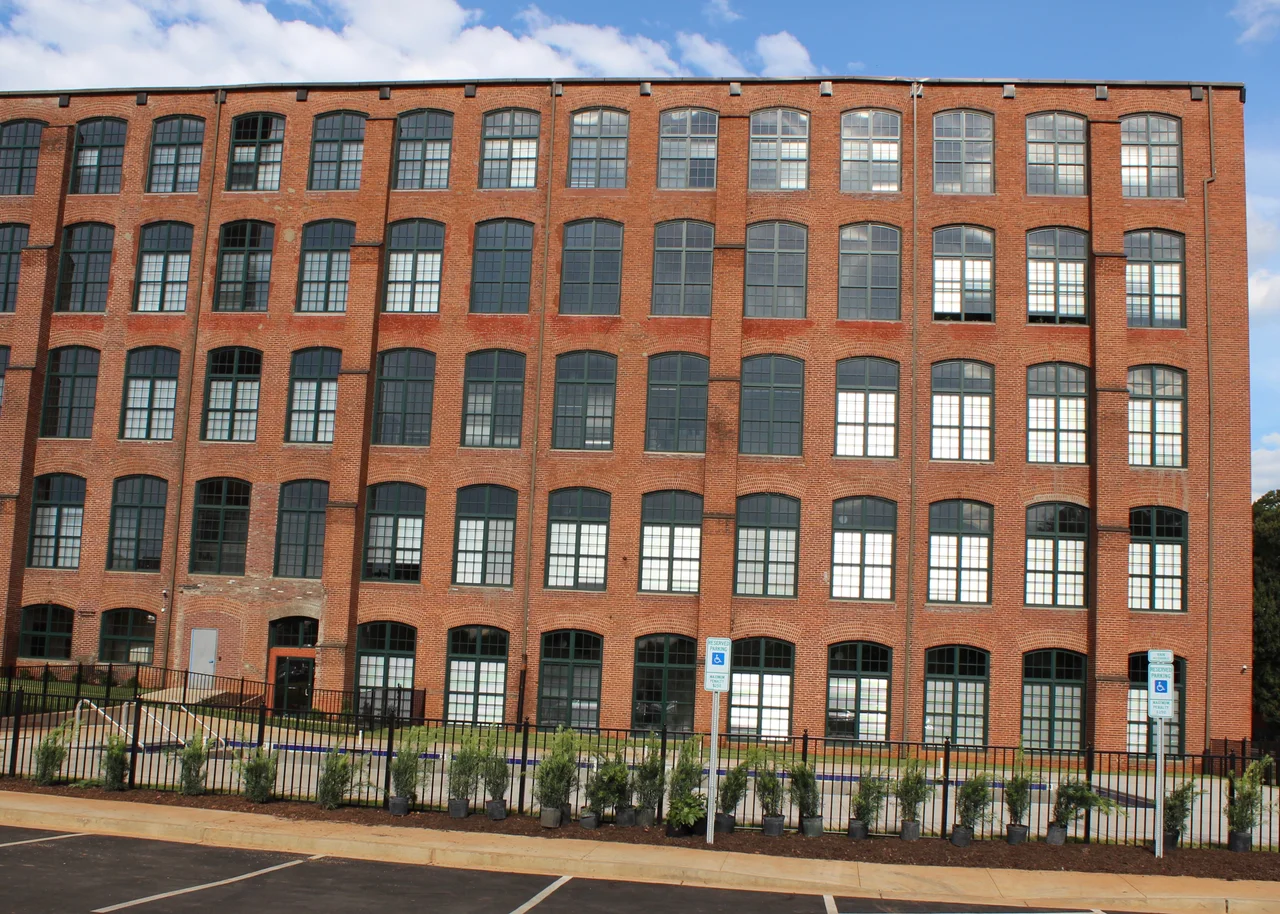

Brandon Mill
The kid who could hit anything anyone threw at him played his first organized baseball games right here. Joseph Jefferson Jackson, born in 1887, was thirteen years old when the Brandon Mill opened in January 1901, and his family was among the rural Appalachian newcomers it pulled into Greenville. He played outfield for the mill team because mill teams were how a mill kid could become someone. By his twenties he was hitting baseballs for the Cleveland Indians and the Chicago White Sox. By 1919 he was caught up in the Black Sox scandal, banned from professional baseball for life. He never came back to the mills. But the bleachers he learned to play in front of stood beside the brick building that is now the West Village Lofts.
From Sixteen Thousand Spindles to Eighty-Six Thousand
Brandon Mill was the kind of place that grew faster than its founders had planned for. Designed by Lockwood, Greene and Company of Providence, Rhode Island, the same firm that designed mills all over New England and the South, the building was planned in 1899 and completed in January 1901. The investors named it Brandon, supposedly for a hamlet near Belfast that produced textiles. In its first five years the mill went from 16,000 spindles to 86,000, from 150 employees to 420, from 66 houses in the mill village to 420. The workforce was recruited from Appalachia and other rural corners of the southeastern United States, and most had never lived in a town before. The mill provided everything: a school, a church, a nursery, a community house with showers and a nurse's station. By 1918 even a library was part of the package.
Baseball as Industrial Policy
Mill owners across the southern textile belt figured out early in the twentieth century that organized leisure was good for productivity. A mill baseball team gave operatives, the term mill owners used for their workforce, something to do on Saturday afternoons besides drink. It built loyalty. It made workers identify with the company. The owners competed for the best players, sometimes hiring them as nominal mill hands but really paying them to swing a bat. Shoeless Joe was the most famous to come out of the Brandon Mill team. He was not the only one. The Greenville Cotton Mill League, in which Brandon competed, produced players who went on to the major leagues throughout the 1910s and 1920s. The grandstands and the diamond are gone, but on Saturdays in the spring you can still imagine the games.
The Stretch-Out and the Picker Sticks
Even before the Great Depression hit, the southern textile industry was already in trouble. Mills tried to squeeze more work out of fewer hands through what management called the stretch-out, a requirement that each worker tend more machines. In March 1929, 1,200 workers walked off the job at Brandon Mill. They settled in May. The economy kept getting worse. To keep the mill running through the worst of the Depression, August W. Smith, the second president of Brandon, cut hours and pay instead of cutting jobs. That decision built a strange kind of loyalty: when the United Textile Workers of America came to Brandon during the general textile strike of 1934, workers reportedly met them at the gates with picker sticks and rifles and told them to keep going. The mill ran straight through the strike. The same pattern, paternalistic management buying labor peace, played out across the southern textile belt for another generation.
From Mill to Lofts
World War II brought a brief boom. Brandon Mill produced duck cloth, medical gauze, and uniform twill for the government. In December 1946 Abney Mills bought Brandon's assets and began selling off the mill village houses to their occupants, which is one of the reasons the neighborhood survived intact long after the mill itself had faded. The 1950s and 60s were profitable for a while. Then offshoring began. By 1969 Brandon was cutting its workforce. In 1977 the mill closed. The main building became a warehouse, then in 2001 a distribution center for Dunlop Sport golf equipment. In 2014 developer Pace Burt bought the property and converted the main building into loft apartments, applying for and receiving National Register of Historic Places status that same year. In 2015 he donated one building in the complex to the Greenville Center for Creative Arts. The lofts opened in 2016. Today, residents look out arched factory windows where spindles once turned, and a few of them know, when they look out toward the patch of grass where the baseball diamond used to be, what happened on that field a century earlier.
From the Air
Located at 34.84 degrees North, 82.43 degrees West, just west of downtown Greenville, South Carolina. The Brandon Mill complex, now West Village Lofts, is a long brick industrial building visible from the air with sawtooth roof patterns characteristic of early twentieth century textile mills. Nearest airports: Greenville Downtown (KGMU) about 3 nm east-northeast, Donaldson Center (KGYH) about 4 nm south, Greenville-Spartanburg International (KGSP) about 12 nm east-northeast. Best viewed at 1,500 to 3,000 feet AGL; the mill village street grid surrounding the main building is clearly distinguishable from later suburban development.
Nearby Stories
- Battle of Musgrove Mill 6.9 km away
- Carl Sandburg Home National Historic Site 13 km away
- Stumphouse Mountain Tunnel 17 km away
- Forest City, North Carolina 20 km away
- Chiquola Mill Massacre 20 km away
- Battle of Blackstock's Farm 26 km away
- Great Smoky Mountains National Park 65 km away
- Tree That Owns Itself 84 km away