
Bray, County Wicklow
On 10 July 1854 the Dublin and Kingstown Railway - the first in Ireland, opened twenty years before - finally reached Bray, and a quiet coastal village began transforming into the favourite seaside resort of nineteenth-century Ireland. A Moorish-style Turkish baths opened in 1859 at a cost of £10,000. Pleasure boats ran in summer. Boarding houses filled with Dublin gentry. Today Bray has 33,512 residents, making it the tenth largest urban area in Ireland, and its history is unusual in that almost every famous resident lived here briefly rather than long. James Joyce as a child. Sir Arthur Conan Doyle and Sheridan Le Fanu as adults. Sinead O'Connor in her last decade. The 2012 Olympic boxing gold medallist Katie Taylor returned home along this seafront to thousands waiting in the rain.
On the Edge of the Pale
Bray's location made it strategically important long before it became a holiday destination. During the medieval period, it sat on the southern border of the Pale - the area around Dublin governed directly by the English crown from Dublin Castle - while the countryside inland fell under the control of Gaelic chieftains, the O'Tooles and O'Byrnes. Bray appears on the famous 1598 Ortelius map of Ireland as "Brey." In 1627 William Brabazon, the first Earl of Meath, purchased the Killruddery Estate just south of the town, where his Elizabethan-revival mansion - the present house dating from the 1820s - still receives summer visitors. The Brabazon family have been a constant presence in Bray for almost four hundred years. The town's name in Irish has been debated; the antiquarian Seosamh Laoide coined Bri Cualann in a 1905 Gaelic League publication, but the scholars Liam Price and Osborn Bergin disputed it. Bri or Bri Chualann lingered into the mid-twentieth century before largely fading.
The Seaside Resort That Almost Was
Bray's Victorian boom should have been bigger. The town developed its esplanade, its handsome cottages ornees, its boarding houses on different scales of economy, and the Parliamentary Gazetteer of 1846 already described it as a favourite resort of wealthy Dubliners and the gentry from a wider Ireland. But every grand plan to lift Bray to the rank of Brighton or Blackpool seems to have stalled. A pleasure pier like the famous one at Brighton was proposed, designs commissioned, capital sought - and abandoned in 1906. A concert hall, theatre, exhibition centre, marine aquarium, winter gardens and an electrified tramway along the seafront were planned and never built. The Turkish baths, opened in 1859 in their Moorish style, closed long before they were finally demolished in 1980. The town slipped quietly into the twentieth century as a middling resort rather than a great one. In 2023 Time Out named it one of the fourteen most underrated travel destinations in the world.
Bray Head and Killruddery
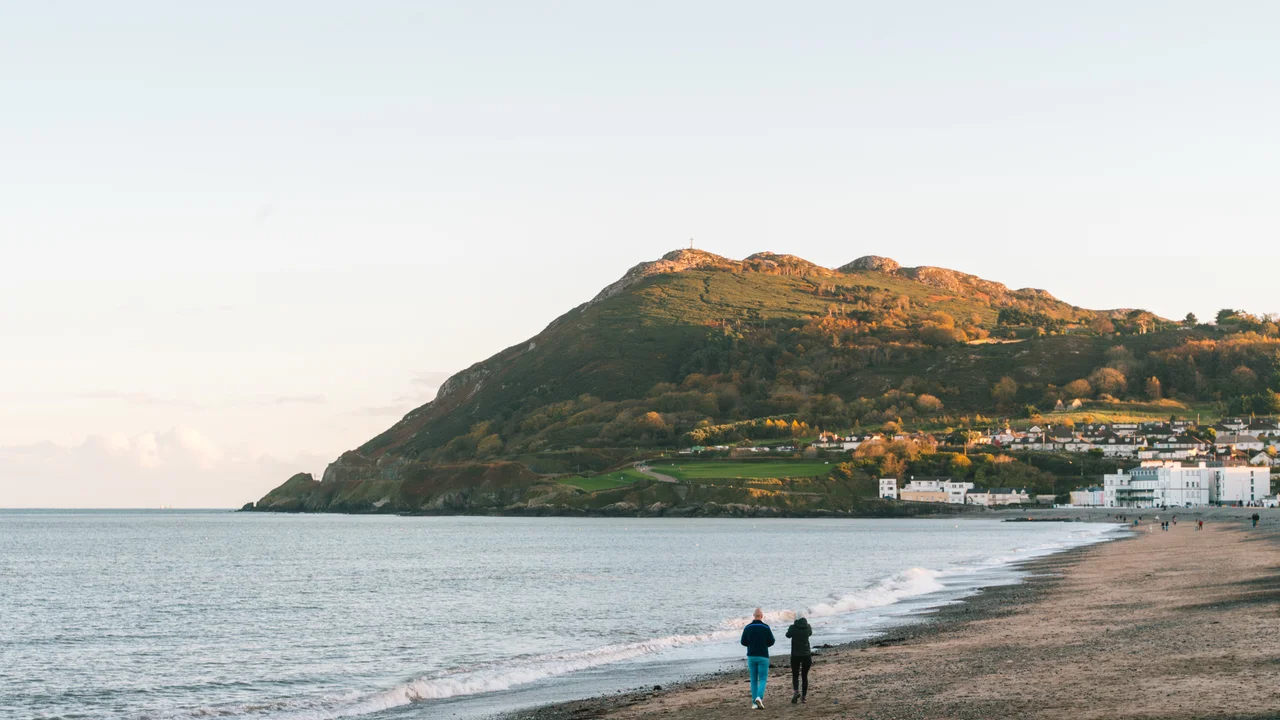
South of the harbour, Bray Head rises from the sea, a mixture of greywackes and quartzite topped with a large concrete cross erected in 1950 for the Catholic Holy Year. A coastal path leads up to the summit. The Cliff Walk runs six kilometres along the railway line around the headland to Greystones - two hours of clifftop walking that is among the most popular short hikes in eastern Ireland. Killruddery House, the Earl of Meath's seat, is open in summer months. The medieval Raheen-a-Cluig church on the north face of Bray Head is a national monument. Holy Redeemer Church in town dates from 1792. The Gothic Revival Christ Church and Bray Methodist Church both followed in 1863-64. The River Dargle, rising near Djouce in the Wicklow Mountains, enters the sea at the north end of town. A colony of mute swans winters where the river meets the harbour.
Ardmore Studios and the Famous Residents
Ardmore Studios, established in 1958, is Ireland's oldest film studio and stands on the western edge of Bray. Excalibur was shot here. So were Braveheart, Breakfast on Pluto, and Neil Jordan's 2012 vampire film Byzantium, parts of which were filmed inside the Bray Head Inn. The town has drawn writers as well as filmmakers. The young James Joyce lived here. Sir Arthur Conan Doyle stayed in the town. The Gothic novelist Sheridan Le Fanu - author of Uncle Silas and the vampire novella Carmilla - lived here too. So did the novelist Molly Keane. In recent years Hozier, Dara O Briain and Laura Whitmore have called Bray home. Sinead O'Connor lived in a house on Strand Road overlooking the sea for the last years of her life, and after her death in London in 2023, her funeral procession moved slowly along Bray seafront, watched by thousands. The Olympic boxer Katie Taylor was raised here. When she returned from London with her gold medal in August 2012, the crowd that turned out to meet her stretched the length of the promenade.
From the Air
Located at 53.20°N, 6.11°W on the Irish Sea coast, about 20 km south of Dublin city centre. Best viewed at 2,000-4,000 ft AGL; the distinctive Bray Head rises sharply from the south end of town, with the long Victorian promenade and harbour clearly visible. Nearest airports: Dublin (EIDW) 25 km north, Newcastle Aerodrome (EINC) 12 km south-west.
Nearby Stories
- Malahide Castle 1.2 km away
- Castlemartin House and Estate 6.4 km away
- Avoca, County Wicklow 8 km away
- Trim, County Meath 15 km away
- German submarine U-1051 29 km away
- County Carlow 29 km away
- HMS Tyler 32 km away
- Irish Sea Bridge 46 km away