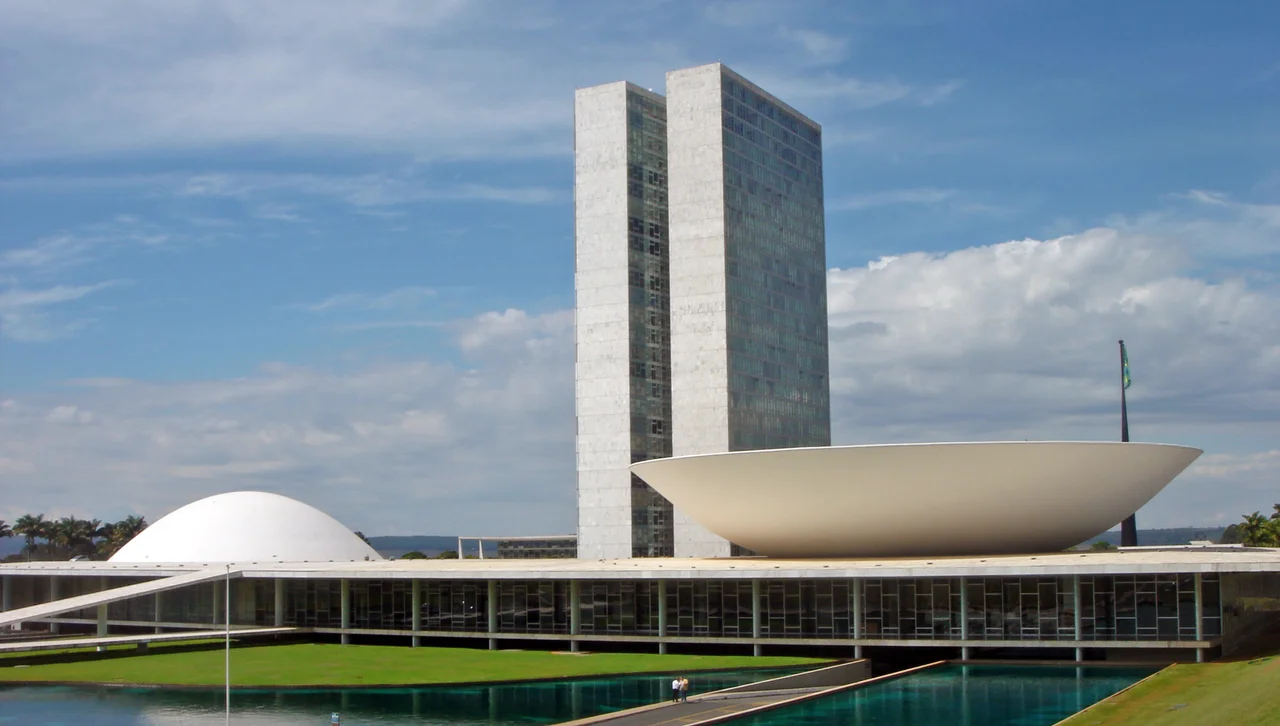

Brazilian National Congress
Look at a Brazilian 200-real banknote, or the cover of nearly any book about 20th-century architecture, and you will see the same composition: a shallow dome resting on the ground, another dome flipped upside down beside it, and between them twin office towers rising 28 stories into the sky. This is the Palácio Nereu Ramos, Oscar Niemeyer's National Congress, completed in 1960 as the centerpiece of Brasília's Monumental Axis. The dome on the left holds the Senate. The upside-down dome on the right holds the Chamber of Deputies. The towers hold offices. The composition reads almost like a diagram: two houses, one government, two towers reaching upward.
The Niemeyer Composition
Niemeyer designed the Congress as part of Lúcio Costa's overall plan for Brasília. The building sits at the end of the Esplanade of the Ministries - twin rows of identical glass-and-concrete blocks that lead the eye directly to this composition. The effect is deliberate. In a city of pure geometry, the Congress is the pivot point. Behind it lies the Praça dos Três Poderes, the Three Powers Plaza, where the Planalto Palace (executive) and the Supreme Federal Court (judiciary) complete the constitutional triangle. In front of it stretches a vast lawn that becomes, at moments of national crisis or celebration, the stage for Brazilian democracy itself. UNESCO added the Congress to the list of original Brasília buildings when the city became a World Heritage Site in 1987.
The Upper House
The Federal Senate - the dome on the left of Niemeyer's composition - holds 81 seats. Each of Brazil's 26 states sends three senators, and the Federal District sends three more. Senators serve eight-year terms, staggered so that either one-third or two-thirds of the chamber turns over every four years. The institution was created by the Constitution of the Brazilian Empire in 1824, inspired initially by the British House of Lords. When the empire fell in 1889 and Brazil became a republic, the Senate was remodeled on the American pattern. The President of the Senate is ex officio President of the National Congress, and third in line of succession to the presidency of Brazil.
The Lower House
The Chamber of Deputies - the inverted dome on the right - holds 513 seats. Unlike the Senate, deputies are distributed by population, with each state guaranteed a minimum of eight seats and a maximum of seventy. São Paulo gets seventy. Acre, Amapá, and other thinly-populated states get eight. The chamber renews entirely every four years through proportional representation. In 2018, 24 of Brazil's 33 political parties won at least one seat in the chamber - a fragmentation that makes governing coalitions complex. Brazilian presidents routinely negotiate with a dozen parties or more, a system called coalition presidentialism.
A Dome Full of History
The Congress building has been central to every major political drama in modern Brazilian history. In June 2013, more than two million Brazilians protested against corruption and fare hikes, and demonstrators climbed onto the Congress dome itself, turning the building into a stage of public anger. On 8 January 2023 - a week after Lula's third inauguration - supporters of outgoing president Jair Bolsonaro stormed the Congress, the Supreme Court, and the Planalto Palace, breaking through the building's doors and smashing its interiors. The scenes resembled the US Capitol attack of 2021, and Brazilian courts moved to hold the organizers accountable. In April 2025, approximately 8,000 indigenous people from 150 ethnic groups gathered in front of the Congress, breaching security barriers to occupy the lawn in protest of land rights legislation. The building keeps absorbing these moments, then standing clean and geometric for the next one.
Before Brasília
For most of its existence, the Brazilian Congress met in Rio de Janeiro. The Senate occupied the Monroe Palace, a neoclassical building near the Cinelândia district, from the 1930s until the move north. That palace was demolished in the 1970s to make way for the Rio subway. The Chamber of Deputies worked from Misericórdia Street. In the 1960s, both houses packed up and moved to the new capital. The legislature, which had already sat in Rio since the imperial General Assembly of 1826, took the historical thread to Brasília and continued. The numbering of legislatures runs continuously back through the 19th century - a reminder that while the building is a mid-century invention, the institution it houses is much older than the city it stands in.
From the Air
Coordinates: -15.800°S, -47.864°W. The Congress sits on Brasília's Monumental Axis, between the Esplanade of the Ministries and the Three Powers Plaza. Visible from cruise altitude when descending to Brasília International Airport (SBBR) about 8-10km to the south. The twin office towers and dual domes form one of the most recognizable aerial landmarks in Brazil.
Nearby Stories
- Valparaíso de Goiás 7.8 km away
- Formosa, Goias 26 km away
- Pireneus State Park 36 km away
- Planaltina, Goiás 40 km away
- Anápolis 59 km away
- Unaí 73 km away
- Ceres, Goiás 117 km away
- Mambaí 181 km away