.jpg)
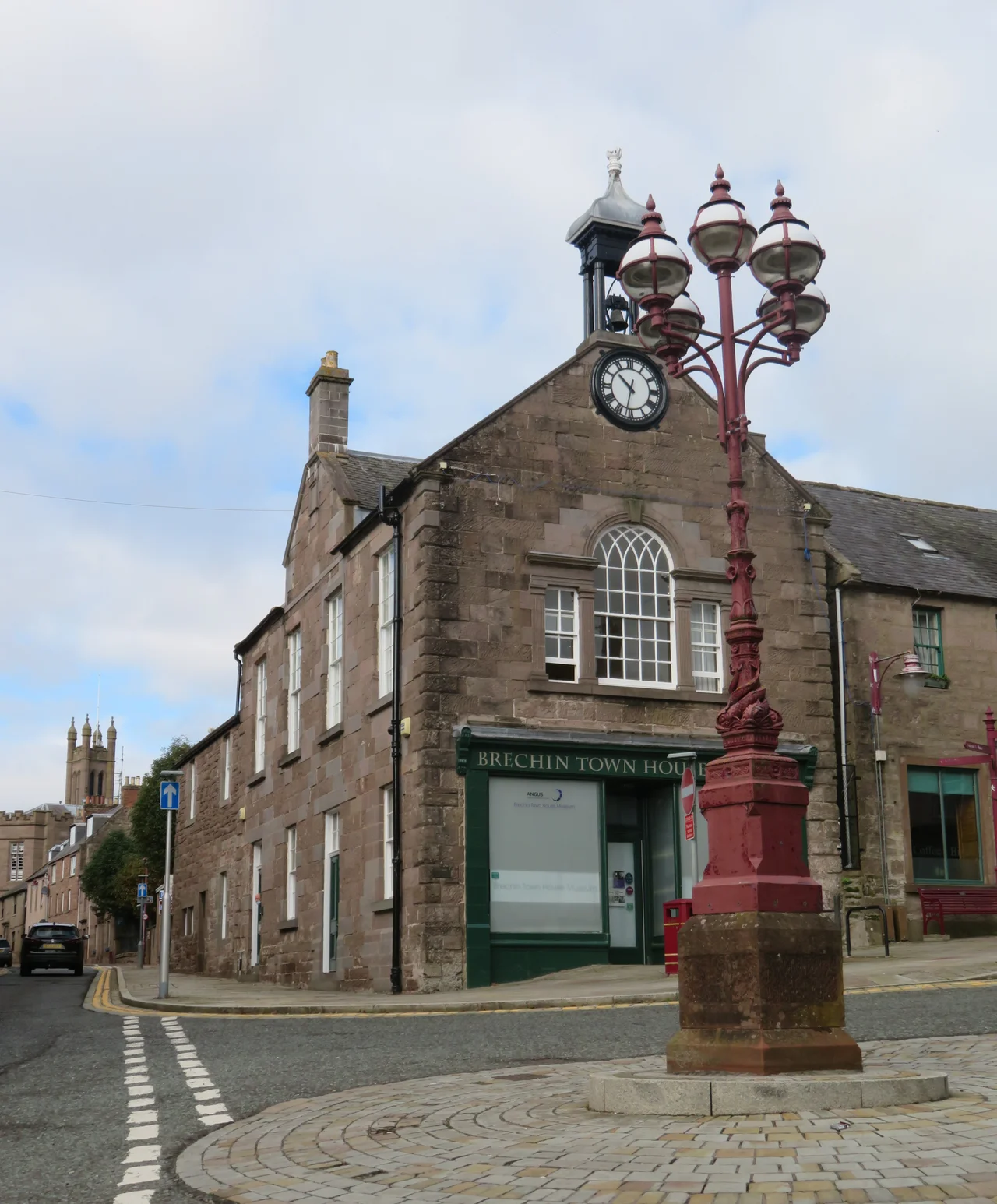
Brechin
A pencil of stone rises above the rooftops of Brechin, narrower than a chimney and impossibly tall, and it looks as though somebody airlifted it in from Ireland by mistake. The tower has stood there since the eleventh century. Across the whole of Scotland, only two of these slender Irish-style round towers survive, and the other is far away at Abernethy in Perthshire. The locals call their town a city because of what stands beside that tower: a cathedral, and the seat of a bishopric that predated the Reformation. The official maps disagree. The football club is Brechin City F.C. The community council is the City of Brechin and District Community Council. The maps can keep their definitions.
The Tower That Came From Somewhere Else
The round tower at Brechin Cathedral was built free-standing, the way Irish monks built theirs, as watchtowers and belfries and refuges from Viking raiders. Somewhere along the way the cathedral grew up around it and absorbed it into its western framework, so what you see now is the cathedral with a strange grey finger jutting from its side. Inside the cathedral, medieval work from the thirteenth and fourteenth centuries survives despite centuries of alteration: a handsome western tower, a processional door worn by feet long forgotten. The eleventh-century round tower remains the oldest thing standing in town, and the strangest. Historic Environment Scotland watches over it now.
The Maison Dieu and the Fire
William de Brechin endowed a Maison Dieu before 1267, a medieval hospital where the poor and sick could find shelter. Part of its chapel still stood seven and a half centuries later, a small fragment of stonework that had outlasted plagues, reformations, civil wars, and the entire sweep of modernity. Then on 5 March 2025, the disused Maison Dieu church caught fire. Crews fought the blaze, homes near the site were evacuated, and the BBC sent reporters. The building survived but bore new scars. A year and a half earlier, Storm Babet had already forced an evacuation of the town centre, in October 2023, when the South Esk burst its banks and turned streets into channels. Brechin keeps absorbing these blows.
The Hedge at Glebe Park
Brechin City Football Club plays its home matches at Glebe Park, and Glebe Park is the only senior football ground in Europe with a hedge running along one of its perimeters. That fact, written down so casually, takes a moment to land. There are thousands of football grounds in Europe. They have walls, fences, advertising hoardings, terraces, stands. Glebe Park has a hedge. It has been there for so long the club incorporates it into the spectator experience. The team, currently playing in the Highland League, is part of a town that also fields Brechin Victoria in junior competition at Victoria Park. The golf club, founded in 1893 at Trinity Muir, once hosted the legendary James Braid in 1926; he liked the course so much he suggested where the bunkers should go in the Limefield section.
The Radar Pioneer Born Here
Robert Watson-Watt was born in Brechin in 1892. By the late 1930s he was the man whose work made radar practical, and whose Chain Home stations along the south coast of England gave the RAF the few minutes of warning that won the Battle of Britain. He was knighted, lionised, and remembered as one of the people who quietly altered the war. Brechin produced other names worth recalling too: James McCosh, the minister who left the town to become president of Princeton University; Thomas Guthrie, the nineteenth-century divine and philanthropist; the composer Robin Orr. There is something about a small town on the road to Aberdeen that keeps sending its sons out into the world to do consequential things.
On the Road North
Brechin sits a little closer to Dundee than to Aberdeen on the A90, the dualled highway that finally got completed in March 1994 when the single-carriageway bypass was upgraded. Stagecoach buses run to Arbroath, Dundee, and Montrose. The nearest national rail station is over at the Dundee-Aberdeen line, but the old Brechin station, closed to passengers in 1952, lives on as the southern terminus of the Caledonian Railway, a heritage line that still steams the four miles to Bridge of Dun. Brechin Castle, seat of the Earls of Dalhousie, sits nearby, and Kinnaird Castle a little further out. From the air, the cathedral and its round tower poke up beside the South Esk, a clear marker on the way north.
From the Air
Brechin lies at 56.73 degrees north, 2.66 degrees west, just east of the A90 between Dundee and Aberdeen on the Angus side of the boundary. From cruising altitude the cathedral and its eleventh-century round tower stand out against the river valley of the South Esk. Nearest major airport is Aberdeen (EGPD) about 35 nautical miles north-northeast, with Dundee (EGPN) roughly 25 nautical miles southwest. Edinburgh (EGPH) lies further south for transit traffic. Visibility is best in clear winter air; the Grampian foothills rise just inland.
Nearby Stories
- Lochnagar 5 km away
- Lindores Abbey 9 km away
- St Andrews Cathedral Priory 13 km away
- Blairgowrie and Rattray 15 km away
- Crathes Castle 17 km away
- River Dee Ferryboat Disaster 21 km away
- Girdle Ness Lighthouse 50 km away
- Eyemouth Disaster 59 km away