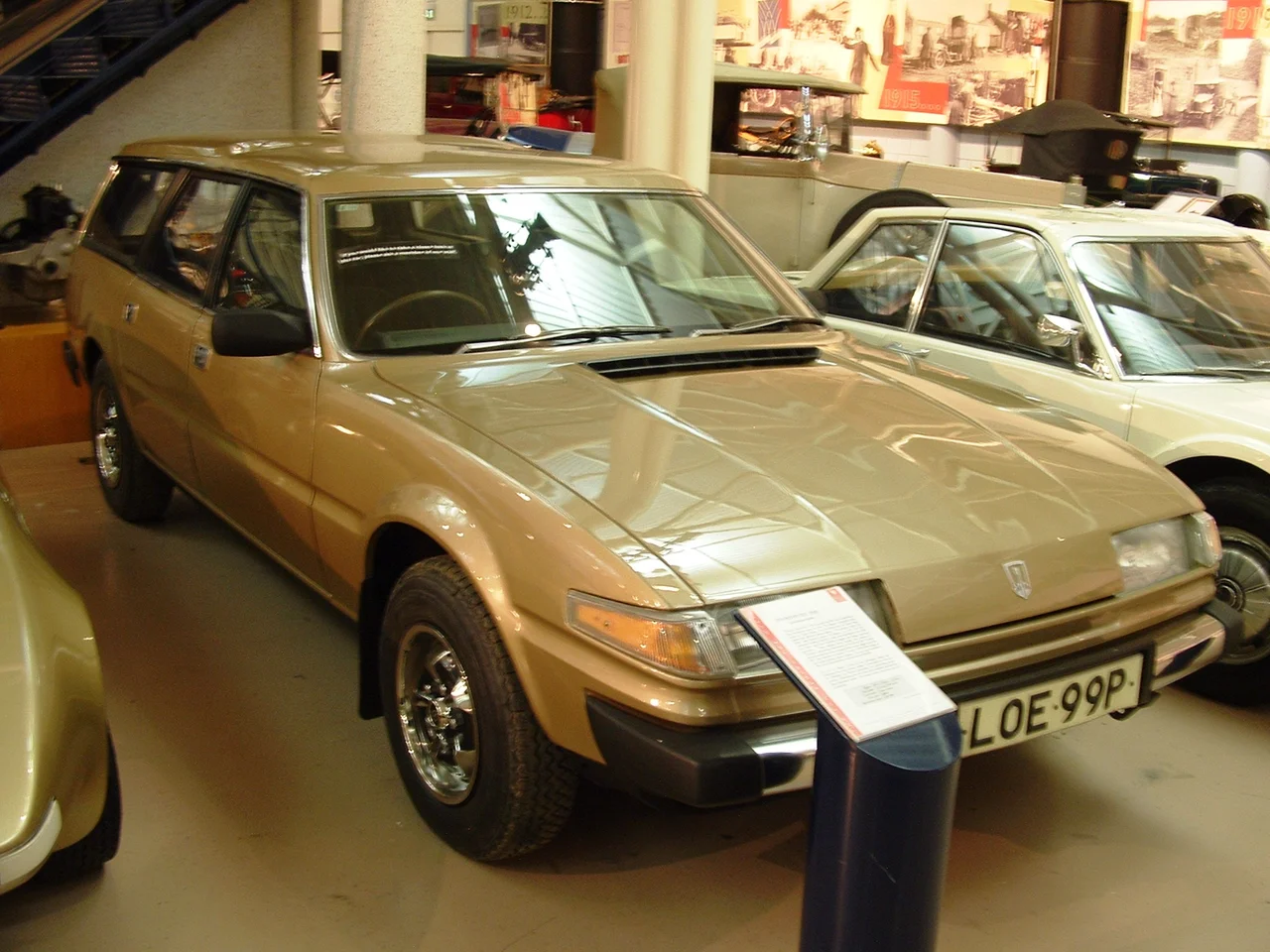

British Motor Museum
In the central hall of the British Motor Museum at Gaydon there is a small green-and-white pickup whose place in the world is not immediately obvious. Look closer: it is the very first Land Rover, built in 1948 - chassis number L01, body number 1, the prototype that became the founding vehicle of the British four-wheel-drive industry. A few aisles away sits the first Mini ever produced, registered 621 AOK. A few aisles further on, the last Aston Martin DB7 to leave the factory. The museum holds the world's largest collection of historic British cars, more than 300 of them on permanent display and another 250 in the reserve collection next door. It would be a strange place anywhere; that it occupies the runways of a former Cold War nuclear-bomber base makes it stranger.
Inheriting British Leyland
When the British government created the British Leyland Motor Corporation in 1968, it pushed together a constellation of marques that had spent decades competing with each other: Austin, Jaguar, Morris, MG, Riley, Rover, Standard-Triumph, Wolseley. Each company had kept its own heritage cars - prototypes, racers, the first off the line of every model. In 1975 BL created a centralised Leyland Historic Vehicles department to manage them all. By the early 1990s the collection had outgrown every available shed, and the trust commissioned a purpose-built museum on the runways at Gaydon. It opened in 1993 as the Heritage Motor Centre and was reborn in 2016, after a £1.1 million refurbishment, as the British Motor Museum. A £4 million two-storey Collection Centre next door now houses the reserve cars - around 250 vehicles available for archive tours.
Three Hundred Cars and Their Particular Stories
What lifts the museum above a long line of shiny metal is that almost every car in the hall has a specific story attached to it. The 1980 Metro displayed at that year's Motor Show. The Mini Coopers that won the Monte Carlo Rally in 1964, 1965 and 1967. The MG land-speed-record cars, including the streamlined EX181 that took Stirling Moss past 245 mph at Bonneville in 1957. The Rover gas-turbine prototypes that ran on jet kerosene in the 1950s and never reached production. The Sinclair C5, the strangely shaped electric tricycle of 1985 that Sir Clive Sinclair believed would change transport. The FAB1 stretched pink Rolls-Royce from the 2004 Thunderbirds film. Several Land Rovers and Range Rovers from the British royal family's working fleets. An SAS Land Rover, sand-coloured, with the bracketry for weapons still in place. The collection rewards looking twice.
The Archive in the Basement
Beneath the public galleries sits something less photographed and arguably more valuable: the British Motor Industry Heritage Trust archive, which holds the original factory ledgers of dozens of British manufacturers. These are bound books in which clerks recorded, by hand, the specification of every car as it came off the production line - colour, engine number, options, original buyer. The trust still answers letters from private owners. Send a Vehicle Identification Number and a small fee, and an archivist will look up your car in the original record and post back a Heritage Certificate confirming what it was when new. For an old Mini or an MG missing its provenance, this single document can mean the difference between a project and a properly registered classic.
The Women Who Made Their Marque
In 2024, for International Women's Day, the museum launched an exhibition called The Women Who Made Their Marque, telling the stories of women whose work shaped Jaguar and the wider British motor industry - the designers, engineers, test drivers, marketing leads and production-line workers who rarely featured in the official histories. The exhibition was developed in part from the archives themselves, by looking at who had actually signed off the drawings and the test reports under names that the marketing of the time then largely ignored. The British motor industry, like most British industries of the 20th century, was both more dependent on women than it admitted and more energetically silent about that fact than was honest.
On the Runways of RAF Gaydon
The museum and the adjacent Jaguar Land Rover engineering centre sit on what was, between 1954 and 1974, RAF Gaydon - the first Royal Air Force station to receive the Vickers Valiant, the leading edge of Britain's V-bomber force and an operational base for British nuclear weapons in the early Cold War. The main runway, built specifically to handle the new V-bombers, was later converted into part of a four-lane vehicle test track, and the long concrete strip still runs through the property. One of the original 1950s control towers still stands. Two of the great Gaydon-type hangars - built to accommodate the wingspan of the Valiants - remain in use, one of them still in its original outline. The British Motor Museum is, in a quiet way, a layered site. Underneath the cars are the bombers.
From the Air
The British Motor Museum lies at 52.189 degrees N, 1.481 degrees W, on the former RAF Gaydon airfield about 1 mile north-west of Gaydon village. Best viewed from 2,500-3,500 feet. The site is unmistakable from the air: two large modern museum buildings and the adjacent Jaguar Land Rover engineering centre cluster around a still-visible mid-1950s runway pattern, the main runway now part of a vehicle test track. Coventry Airport (EGBE) lies 13 nautical miles north-east; Birmingham Airport (EGBB) is 22 nautical miles north-west. The M40 motorway runs about 4 nautical miles to the east.
Nearby Stories
- RAF Defford 3.6 km away
- Great Witcombe Roman Villa 4.1 km away
- Coventry War Memorial 4.5 km away
- Hagley Hall 4.6 km away
- Battle of Naseby 5.4 km away
- Silverstone Circuit 5.9 km away
- Waddesdon Manor 8.8 km away
- Woodstock Palace 15 km away