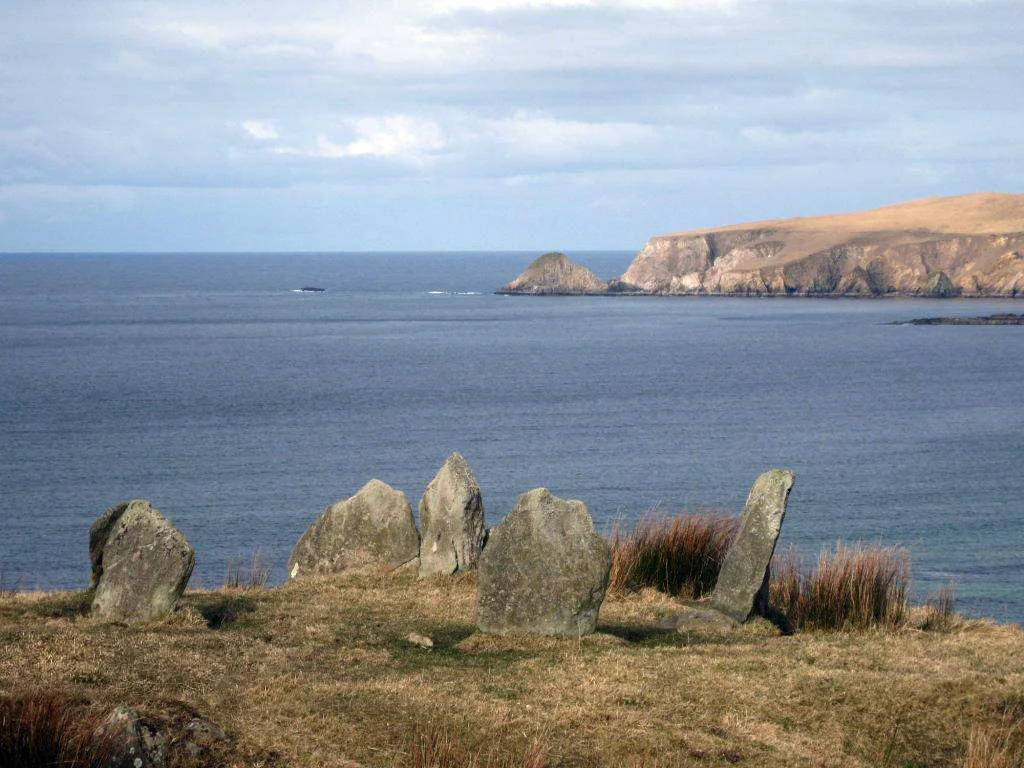

Broadhaven Bay
Broadhaven Bay is the only place in Ireland where you can reliably encounter all five of the marine mammals the European Union considers worth its highest level of legal protection. The bottlenose dolphin, the harbour porpoise, the grey seal, the common seal, the European otter, all five swim, hunt, breed, or rest in the same 8.6-km-wide cup of north-facing Atlantic water. Seventy-two marine species in total have been counted in this bay. None of them voted on the gas pipeline that was buried under the seabed beneath them, and a local fisherman went to prison for five months in 2010 rather than stop fishing while it was laid.
Where the Atlantic Comes In
The opening of Broadhaven Bay faces straight north, 8.6 km of water between Erris Head in the west and Kid Island in the east. Behind it sit the parishes of Kilcommon, Kiltane, and Kilmore Erris, three pieces of the ancient Barony of Erris. The land that wraps around the bay is mostly Atlantic blanket bog, broken here and there by machair, the rare wind-shaped grassland that grows only where sand, sheep, and salt agree to coexist. Sand beaches lie along the eastern and southern shores at Carrowteige, Glengad, and Inver. The population scattered around these inlets is small. The bay does most of the work.
An Armada in the Mud
In 1588, ships of the Spanish Armada, scattered by storms after their failed attempt on England, were driven onto the west coast of Ireland. Several foundered in the waters of North Mayo. One of them, the Santiago, went down in Broadhaven Bay. The wreck became one entry in a long ledger of vessels lost on this coast. The Wikipedia record notes 'many tales of fortunes of gold and valuables being stashed away by local pirates after looting unfortunate ships,' a memory preserved in stories like that of Brian Rua U'Cearbhain, the Erris prophet whose vivid visions of the future supposedly drew on the spoils of foundered ships. Whatever lay buried, the bay has kept most of it. Broadhaven still claims wrecks; the Ballyglass lifeboat at the eastern pier exists because the work of saving lives here is not finished.
The Stags
Look northeast from the bay toward Benwee Head and you will see them: five jagged rocky islands rising out of the Atlantic like the fingertips of something half-drowned. Na Stácaí, the Stags of Broadhaven. The highest, called Teach Dónal Ó'Cléirigh, sits in the centre of the group. An t-Oighean stands 78 metres above sea level. They lie just over a mile from the mainland and yet officially fall outside County Mayo's coastal boundary. Puffins nest here. So do storm petrels and Leach's petrels, both small ocean birds that spend most of their lives at sea and come ashore only to breed. One of the Stags is bisected by a long narrow cave that opens at both ends, a feature divers and kayakers travel to see. Sheep once grazed here for six weeks every summer until the 1960s, when the grazing stopped.
The Pipeline and the Prisoner
Between 2002 and 2014, Broadhaven Bay was the front line of one of Ireland's longest environmental disputes. Royal Dutch Shell, working to bring gas ashore from the Corrib field offshore, sent the Solitaire, then reputed to be the largest pipelaying ship in the world, into the bay. Local opposition was sustained and bitter. The planning appeals board, An Bord Pleanála, overturned Shell's proposals more than once. A third application proposed boring a 4.2-metre tunnel under the entire length of the bay to carry a 0.5-metre pipeline, with the developers acknowledging that the oversized tunnel was sized to carry all future finds along the same route. The fisherman Pat O'Donnell served five months in Castlerea prison in early 2010 for refusing to stop fishing the bay while the work continued. The protected anemones, the brent geese, the otters, the visiting whales, the seventy-two marine species: all of it sat above what was being built below.
From the Air
Broadhaven Bay sits at 54.29°N, 9.89°W on the northwest coast of County Mayo. The 8.6-km-wide opening faces due north; Erris Head marks the western entrance, Kid Island the eastern. Broadhaven Lighthouse on Eagle Island and Ballyglass Lighthouse at the northwestern mouth provide clear visual references. The Stags of Broadhaven (Na Stácaí), five rocky islands rising over 100 m, sit off Benwee Head to the northeast. Belmullet Aerodrome (EIBT) is about 10 km southwest; Ireland West Airport (EIKN) is roughly 75 km east-southeast. The bay generates dramatic light in low sun; the white beaches at Carrowteige and Glengad are striking from altitude in good visibility.
Nearby Stories
- Achill Island 1.4 km away
- Ballycastle, County Mayo 10 km away
- Battle of Castlebar 17 km away
- Action of 7 May 1794 27 km away
- Glencolmcille 55 km away
- RMS Carinthia (1925) 84 km away
- RMS Empress of Britain (1930) 87 km away
- The Laki Eruption: The Volcano That Changed World History 1149 km away