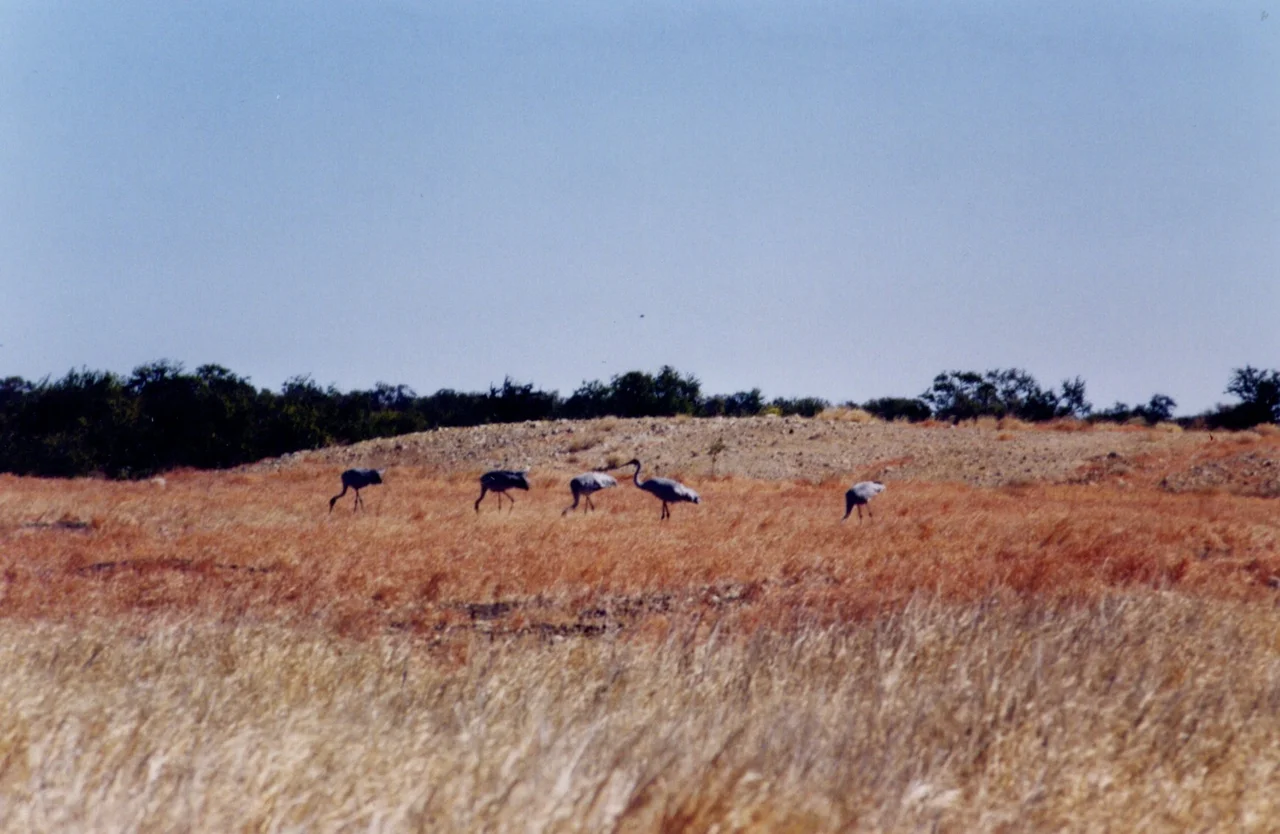

Brunette Downs Station
Twelve thousand square kilometres of golden Mitchell grass roll out under one of the emptiest skies on Earth, and all of it answers to a single homestead. Brunette Downs is bigger than some countries. It is one of the largest pastoral leases in the Northern Territory, a working cattle station of roughly three million acres on the Barkly Tableland, straddling the country between Tennant Creek and the Queensland border. Once a year the silence breaks: light planes and dusty four-wheel-drives converge from a thousand kilometres around, and the great plain hosts a horse race.
A Kingdom Measured in Bores
The numbers at Brunette Downs stop sounding like a farm and start sounding like a small nation. The lease covers 12,212 square kilometres and carries up to 110,000 head of cattle, with an annual turn-off around 35,000. Keeping that herd watered on a plain where the rain is fickle took ingenuity from the start: the station sank its first sub-artesian bore in 1903, and by 2010 some 180 bores were pumping water up from a hundred metres below, feeding more than two hundred ponds and four hundred troughs. By the late 1970s the payroll included a full-time saddle maker, a clinic nurse, a pilot, and a grader driver whose entire job was the 3,600 kilometres of dirt road threading the property. It is country run like an outpost, because that is what it is.
The Cattle Duffer Who Started It
The first mob of cattle to reach Brunette Downs — some 3,000 head — was driven there in 1883 by Harry Readford, the legendary drover and cattle thief whose exploits inspired the fictional bushranger Captain Starlight. Readford came on behalf of Macdonald, Smith and Company, and the following year moved a further 120 head down along the Playford River just as good rains filled the lakes. He stayed on for years as manager before leaving to start his own run at Corella Downs. The station's history runs through floods and droughts in brutal alternation. In January 1895 it took 15.5 inches of rain in a single month; in early 1958, after the rains failed, some 25,000 head perished for want of water. Between 1973 and 1974 a record 1,575 millimetres fell, drowning a third of the property and filling the dry lakes so completely that half a million pelicans came to nest.
Visitors to the Middle of Nowhere
For somewhere so remote, Brunette Downs has drawn a strange procession of notable guests. In 1956, Prince Philip, the Duke of Edinburgh, stopped here on his way to the Melbourne Olympics, spending a morning in 107-degree heat watching stockmen work before flying on to Tennant Creek. Earlier, in 1935, Nazi Germany's consul-general to Australia paused three days en route to Darwin. The owners have read like a roll call of pastoral empire: the White family of Muswellbrook bought it in 1919, the Texan King Ranch company took it over in 1958 and poured in money and Santa Gertrudis bulls, and since 1979 it has belonged to the Australian Agricultural Company, Australia's oldest continuously operating company.
The Day the Plain Fills Up
Every June, the Brunette Downs Races turn the empty tableland into the social capital of the Barkly. Run by the A.B.C. Amateur Race Club, it is the biggest event on the region's calendar, drawing people from across the country to a racetrack in the middle of three million acres of grass. There is amateur horse racing, but the real heart of it is the campdraft, that uniquely Australian contest in which a rider cuts a beast from the mob and works it through a course at a gallop. Add a rodeo, a gymkhana, fashions on the field, and a swag rolled out under more stars than most people ever see, and you have the Outback throwing the only party for hundreds of kilometres in any direction.
From the Air
Brunette Downs lies at 18.64 degrees south, 135.95 degrees east, on the Barkly Tableland in the Northern Territory, about 216 km north-east of Tennant Creek. The Tablelands Highway bisects the property, and the homestead sits on Brunette Creek; the station maintains its own airstrips, as do most Barkly runs. From altitude the land reads as near-featureless golden plain, broken by the dark threads of ephemeral creeks and, after big wet seasons, the shallow sheets of Lakes Corella and Sylvester. Tennant Creek (YTNK) is the nearest sizeable airfield to the south-west; Mount Isa (YBMA) lies to the east in Queensland. Clearest flying is the dry season, May to September.
Nearby Stories
- Tennant Creek 142 km away
- Barkly Tableland 168 km away
- Merlin diamond mine 185 km away
- Wollogorang Station 214 km away
- Boodjamulla National Park 219 km away
- Tree of Knowledge, Camooweal 256 km away
- Daly Waters Airfield 321 km away