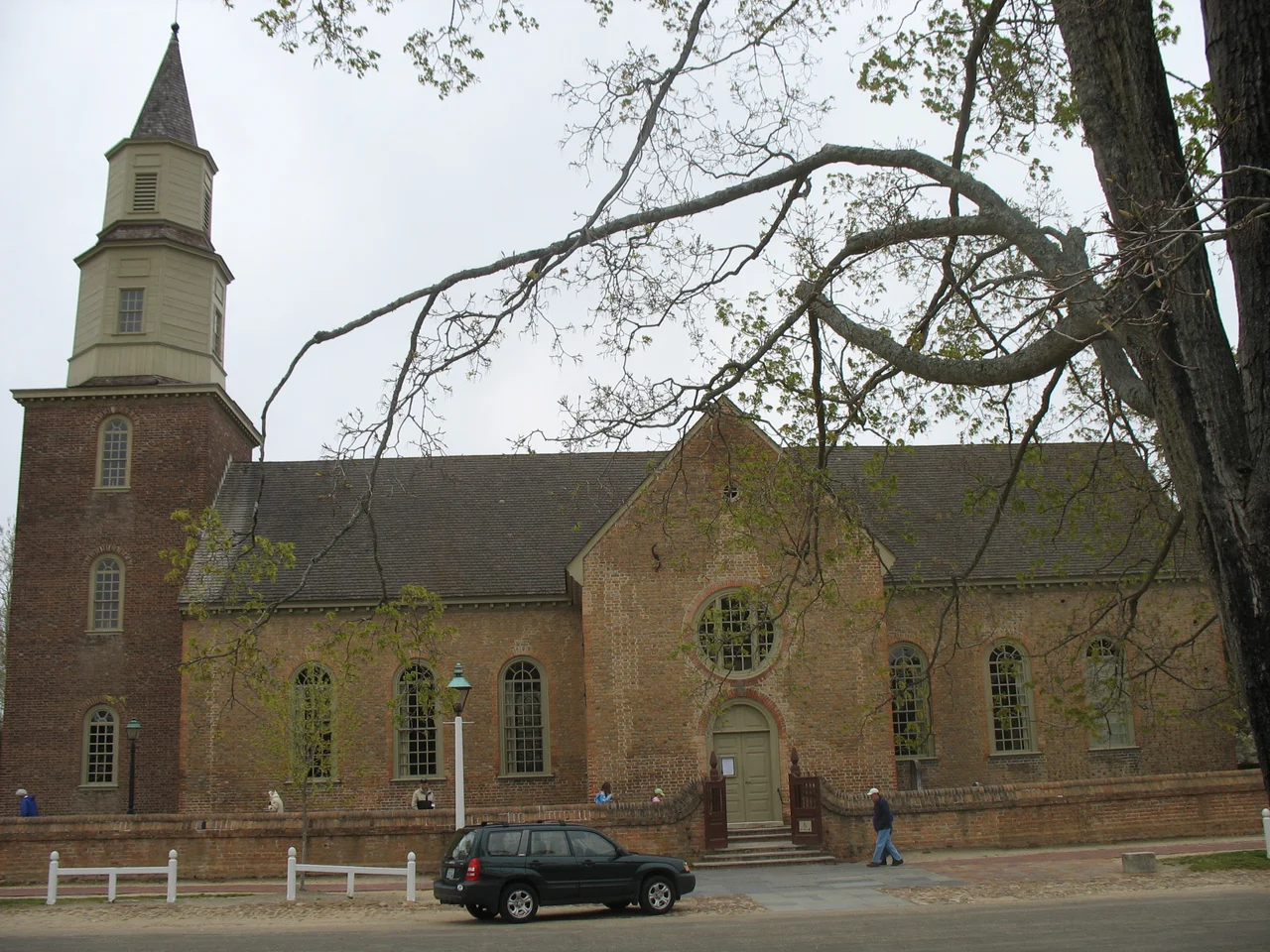

Bruton Parish Church
The bell in the tower of Bruton Parish Church was cast in England in 1761, and the inscription reads: "The Gift of James Tarpley to Bruton Parish, 1761." That bell rang to celebrate the repeal of the Stamp Act in 1766. It rang for the Virginia Declaration of Rights in 1776. It rang for the signing of the Declaration of Independence in Philadelphia later that year. It rang for the Treaty of Paris in 1783 that ended the war. It is still ringing today. Around the corner from the Wren Building, half a block from the Capitol, Bruton Parish sits at the precise hinge of American history, the place where the people who shaped a revolution worshipped together every Sunday for decades.
Middle Plantation Becomes a Capital
The roots of Bruton Parish run back to the first ship landings at Jamestown in 1607. The Reverend Robert Hunt, chaplain to Christopher Newport's three-ship expedition, planted a cross at Cape Henry on April 29 of that year and held the first Anglican services in Virginia. Captain John Smith called him "our honest, religious and courageous divine." Worship in the higher, drier ground inland came later, after the 1644 conflict with the Powhatan Confederacy quieted the frontier. By the 1650s, a settlement called Middle Plantation was growing on the watershed between the James and York rivers. Colonel John Page, a merchant from Middlesex who arrived with his wife Alice Luckin in 1650, built a substantial brick house and pulled the village toward something like a town. The Ludwell brothers built a still larger brick house. In an era of wooden buildings, brick was a flag of permanence.
From Marston Parish to Bruton
Middle Plantation Parish was established in 1633, with a wooden church up by around 1660. In 1658 it merged with Harrop Parish to form Middletown. In 1674 Middletown merged with Marston Parish, in York County, to create the parish that survives today. The vestrymen of that founding moment included Thomas Ballard, Daniel Parke, John Page, James Besouth, Robert Cobbs, James Bray, Philip Chesley, and William Aylett. The name came from a town in the English county of Somerset, ancestral home of Virginia's colonial secretary Thomas Ludwell and the Royal Governor Sir William Berkeley. In 1678 Page donated land and money for a brick church. The construction contract was awarded in June 1681 and the building was finished by November 29, 1683. The first rector, the Reverend Rowland Jones, dedicated it on January 6, 1684, the feast of the Epiphany.
The Town That Found Itself at the Center
In 1693 the College of William & Mary was founded by royal charter, just up the road. In 1698 the State House at Jamestown burned for the third time, and the legislature once more took up temporary quarters at Middle Plantation. On May 1, 1699, James Blair (president of the new college) and five students stood before the House of Burgesses and asked them to move the capital to Middle Plantation permanently. A month later they agreed. The town was renamed Williamsburg in honor of King William III. Bruton Parish Church suddenly found itself between the new college and the new capital, with the governor and his entourage, the legislature, and the students all required to attend Sunday services. The little church could no longer hold the crowd. A new, much larger building was constructed between 1711 and 1715. That is the building that stands today, the structure that was named a National Historic Landmark in 1970.
Founders in the Box Pews
Step inside Bruton Parish today and the box pews carry small name plates from the 18th century: George Washington, Thomas Jefferson, James Madison, John Tyler, Benjamin Harrison, Patrick Henry, George Wythe, Richard Henry Lee, George Mason. They were not symbolic worshippers; they were actual congregants. Public officials in Williamsburg were required by law to attend, and during legislative sessions the church bulged with delegates and their families. The American Revolution was, among many other things, an internal Anglican crisis here, the colony's leading citizens working out their break with a Church of England that was inseparable from the British Crown. After the Revolution, with disestablishment, the parish entered a slow decline. The roof leaked. Plaster fell. The famous restoration came in two waves: completion of the church's own restoration by 1907 for the 300th anniversary of the Episcopal Church in America, and the much larger project that the Reverend W.A.R. Goodwin convinced John D. Rockefeller Jr. to fund starting in 1924, which eventually became Colonial Williamsburg.
Bacon's Vault and Other Mysteries
Bruton Parish has its share of strange episodes. In 1938 Marie Bauer, a follower (and future wife) of the mystic Manly P. Hall, claimed to have decoded a 1635 emblem book by George Wither and located a hidden vault beneath the original 1683 church foundations. She said it contained lost writings by Francis Bacon, proof Bacon wrote Shakespeare, and plans for a utopian society. The parish let her dig. She found the foundations of the old church but no vault, and stopped at nine feet for fear of disturbing graves. Interest revived in 1985 with new radar readings. After three people were arrested digging at night, the Colonial Williamsburg Foundation conducted a proper excavation in 1992 to a depth of twenty feet. They found nothing. A geologist from William & Mary tested the soil and concluded it had lain undisturbed for three million years. Today Bruton Parish remains the most active congregation in the Episcopal Diocese of Southern Virginia, nearly two thousand members, four Sunday services, the candlelight concerts started in the 1750s by organist Peter Pelham still running on Tuesday, Thursday, and Saturday nights.
From the Air
Bruton Parish Church sits at 37.27 N, 76.70 W in the Colonial Williamsburg Historic Area, three blocks west of the Capitol on Duke of Gloucester Street and directly across from the Wren Building of William & Mary. From the air, the entire 301-acre Colonial Williamsburg Historic Area is clearly visible: a tight cluster of red brick buildings, white-fenced gardens, and tree-lined lanes set against the surrounding 20th-century town. The cruciform shape of Bruton Parish is easy to spot. Nearest field is Williamsburg-Jamestown (KJGG) 4 nm west; Newport News/Williamsburg International (KPHF) is 13 nm east; Felker Army Airfield (KFAF) at Fort Eustis lies 12 nm southeast. Best viewed at 1,500-2,500 feet AGL with morning sun lighting the east-facing brickwork.
Nearby Stories
- Battle of Trent's Reach 2.7 km away
- Mathews County, Virginia 7.4 km away
- Lewis Ginter Botanical Garden 11 km away
- Ocean View Amusement Park 16 km away
- USS Texas (1892) 21 km away
- Christopher Newport University 29 km away
- Menokin 44 km away
- Fort Christanna 63 km away