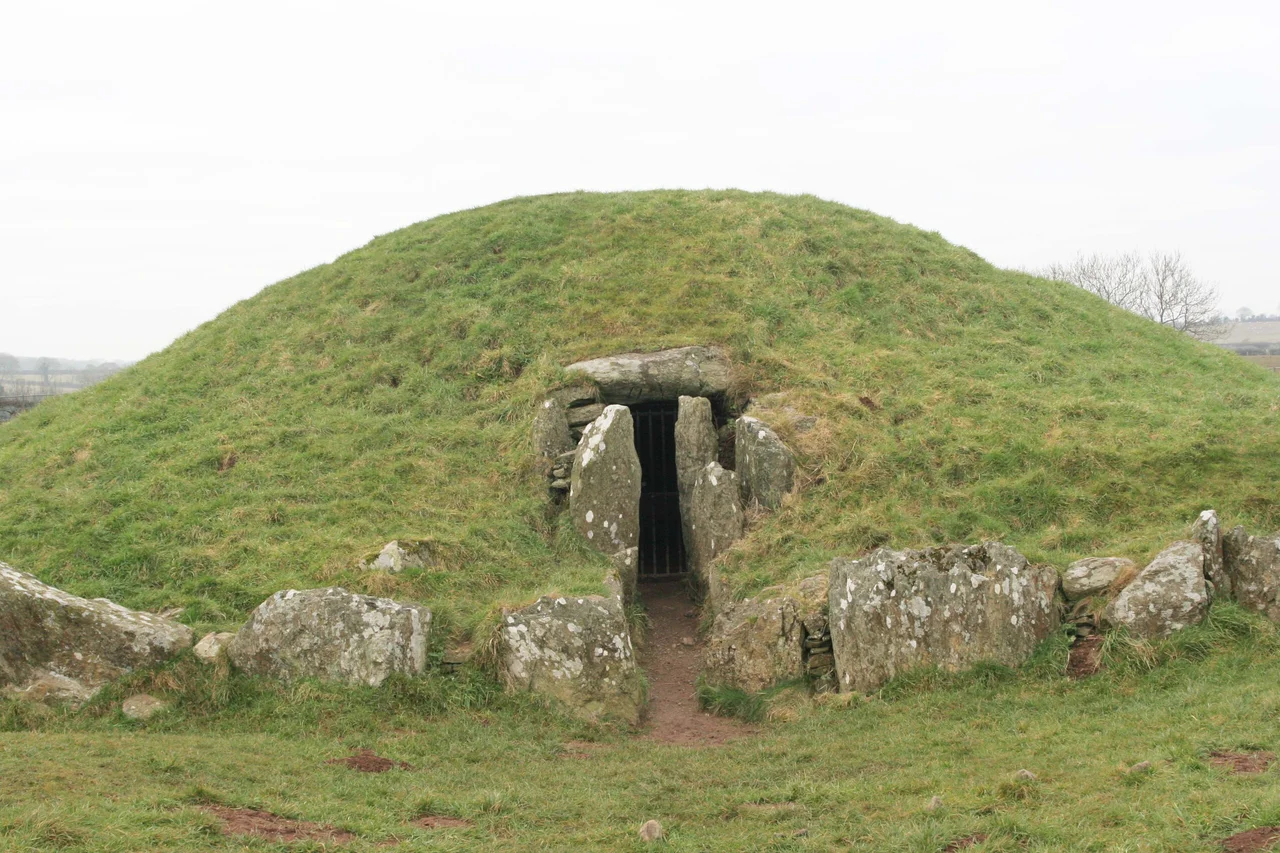

Bryn Celli Ddu
On the morning of the summer solstice, just before sunrise, people walk in the dark across a wet field on the Welsh island of Anglesey and crowd around the entrance to a low stone passage. They wait. The sun rises somewhere over the Berwyn Mountains to the east, and for about fifteen minutes - if the cloud cooperates - a narrow beam of light threads through the passage of Bryn Celli Ddu, crosses the burial chamber, and strikes the quartz-rich stone at the back. The mound was built around 5,000 years ago. Whoever did the engineering knew exactly what they were doing.
The Mound in the Dark Grove
Bryn Celli Ddu means 'the mound in the dark grove', and the name still fits. The site sits in a slight hollow near the village of Llanddaniel Fab, surrounded by farmland that the trees have repeatedly taken back. The mound is small compared to its Irish cousins at Newgrange and Knowth - only about 26 metres across at its present extent - but the passage and the burial chamber inside it are both intact. The passage runs for 8.4 metres, the first 3.4 metres open to the sky between a pair of upright portal stones, and the rest covered by a series of stone lintels. Visitors crouch through it to reach the chamber, which is just tall enough to stand up in. Free-standing inside is a smooth, rounded pillar of blueschist - a metamorphic rock about 1.7 metres high - that has no obvious structural purpose. Nobody knows what it was for.
The Sun and the Stone
The midsummer alignment is the most studied feature of the site. Steve Burrow, formerly curator of Neolithic archaeology at the National Museum of Wales, has argued in detail that the passage is oriented to catch the rising sun on the longest day of the year, and that the light is designed to fall on the quartz-rich back stone. The configuration links Bryn Celli Ddu to a small handful of solar-aligned tombs across Atlantic Europe - Maeshowe on Orkney, Newgrange in the Boyne Valley - though both of those point to the midwinter sunrise, not midsummer. Some archaeologists have also suggested a 'lightbox' feature similar to the one at Newgrange, where a deliberate gap above the main entrance lets in light independently of the door. The case is plausible. The chamber is too small for a stone-age camera obscura to be accidental.
Older Than the Tomb
What you see now is only the most spectacular phase. Underneath the mound, archaeologists found postholes for a row of five timber uprights that radiocarbon-date to around 4000 BC - a thousand years before the passage tomb was built, at the very end of the Mesolithic. The site was a sacred place long before anyone thought to bury the dead there. Later, around 3000 BC, it became a henge: a circular ditch enclosing a stone circle. The kerbstones that ring the present mound trace the line of that earlier henge ditch, and at least three of the stones embedded in the mound itself appear to have been taken from the original circle. The decorated 'Pattern Stone', carved with sinuous serpentine designs on both sides, was found buried beneath the mound and is now in the National Museum of Wales. A replica stands in roughly its original spot beyond the back wall. People kept choosing this exact patch of ground for nearly two thousand years.
The 2019 Surprise
In 2019, fieldwork around the site uncovered a second burial cairn fifty metres south of the main mound, large and circular and previously leveled to the point of invisibility. Radiocarbon dating put it at around 1900 BC - more than a thousand years later than the passage tomb. The discovery rewrote the landscape. What had looked like a single isolated monument was the centrepiece of a much longer ritual complex spanning the Neolithic and into the Bronze Age. Two further cairns have been identified just to the south, and a standing stone and a rock outcrop with cupmarks lie immediately to the west. Wilfrid Hemp excavated the main mound in 1928 and 1929; ninety years later, his successors are still finding things he missed.
Still Sacred
The Anglesey Druid Order uses Bryn Celli Ddu for ceremonies marking the eight festivals of the modern pagan wheel of the year, including both solstices. Cadw keeps it open to the public, free, with no booking required. The chamber smells of damp stone and wet wool. On a quiet weekday afternoon in winter you can sit alone in it and listen to your own breath. On the morning of 21 June a hundred people might be standing around outside in the rain at four in the morning, waiting for the sun. Either experience is the real one.
From the Air
Bryn Celli Ddu lies at 53.21 degrees north, 4.24 degrees west on south-eastern Anglesey, about a mile and a half south of Llanddaniel Fab and three miles west of the Menai Bridge. The small grass-covered mound is hard to spot from the air but the surrounding field pattern is distinctive. Best viewed at 1,500-2,500 feet. Caernarfon Airport (EGCK) lies six nautical miles south-west; RAF Valley (EGOV) is 14 miles west on the other end of Anglesey - watch for fast-jet activity and the Valley MATZ.
Nearby Stories
- Wakestock 1.7 km away
- Trefriw 3.8 km away
- Irish Sea 8.7 km away
- Irish Sea Bridge 20 km away
- East–West Interconnector 30 km away
- Machynlleth 36 km away
- HMS Tyler 41 km away
- New Brighton Lifeboat Station 54 km away