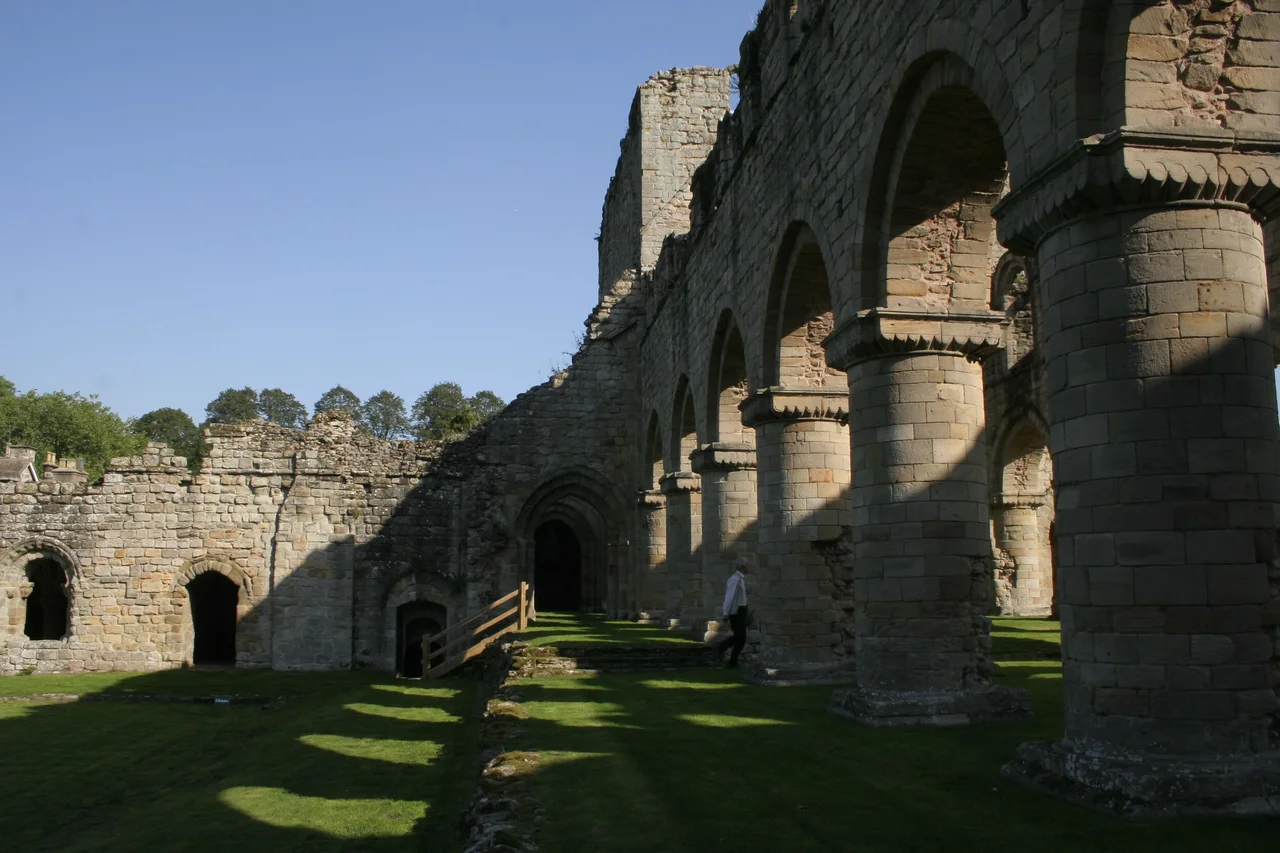

Buildwas Abbey
Roof gone. Most of the cloister gone. The east end stripped of its altar, the great west window without glass for nearly five centuries. Yet the church at Buildwas still stands - walls, arcades, crossing tower, transepts, the lot - more or less as the Cistercian masons left it around 1170. Three centuries of rain and stone-robbing after the Dissolution, and Buildwas refused to fall down. It is now one of the best-preserved twelfth-century Cistercian churches in Britain, in the care of English Heritage, sitting beside the River Severn about two miles upstream of Ironbridge, on a road that runs out of nowhere into nowhere through some of the quietest countryside in Shropshire.
A Savigniac Foundation
The abbey was founded in 1135 by Roger de Clinton, Bishop of Coventry and Lichfield, on land that had belonged to his diocese. He did not found a Cistercian house. He founded a Savigniac one - a small, reformed offshoot of the Benedictine order centred on the Abbey of Savigny in Normandy, which had been founded only in 1112. The first monks were sent from Furness Abbey in Lancashire, then the most senior Savigniac house in England. The whole Savigniac congregation merged into the Cistercian order in 1147, on the order of Pope Eugenius III. Buildwas became Cistercian without anyone moving an inch. Its early endowments were modest, but the bishop's gift included Meole Brace just south of Shrewsbury, and the parish church scot from the hundreds of Condover and Wrockwardine - enough to live on, just.
Abbot Ranulf's Years
Things changed under Abbot Ranulf, who took office by 1155 and ruled until 1187. Ranulf was a builder, an administrator, and a regular traveller on Cistercian business. The abbey acquired land in Shropshire, Staffordshire, Cheshire, Derbyshire, and even Cambridgeshire. It built up a substantial library - books still survive in the collections of Trinity College Cambridge, Balliol Oxford, and St George's Chapel Windsor, fifty-seven volumes in all, fifteen of them definitely from the twelfth century. Two are dated internally to Ranulf's abbacy: a copy of Augustine of Hippo from 1167, and a glossed Book of Leviticus from 1179. Ranulf travelled to Ireland on royal business under Henry II, helped administer the Synod of Cashel in 1172, and acquired two daughter houses for Buildwas - Basingwerk Abbey in Flintshire and St Mary's Abbey in Dublin. He died on the road in 1187, on his way to the Cistercian general chapter in Burgundy.
The Black Death
The fourteenth century brought catastrophe in waves. In 1342 the abbot of Buildwas - his name unknown - was murdered, possibly in Ireland, where he had been investigating a quarrel between the Dublin daughter house and Dunbrody Abbey. A monk called Thomas of Tonge was indicted for the killing but maintained his innocence. The dispute over the succession split the community into rival factions. In 1346 the king himself had to intervene. Then in 1349 the Black Death arrived in Shropshire. The Cistercian population of England roughly halved - from over 1,600 monks before the plague to just over 800 after - and at Buildwas the chapter shrank from a dozen or more monks to perhaps six in 1377 and four in 1381. Lay brothers, whom the order depended on for manual work, became almost extinct as a vocation. The abbey gave up its demesne farming and leased out its estates to survive.
Welsh Raiders
The worst was not over. In 1350, while the plague was still receding, a large raiding party from Powys broke into Buildwas, looted the church and the monastic chests of jewels, vestments, chalices and books, and carried the abbot and his monks away as prisoners to mid-Wales. A royal commission of oyer and terminer was issued in response. Whether the monks were ransomed back, or escaped, or simply released, the records do not say. Half a century later, during Owain Glyndŵr's rebellion against the English crown, the abbey's estates were burned again - extensively enough that in 1406 Henry IV granted Buildwas the rectory of Rushbury church by way of compensation. The abbey survived. But the great period of Cistercian growth was over, and Buildwas spent its last century renting out land and making slow accommodations with the world.
Dissolution and Romantic Ruin
A Cistercian visitation in 1521 found the abbey "very far from virtue in every way" - a judgement standard enough that historians read it as the formula of impending dissolution rather than as actual scandal. The abbot Richard Emery was deposed. In 1536 Buildwas was suppressed in the first wave of Cromwell's dissolutions, its net income at £110 19s 3½d, comfortably below the £200 threshold for the larger monasteries. The buildings passed into private hands, were converted into a country house, and by the eighteenth century were a picturesque ruin much painted by J. M. W. Turner, Paul Sandby, and Michael Angelo Rooker - one of Turner's drawings shows the church being used as an agricultural store. In 1925 the site was placed in state guardianship. Today the abbey is in the care of English Heritage. The fact that the church stands at all - simple, blunt, transitional Romanesque, with its short cylindrical piers and round-headed arches still intact - is one of the small wonders of British medieval archaeology. Some buildings just refuse to die.
From the Air
Buildwas Abbey lies at 52.638°N, 2.522°W on the south bank of the River Severn, about 3 km west of Ironbridge and 2 km southeast of the village of Buildwas. The abbey is set back about 300 m from the river on level ground, with the wooded ridge of Wenlock Edge rising to the south. The ruined church and abbey complex are visible from low altitudes as a roofless cruciform structure with a surviving crossing tower. Nearest airfields are RAF Cosford (EGOC) 11 km east, Wolverhampton Halfpenny Green (EGBO) 17 km southeast, and RAF Shawbury (EGOS) 22 km north. The Wrekin (407 m) is 7 km northeast as the most prominent landmark.
Nearby Stories
- Ludlow 5.7 km away
- Llangollen 6.7 km away
- Murder of Shawn Seesahai 8 km away
- Avoncroft Museum of Historic Buildings 8.1 km away
- Caverswall Castle 8.4 km away
- Combermere Abbey 9.4 km away
- Battle of Maes Moydog 11 km away
- Cwmhir Abbey 16 km away