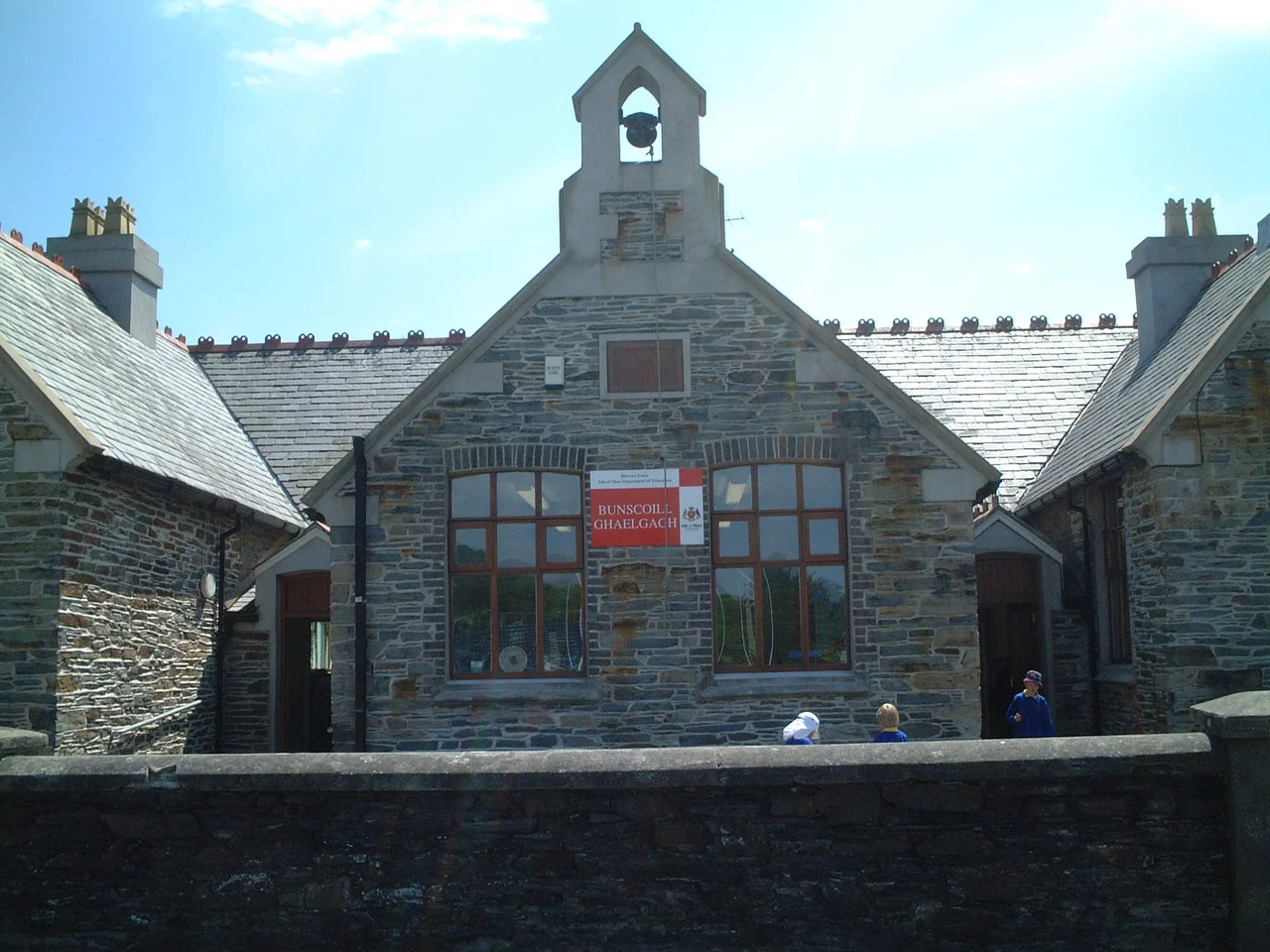

Bunscoill Ghaelgagh
In 2009, UNESCO published a list of languages it considered extinct. Manx Gaelic - the Celtic tongue spoken on the Isle of Man for more than a thousand years - was on it. The children of Bunscoill Ghaelgagh, a small primary school in the village of St John's, wrote letters to UNESCO. The letters were in Manx. The question they asked was disarmingly simple: if our language is extinct, what language are we writing in? UNESCO reclassified Manx as critically endangered. The children had won the argument by demonstrating it. Bunscoill Ghaelgagh - the name simply means 'Gaelic Primary School' - had been founded only eight years earlier, in September 2001, and it had already produced enough fluent Manx speakers to write to the United Nations in their own language. The Manx revival is one of the great quiet victories of modern language preservation, and this school sits at its centre.
A Parents' Society
Sheshaght ny Paarantyn - the parents' society - formed in 1999. Their goal was specific and at the time felt impossible: a primary school where all teaching happened in Manx. Manx had been functionally extinct as a community language since 1974, when Ned Maddrell, the last native speaker raised in a Manx-speaking household, died on the island. A small number of enthusiasts had kept the language alive in adult learning circles, but no Manx child was growing up with it as a first or co-first language. The parents approached the Isle of Man's Department of Education with their request, and in September 2001 the school opened with one class, sharing premises at Ballacottier School in Douglas. There were nine children. In January 2003, the school moved to its own building - the old St John's School - and the enrolment began to climb. By 2006 there were 47 children. By 2012 there were 69. By the school's own count, 170 children have learned fluent Manx through its programme.
What Happens in the Classroom
Everything - maths, science, history, art, lunch, recess - happens in Manx. Children arrive in Reception with the language they have at home, usually English, and within months they are operating in Manx for the full school day. The school refers to Finnish research by Aini-Kristiina Jäppinen, who studied 334 pupils in 12 schools on content-and-language-integrated programmes and compared them to 334 matched peers studying only in Finnish. Her conclusion was that conceptualising and grasping issues in a foreign language as well as a mother tongue helps develop an ability to understand complex and multifaceted relationships between various themes. That research turns out to apply equally to Manx. The pupils graduate able to read books like Ealish ayns Cheer ny Yindyssyn - Lewis Carroll's Alice in Wonderland, translated into Manx and presented in 30 copies by the Manx Gaelic Society at the book's official launch. From Bunscoill Ghaelgagh, pupils can go on to Queen Elizabeth II High School in Peel, where they can sit a GCSE-equivalent qualification - the Teisht Chadjin Ghaelgagh - in the language, and continue up to two subjects in Manx to maintain fluency.
An Award and a Visit
In January 2006, the school won the Reih Bleeaney Vanannan award - 'Manannan's Choice of the Year,' an annual prize given since 1987 to honour outstanding contributions to Manx culture. It was presented by James 'Tony' Brown, then Speaker of the House of Keys. The prize put the school on the cultural map; the UNESCO letters, three years later, put it on the international one. Alex Salmond, then First Minister of Scotland, visited in 2013. The visit is the kind of detail that bookmarks how far the school had travelled in a dozen years - from a single class sharing space at Ballacottier, to a Scottish First Minister stopping by to see what minority-language education looked like when it worked.
A Language Coming Back
Manx died slowly. It died in households where parents made the choice to speak English to their children so the children would do better in an English-language world - a calculation parents make in minority-language communities everywhere. By the 1970s, the last home where Manx had been the first language was gone. But the language had not entirely vanished from books, from recordings, from the memories of people who had grown up around it. The revival rebuilt from those sources, and from the political will of an island that decided, in the end, that this particular thing about itself was worth keeping. Bunscoill Ghaelgagh is what that decision looks like in classroom form - a small school in a Manx village, where children learn fractions and rivers and the names of birds in a language UNESCO once declared dead.
From the Air
Bunscoill Ghaelgagh sits in St John's at approximately 54.203 deg N, 4.641 deg W, in the centre of the Isle of Man. The village is set inland between the western coast and the central uplands. Ronaldsway (EGNS) is the nearest airport, roughly 12 nm south-east. Visual landmarks include the conical mound of Tynwald Hill at the centre of the village - the ancient open-air parliament site where Manx laws have been proclaimed for over a thousand years - and the bulk of Snaefell rising to the north-east. St John's is also home to Culture Vannin, which sits next door to the school.
Nearby Stories
- Ballywalter 14 km away
- Pasages (steam trawler) 15 km away
- SS Georgetown Victory 19 km away
- Celtic Array 31 km away
- Raeberry Castle 34 km away
- German submarine U-1051 36 km away
- St Bees Lifeboat Station 49 km away
- PS Rothsay Castle 73 km away