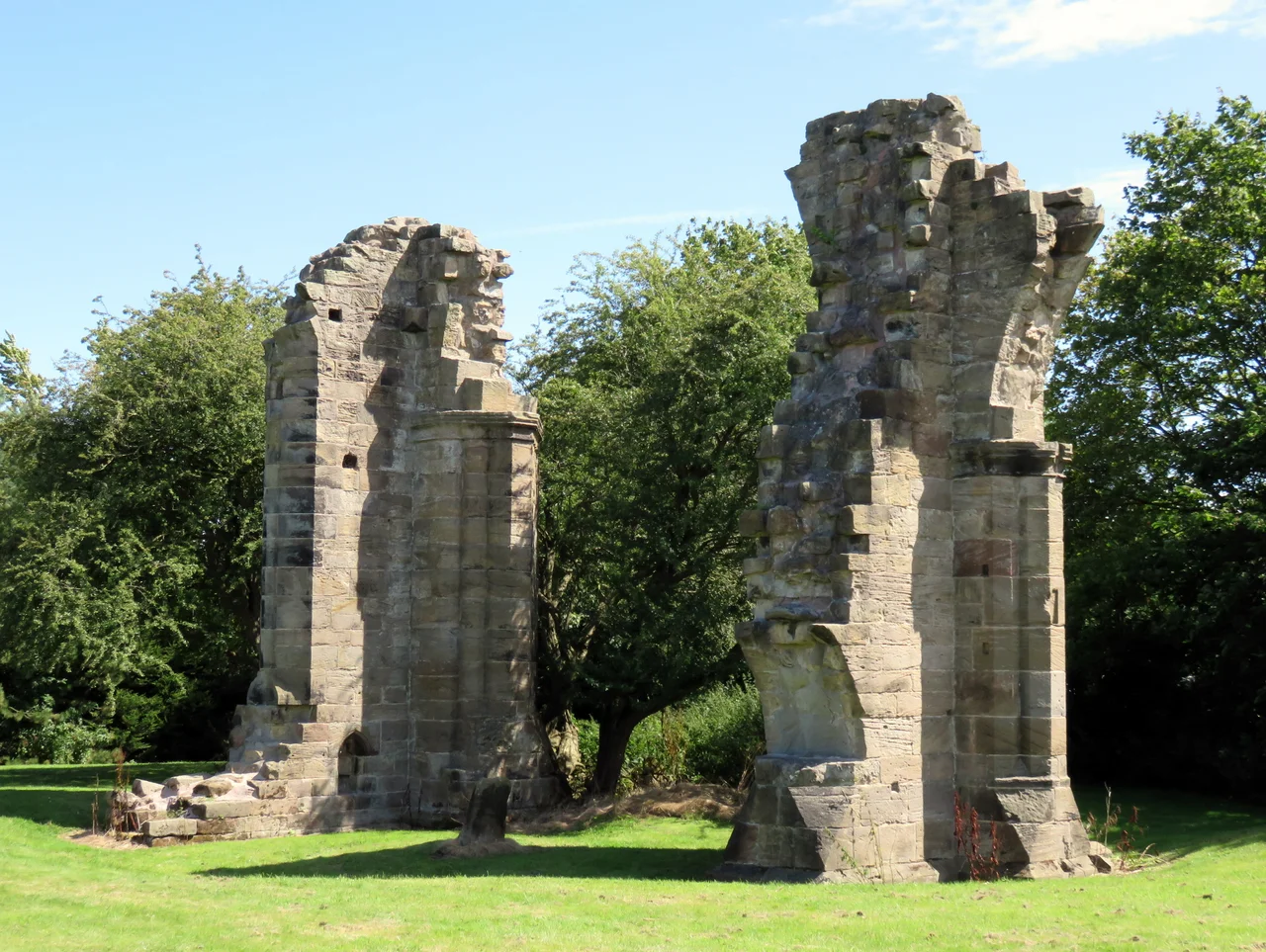

Burscough Priory
Two piers. That is all that stands above ground. They rise out of a quiet field at Burscough in Lancashire, the surviving stubs of the crossing tower of an Augustinian priory church that once contained eight bells, a cruciform plan a hundred feet long, and the tombs of one of the most powerful noble families in late-medieval England. The piers support nothing now except the sky. They are the last vertical evidence that a place worth burying earls in once stood here.
Founded by a Lord, Endowed Generously
Robert Fitz-Henry, Lord of Lathom, founded the priory around 1190 for a community of Augustinian canons. He gave it land in Burscough, the entire neighbouring township of Marton, the chapel of St Leonard of Knowsley, all the mills on his demesne, and the patronage of three parish churches, at Ormskirk, Huyton and Flixton. The dedication was to St Nicholas. An associated leper hospital cared for the sick whom medieval society otherwise shunned, an act of practical Christian charity that was, for the era, both ordinary and remarkable. Fitz-Henry's gifts made the priory secure for several centuries, although the patronage of Flixton proved difficult and eventually slipped from the priory's grasp.
The Stanleys, Buried Here
In 1390 the lordship of Lathom and its associated lands passed by marriage to the Stanley family. The Stanleys would, in the next century, become one of the most consequential noble houses in England. Several were buried in Burscough Priory. Thomas Stanley, 1st Baron Stanley, KG, of Lathom and Knowsley, was laid here in February 1459; his wife Joan followed in 1466; their son Thomas Stanley, 1st Earl of Derby, the man whose late intervention at the Battle of Bosworth helped put Henry Tudor on the throne in 1485, was buried here too. Earlier Stanleys lie here as well: Sir John Stanley who died in 1414, John I Stanley of the Isle of Man, and Joan Goushill Stanley, daughter of Elizabeth Fitzalan, Duchess of Norfolk. For a small Lancashire priory, the burial register reads like a family tree of Plantagenet politics.
Eight Bells and a Tudor Visit
When Henry VIII dissolved the priory around 1536, eight bells from its church were carried to Ormskirk Parish Church. The Ormskirk steeple could not bear the weight, so a tower had to be built specifically to house them. The remaining bells went to Croston church. The tenor bell at Ormskirk, the third bell from Burscough Priory, carries a Latin inscription that translates as 'J.S. de Burscough, Esq., and E. my wife, made [this bell] in honour of the Trinity. R.B. 1497.' The bell also bears the symbols of the rose, portcullis and fleur-de-lis. Those are some of Henry VII's favourite badges. The bell was very likely cast in honour of a royal visit by the first Tudor king, and it is now still ringing, four and a half centuries after the priory that owned it was demolished.
What an 1886 Survey Recorded
We know what the church looked like only because someone made a careful survey of the ruins in 1886. The plan was cruciform: a chancel 42 by 24 feet, a central tower 22 feet square, north and south transepts, and a nave 100 feet by 24 feet with a north aisle. On the south side of the nave stood a cloister 67 feet square. The seal used on the priory's surrender deed shows a small view of the monastic buildings. Of all that, only the two crossing piers remain visible. Fragmentary walls run from the eastern pier; the western pier holds a small trefoil-headed recess called an aumbry. The Earl of Derby tried, around the time of dissolution, to save the church where his family had been buried. He failed. The ruins are now a scheduled monument and a Grade I listed building, and Burscough Priory Academy, the local secondary school of around 700 pupils aged 11 to 16, carries the priory's name forward into the present.
From the Air
Burscough Priory lies at 53.583N, 2.85627W in Burscough, West Lancashire, England, north-east of Ormskirk. From the air the ruins read as a small enclosed grassy site with the two upstanding stone piers visible at low altitude, set in the flat agricultural landscape of West Lancashire. Best viewed at 1,000-2,500 ft. Nearest airports: Liverpool John Lennon (EGGP) and Manchester (EGCC). The bells from the priory still hang in nearby Ormskirk Parish Church, a useful landmark to the south-west.
Nearby Stories
- Blackpool Pleasure Beach 4.4 km away
- Whalley Abbey 4.8 km away
- Worsley 5.4 km away
- Second Battle of Middlewich 7.7 km away
- Chester Zoo 7.9 km away
- Llanrwst 23 km away
- Abergele Rail Disaster 27 km away
- Sea Lion Rocks railway station 73 km away