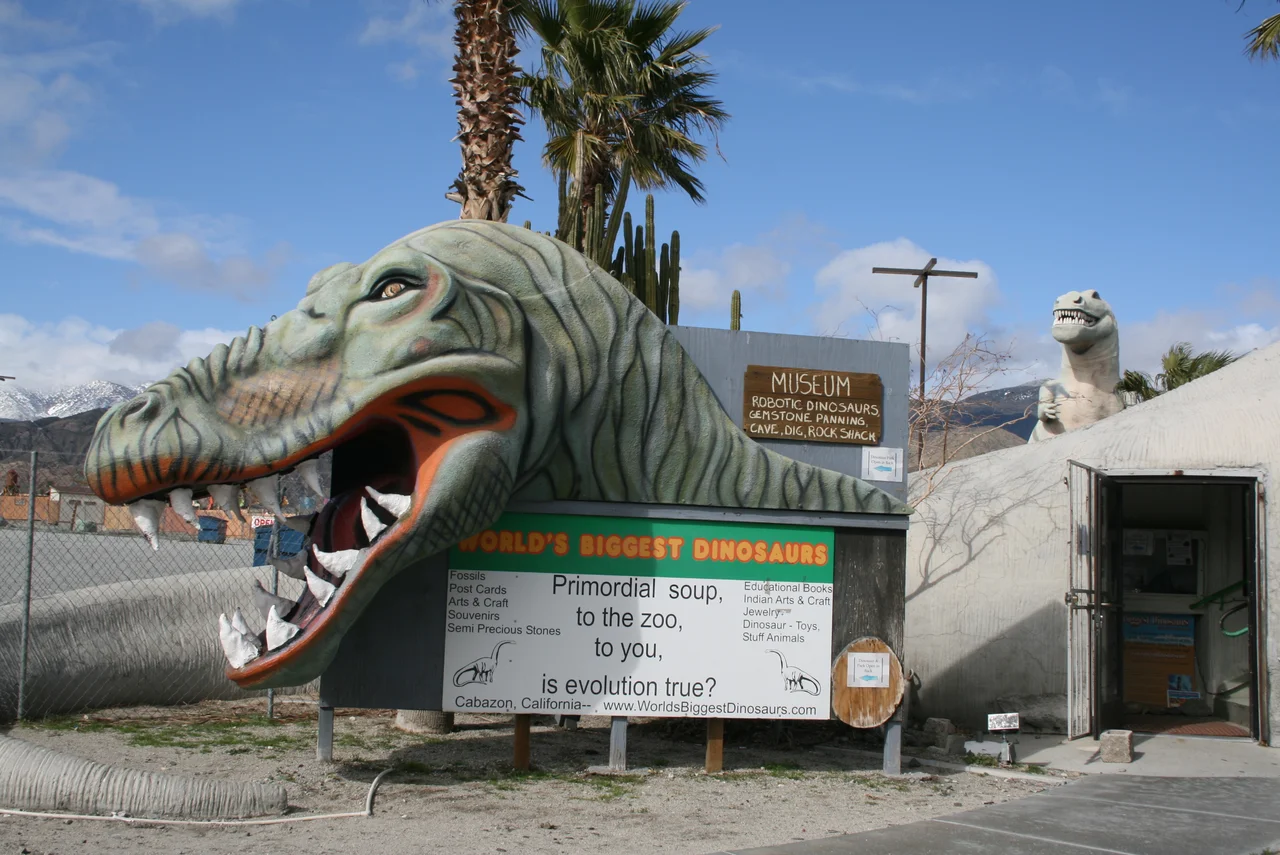

Cabazon Dinosaurs
Claude Bell ran a diner. The Wheel Inn sat just off the new Interstate 10 in Cabazon, halfway between Los Angeles and Palm Springs, and in the early 1960s Bell watched in slow horror as drivers blew past his exit at seventy miles an hour. He needed something they could not ignore. A billboard would not do. So in 1964, at the age of sixty-eight, he started building a 150-foot-long Brontosaurus in his parking lot. He would work on it on weekends, by himself, mostly with welded steel and shotcrete, for the next eleven years. By the time Dinny was finished in 1975, traffic was stopping at Cabazon whether Bell needed it to or not.
One Man, Eleven Years, One Brontosaurus
Bell was a sculptor by training. He had spent years carving the giant figures at Knott's Berry Farm and had a reasonable idea of what it took to build at heroic scale. Even so, Dinny was extraordinary. The body is a welded steel skeleton wrapped in expanded metal lath and finished in shotcrete - the same technique used for swimming pools, sprayed on by hand and shaped while wet. The finished dinosaur stretches 150 feet from nose to tail and stands 45 feet tall at the head. It has a gift shop inside its belly. Bell paid for the project by selling concrete burros to neighbors and tucking earnings from the diner into the construction fund. He never took out a loan for it. Friends would drop by on Saturday afternoons to find him welding ribs to a spine fifty feet up in the air, working alone.
Then He Built Another One
Dinny was not enough. In 1981, Bell started on Mr. Rex - a 65-foot-tall Tyrannosaurus rex he intended to install a slide in, exiting through the mouth. He was eighty-five years old. Construction stretched until 1986, and the slide never quite happened, but the second dinosaur did. Mr. Rex stands a short walk from Dinny, head tilted back, jaws open. Bell died two years after finishing him, in 1988. The two dinosaurs together remain almost certainly the largest sculptures ever completed by a single artist working alone in his own backyard. They are also, in a peculiar way, an act of advertising that outlasted the thing it was meant to advertise: the Wheel Inn diner closed in 2013. The dinosaurs did not.
The Pee-wee Effect
Most Americans of a certain age know the dinosaurs from a single scene. In 1985's Pee-wee's Big Adventure, Pee-wee Herman and waitress Simone watch the sunrise together from inside Mr. Rex's open jaws - the scene was recreated on a Warner Brothers soundstage, but the exterior shots show both dinosaurs clearly. The sequence is brief and shows almost the whole site, diner and all. The Cabazon Dinosaurs were already locally famous when the film came out, but Pee-wee turned them into a national one - the kind of place a generation of kids insisted their parents pull off the highway to see, and then, twenty years later, pulled off the highway themselves to show their own kids. The dinosaurs have also appeared in The Wizard, several music videos, and uncountable car-commercial drive-bys. Their pose on the desert horizon has become a kind of visual shorthand for the American road trip.
Changing Hands, Changing Stories
Bell's family sold the property in the mid-1990s to new owners, who in 2005 reopened the gift shop inside Dinny with a creationist museum theme - young-Earth exhibits, signage suggesting the dinosaurs had walked with humans, and so on. The reinvention drew a strange mix of curious visitors and pointed criticism, and after about a decade the displays were quietly removed. Since 2017 the site has operated as a more straightforward roadside attraction again, with a paid walking area featuring smaller dinosaur sculptures behind Dinny and Mr. Rex. The two original giants are still free to look at from the parking lot, which is the way Bell always intended. He built them to be seen from the freeway, after all. Pulling in was always optional.
A Monument to Stubbornness
What is striking about Cabazon, once you stand under Dinny, is how little of him is funny up close. The proportions are right. The skin texture is patient, careful work. The teeth are individually shaped. Bell could have done this faster and cheaper. He chose not to. A sculptor near retirement age decided his last serious works would be two of the largest dinosaurs in the world, built by hand, on a corner lot in the desert, mostly for the benefit of strangers who were driving past on their way to somewhere else. The Wheel Inn is gone. Bell is gone. The interstate is busier than ever. The Brontosaurus is still there, looking exactly the way one man, working alone on Saturdays for eleven years, decided it should look.
From the Air
Coordinates 33.9203 N, 116.7728 W. The dinosaurs stand immediately south of Interstate 10 in Cabazon, on the desert floor between the San Bernardino Mountains to the north and the San Jacinto Mountains to the south. From the air the two figures are clearly visible against the pale alluvial fan - Dinny's long horizontal silhouette and Mr. Rex's vertical bulk make them easy to spot from 3,000 feet AGL. The site sits within the San Gorgonio Pass wind corridor; expect strong westerlies, often 20-35 knots, especially in the afternoon. Nearest airports: Banning Municipal (KBNG) about 5 miles east, Palm Springs International (KPSP) roughly 20 miles southeast, and Bermuda Dunes (KUDD) 30 miles southeast. KPSP is the standard arrival for travelers visiting the attraction by air.
Nearby Stories
- 1959 Ryder Cup 5.1 km away
- Little San Bernardino Mountains 6.4 km away
- Cranston Fire 9.4 km away
- Bell Canyon 11 km away
- Tell Them Willie Boy Is Here 33 km away
- Silverado Fire 42 km away
- Bagdad-Chase Mine 42 km away
- Aerospace Walk of Honor 81 km away