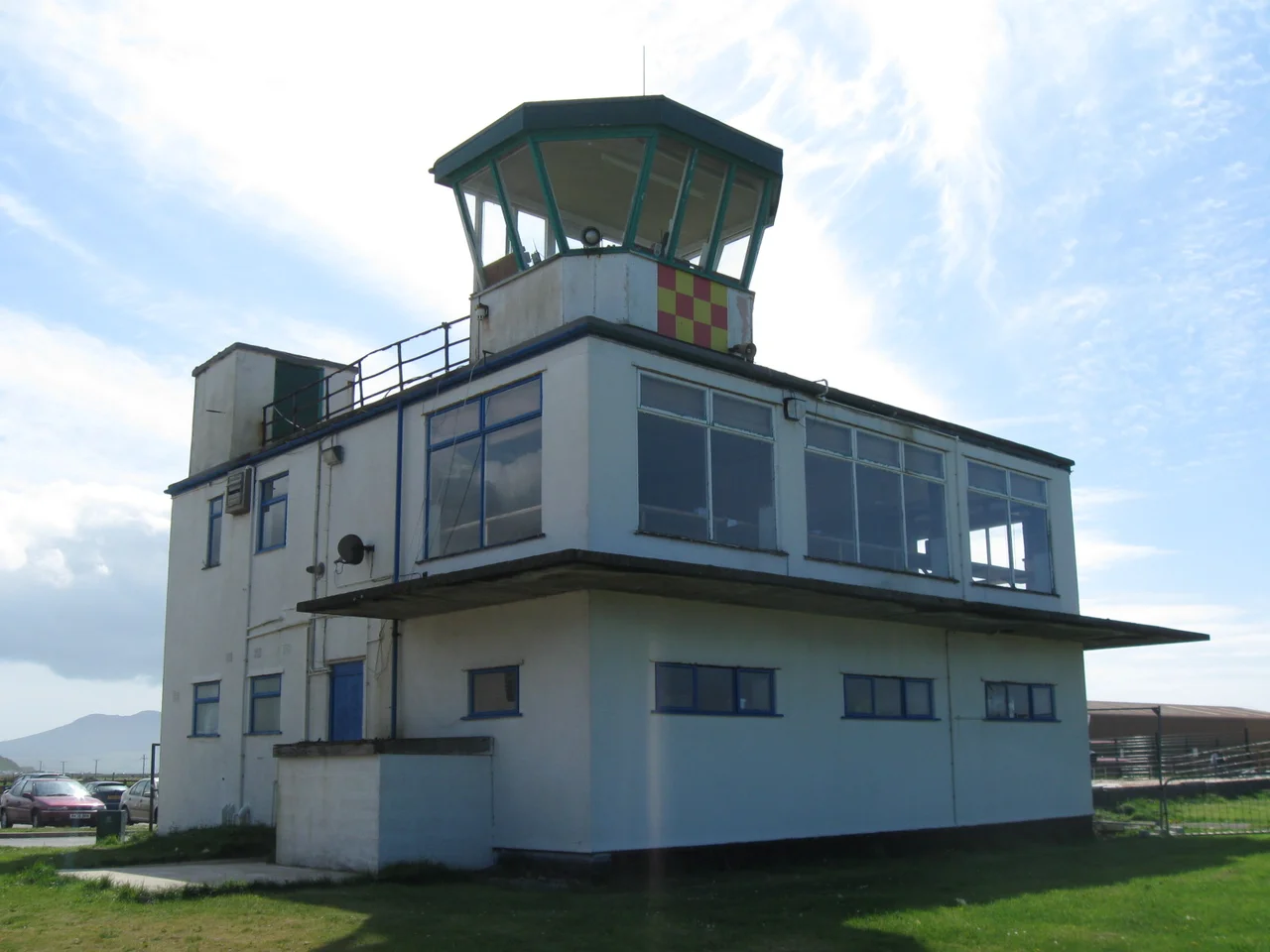

Caernarfon Airport
If you fly low over the western shore of the Lleyn Peninsula on a clear morning, you can pick out three pale concrete strips meeting in a rough triangle - the unmistakable signature of a Second World War RAF training airfield. The triangle layout dates from 1941, when the Air Ministry built Llandwrog as a base for No. 9 Air Gunners School and No. 9 Air Observers School. Eighty-five years later, the same runways serve as Caernarfon Airport: ICAO code EGCK, one licensed runway, and helicopters that lift off most days on missions that the people who built the place would never have imagined.
The Coastguard Comes North
Since 1 July 2015, Caernarfon Airport has been a base for His Majesty's Coastguard search and rescue. Bristow Helicopters won the ten-year contract from the Department for Transport in 2013, replacing the long-running RAF operation, and they operate two Sikorsky S-92 helicopters from the airfield - large twin-engined machines painted bright red and white, configured for over-water hoist rescues. From this corner of north-west Wales they cover the Irish Sea, Cardigan Bay, Snowdonia, and most of the rocky coastline between Holyhead and Aberystwyth. The Coastguard pilots who used to fly out of RAF Valley a few miles north now share the wider job from a civilian apron with a cafe and a small museum.
Wales Air Ambulance
Caernarfon is also one of the home bases for the Wales Air Ambulance, the charity-funded Helicopter Emergency Medical Service that covers the whole country. The aircraft is an Airbus H145 - a twin-engined light utility helicopter, leased and operated on the charity's behalf by Babcock Mission Critical Services Onshore. The aircraft can be airborne within minutes and reach almost any incident in Snowdonia faster than a road ambulance could climb the same mountain. The crews live with their helicopter, do their own pre-flight checks, and respond to call-outs that range from climbing falls on Crib Goch to motorway crashes on the A55. The H145 is loud and unmistakable in the air; if you hear it overhead in Snowdonia, somebody is having the worst day of their life.
Sharing the Field
Around the rescue helicopters, the rest of Caernarfon Airport gets on with general aviation. The single licensed runway is 07/25; there is an unlicensed second runway 02/20, and a third 14/32 that has been disused for decades, the original wartime triangle now reduced to one and a half useful sides. The North Wales Flight Academy runs Private Pilot Licence training, the Microlight School handles the buzzing microlights that are a notable share of local traffic, and Geo Helicopters teaches rotorcraft on the apron. Pleasure flights and charters operate from the same buildings. There is no night licence; everyone goes home at dusk. The Caernarfon Airworld Aviation Museum on site has a helicopter simulator and a collection of period aircraft, including the only intact Hawker Sea Hawk in private hands.
From Llandwrog to EGCK
The airfield opened in July 1941 with three runways, each fifty yards wide, two T1 hangars, a Bellman hangar, and six blister hangars strung along the northern perimeter track. No. 9 Air Gunners School operated Armstrong Whitworth Whitleys for turret training, Westland Lysanders for target towing, Fairey Battles, and twin-engined Avro Ansons. The school disbanded in June 1942 after just eleven months; No. 9 Air Observers School - later redesignated as No. 9 (Observer) Advanced Flying Unit - took over and ran night-flying training out of the field until June 1945. The wartime fatality rate at training fields was high. The airfield closed for flying in 1945, drifted through the 1950s and 60s as civil aviation slowly returned, and gained a full operating licence in 1976. The story since then has been a steady drift from training to transport to rescue - the same triangle of concrete carrying very different missions through eighty-five years of British aviation.
From the Air
Caernarfon Airport, ICAO EGCK, lies at 53.10 degrees north, 4.34 degrees west on the coast of the Lleyn Peninsula, four nautical miles south-west of Caernarfon. Single licensed runway 07/25. Daylight only - no night licence. Watch for active search-and-rescue helicopter and Wales Air Ambulance H145 traffic, both of which can launch with little notice. RAF Valley (EGOV) is 13 miles north-west across the Menai Strait - check Valley MATZ and fast-jet activity. Best photographed at 1,500-2,500 feet with the Llyn coastline below.
Nearby Stories
- Wakestock 1.7 km away
- Trefriw 3.8 km away
- Irish Sea 8.7 km away
- Irish Sea Bridge 20 km away
- East–West Interconnector 30 km away
- Machynlleth 36 km away
- HMS Tyler 41 km away
- New Brighton Lifeboat Station 54 km away