.jpg)
Caernarfon Town Walls
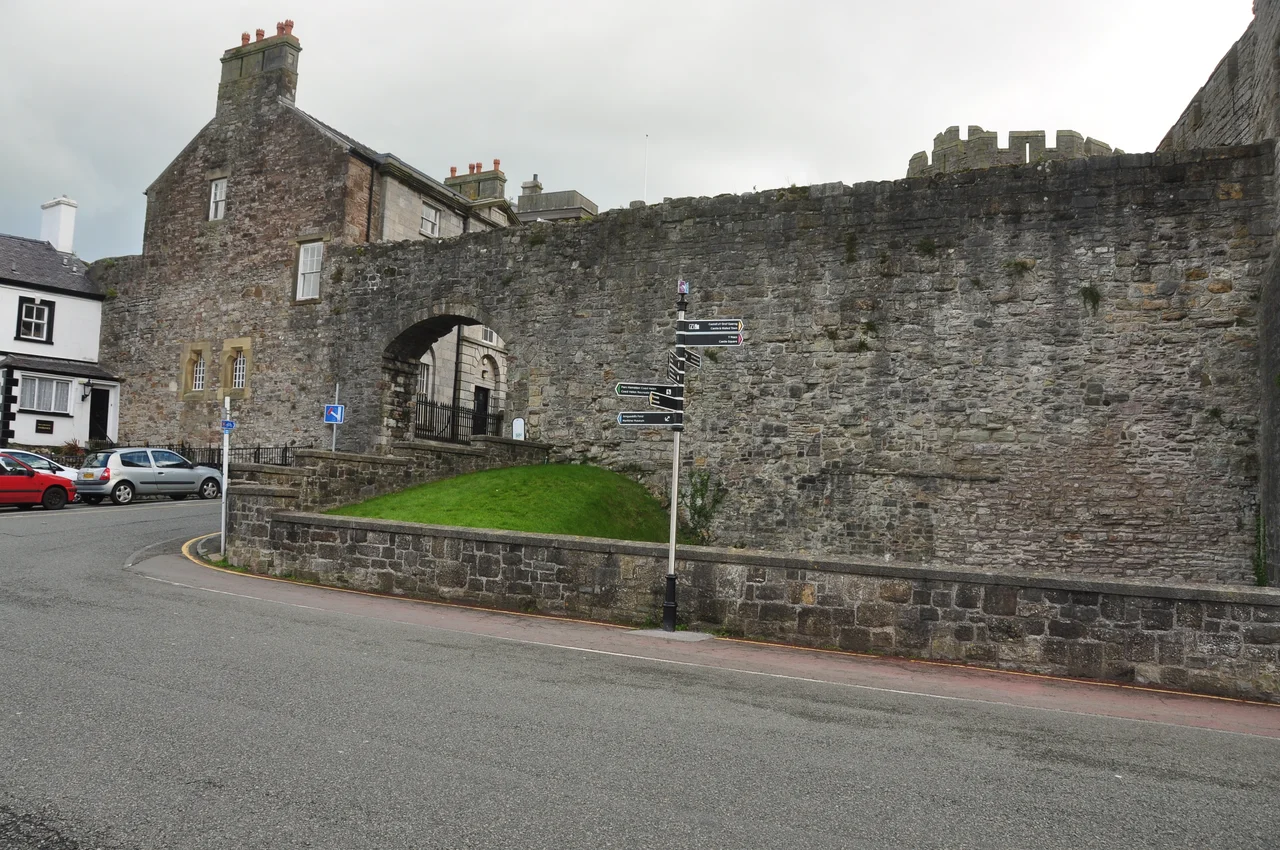
Walk the lane behind the Royal Welsh Yacht Club on a winter afternoon and you can put your hand on stone that was cut, dressed and set in place between 1283 and 1285 - more than 740 years ago. The town walls of Caernarfon are one of the most complete medieval circuits surviving anywhere in northern Europe. Eight towers, two twin-towered gatehouses, an 800-yard ring around the original Edwardian planted town. They were built in two short construction seasons by the same workforce that was raising Caernarfon Castle next door, and they have outlasted everything they were designed to defend against.
The Walled Town of Edward I
Edward I conquered Gwynedd in 1283. Within months, his master mason James of St George - the most accomplished military architect in late medieval Europe - was laying out a new town immediately north of the castle, with English settlers, a market grant, and a high stone wall to keep the Welsh out. The walled town was a colonial settlement in the literal sense. Welsh people were initially banned from living inside the walls or from trading there outside market days. The wall was a piece of legal architecture as much as military infrastructure: it defined who counted as a burgess of the new royal borough, and who did not. The walls and gatehouses cost the Crown around 1,500 pounds in 1280s money, an enormous sum, paid out of revenues squeezed from the same conquered country.
The East Gate and the Buried River
The principal landward entrance was the East Gate, originally a portcullis-defended gatehouse looking out over the river Cadnant. The river is now culverted - flowing in a brick conduit beneath Bridge Street - and the gatehouse was modified with Gothic decoration in the 19th century. The gatehouse contained civic offices almost continuously from the 13th century to the 1960s. First it housed the royal exchequer for north Wales. Later it became Caernarfon's town hall. Then the guildhall. The medieval base of the towers survives; everything above it has been rebuilt at least once. Newer breaches in the walls - Northgate, Greengate, the entrance to Market Street - were punched through later to ease traffic. The medieval circuit is intact in plan if not always in pure fabric.
Saint Mary's in the Wall
In the north-west corner of the circuit, the 14th-century chapel of St Mary's was built directly into the defences. It uses the only fully circular tower in the walls as its vestry - a unique architectural marriage of garrison church and town wall. The chapel began in 1307 as a place of worship for the castle and town garrisons. Inside, the arcades and parts of the nave are medieval; the exterior was largely rebuilt by Benjamin Dean Wyatt between 1811 and 1814. The north and west walls, however, are still the original limestone masonry laid down by the workforce of Master James of St George in 1284 to 1290. Sitting in the pews on a quiet weekday, you are inside a structure that is simultaneously a chapel and a piece of military engineering.
Towers Repurposed
Several of the towers along the west side of the walls have been quietly converted into other things. One was absorbed into the former Caernarfon Gaol in the 19th century and now forms part of the County Offices. Another has been the home of the Royal Welsh Yacht Club since the 1800s, with a flagpole rising directly out of medieval stonework. A third - the Bath Tower at the south-western corner - has been a Landmark Trust holiday home since the 1960s, sleeping four people in rooms whose windows look directly down onto the Menai Strait. Across the whole circuit, the walls are simply too large and too well-built to demolish, and Caernarfon has learned to live around them, in them, and on them.
World Heritage and a Yacht Club
UNESCO declared the castle and walls together a World Heritage Site in 1986, grouping them with Beaumaris, Conwy and Harlech as the Castles and Town Walls of King Edward in Gwynedd. The citation calls them 'the finest examples of late 13th century and early 14th century military architecture in Europe'. Cadw, the Welsh heritage body, manages the walls. Only a small section is currently open to the public for walking on top, though plans to extend the wall-walk have been discussed for years. The rest of the circuit you take on foot at ground level, hand on stone, ducking your head where the medieval headroom dictates. Edward I's planted town is now a Welsh-speaking town of 9,852 people. The walls keep nobody out anymore. They simply stand.
From the Air
Caernarfon's medieval town walls form an 800-yard polygonal circuit around the old town at 53.139 degrees north, 4.278 degrees west, on the eastern shore of the Menai Strait. From the air the walled town is sharply defined - eight towers and two gatehouses around a tightly packed grid of streets, with Caernarfon Castle at the south-western corner. Best viewed at 2,000-4,000 feet for full circuit perspective. Caernarfon Airport (EGCK) is four nautical miles south-west; RAF Valley (EGOV) lies 15 miles north-west - watch for Valley MATZ and fast-jet activity.
Nearby Stories
- Wakestock 1.7 km away
- Trefriw 3.8 km away
- Irish Sea 8.7 km away
- Irish Sea Bridge 20 km away
- East–West Interconnector 30 km away
- Machynlleth 36 km away
- HMS Tyler 41 km away
- New Brighton Lifeboat Station 54 km away