
Cala Benirrás
On a Sunday in August 1991, people came to this cove to drum against a war, and in a sense they never left. Cala Benirras is a small beach on the northern coast of Ibiza, cupped between densely pine-forested cliffs in the municipality of Sant Joan de Labritja. Its mix of pebbles and sand, its crystal-clear water, and its sheltered bay would make it lovely enough on their own. But Benirras is famous for something you hear before you see it: the drums that still gather here at sunset, decades after the first beat.
The Cove Beneath the Pines
Benirras sits well off the island's crowded southern strips, reached through woodland on the wilder northern seaboard. Pine-clad cliffs rise steeply on either side, sheltering a bay whose clear water makes the cove a favorite for snorkeling, though swimmers are warned to watch for the boat traffic that crowds the bay in summer. Rocks bracket both ends of the beach, and along them stand several old dry-dock fishermen's shacks, low stone boathouses that recall the cove's working past. Private yachts and motorboats drop anchor in the calm water, while footpaths thread up from the sand and into the surrounding woods.
The Rock That Won't Be Named
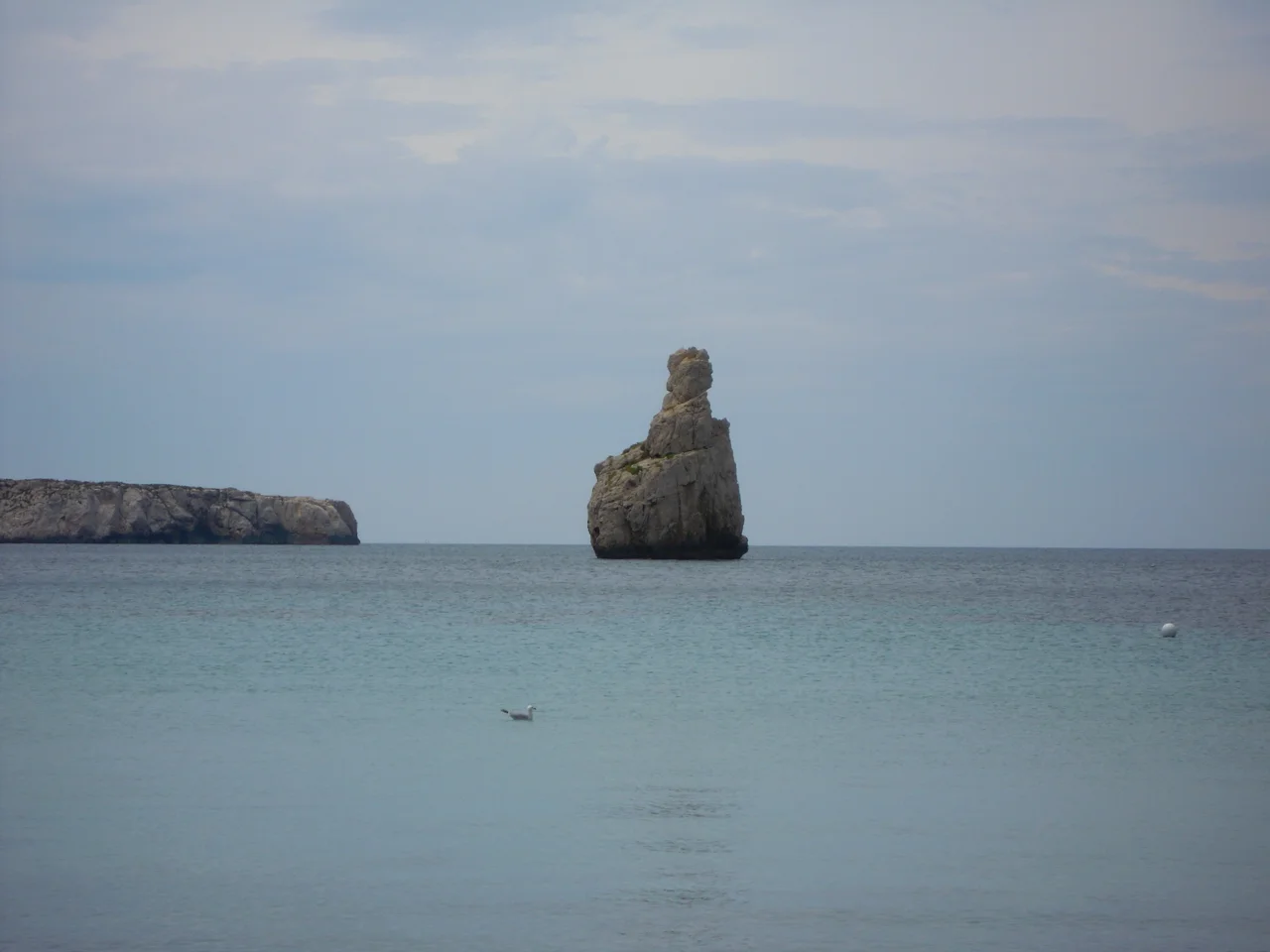
Offshore, in the middle of the bay, a distinctive rock rises from the water: Cap Bernat. Its silhouette refuses to settle into one thing. Islanders and visitors have described it, variously, as a woman kneeling at prayer, a giant baby, and the Sphinx of Egypt, each viewer finding a different figure in the same stone. That ambiguity suits Benirras, a place that has always meant different things to different people. Framed against the sunset, with the drums going, the rock becomes the natural focal point of the cove, a fixed silent shape at the center of all that movement and noise.
The Day of the Drums
The drumming has a specific origin. On Sunday, 18 August 1991, a gathering of anti-war activists, hippies, and other sympathizers assembled on the beach at Benirras to protest the first Gulf War in Iraq. The event became known as the Day of the Drums, and it did not end when the protest did. It grew into an annual gathering, and then into a weekly one, much to the unease of local authorities and emergency services who worried about the crowds descending on so small and remote a cove. Bylaws increasingly restricted the gatherings until, in 2002, the organized event was banned outright.
A Ritual That Refused to End
The ban did not silence the drums. A devoted collective of drummers kept turning up, and the Sunday-sunset ritual quietly reestablished itself as the cove's signature, so that today people still come from around the world to drum the sun down over the water. As the light drops behind the headland, the rhythm builds and dancers move on the sand, entranced by the endless beat, while Cap Bernat darkens to a silhouette offshore. What began as a single day's protest against a distant war has become one of Ibiza's most enduring rituals, proof that a gathering can outlast the cause that started it and simply become a way of marking the end of the day.
From the Air
Cala Benirras lies at 39.090N, 1.454E on Ibiza's north coast, in the municipality of Sant Joan de Labritja, about 13 nm north of Ibiza Airport (LEIB). From 1,500-2,500 feet it appears as a small notch of pale beach set between steep, dark pine-covered cliffs, with the distinctive Cap Bernat rock standing alone in the mouth of the bay, a reliable visual marker from the air. Approach from offshore to the north for the clearest view into the cove. Summer visibility is usually excellent; late-afternoon light, when the sunset crowds gather, throws the cliffs and the offshore rock into strong relief.
Nearby Stories
- S'Espalmador 15 km away
- Andratx 35 km away
- Puig de sa Morisca Archaeological Park 55 km away
- Illa Grossa 66 km away
- Cap de la Nau 74 km away
- Santa Ponsa 79 km away
- Cape Sant Antoni, Spain 82 km away
- Battle of Cape Cherchell 216 km away