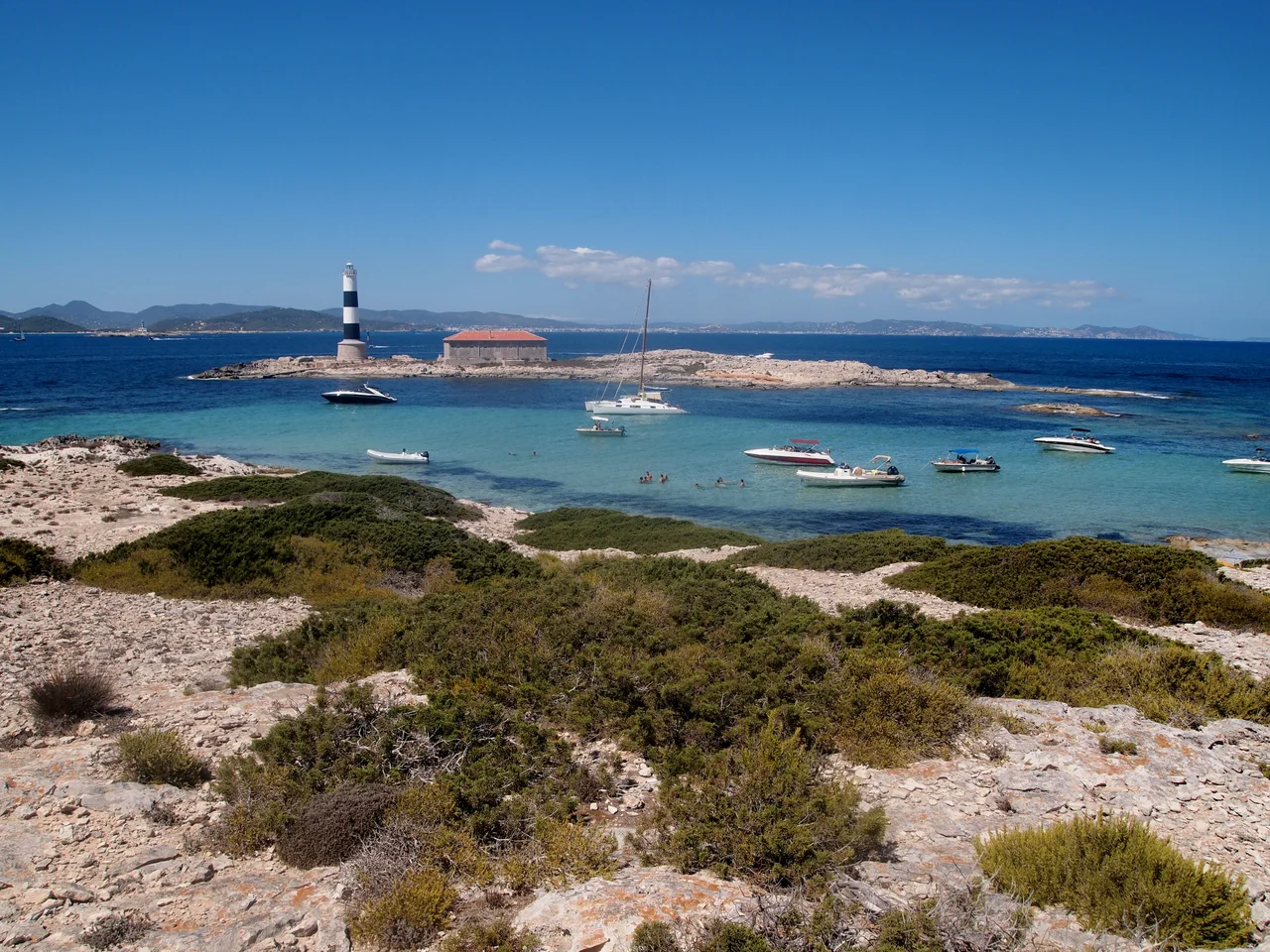

S'Espalmador
At low tide, you can walk to a private island. A shallow sandbar links the northern shore of Formentera to S'Espalmador, and when the water drops you can wade across the warm shallows to reach it on foot. What waits on the far side is an uninhabited Spanish island of pristine beaches, freshwater springs, and a natural mud-bath that visitors have long smeared over their skin. There are no hotels, no roads, no residents. There is only the sandbar, the yachts anchored offshore, and a silence that money has spent decades trying to buy.
A Walk to a Private Island
S'Espalmador sits just off Formentera's tip, small and low and separated from its larger neighbor only by that tidal sandbar. Canoeists paddle across the strait; yachts heading between Ibiza and Formentera drop anchor in its lee. The island's appeal is precisely its lack of development. Freshwater springs surface where you would not expect them on so small a rock, and a mud-bath draws bathers who coat themselves in gray silt and let it dry in the sun. It is the kind of place that feels like a secret, even though thousands of boaters know exactly where it is.
Pig Island and the Light
Just to the north lies a smaller companion, Illa des Porcs, which translates as Pig Island. The name is not decorative. The islet once served as a hideout and stronghold for pig smugglers working these waters. In 1861 the En Pou lighthouse rose here to mark the southern edge of the Es Freus strait, the channel that separates the island group from Ibiza. For sailors threading between the two big islands, that light has been a fixed point for more than a century and a half, blinking above a rock that once concealed contraband.
From 252 Euros to 18 Million
The economics of S'Espalmador tell their own story. In 1932 the Cinnamond family bought the entire island for the equivalent of 252 euros. For generations it stayed in their hands. Then, in March 2018, despite the Formentera government's efforts to purchase and protect it, the Catalan architect Norman Cinnamond and his sister Rosy sold the island to two wealthy Belgian brothers, Christian and Jean Cigrang, for 16 million pounds, roughly 18 million euros. In under a century, the price had climbed by a factor no one in 1932 could have imagined, a measure of how rare untouched Mediterranean coastline had become.
A Pop Star and the Dunes
Even a private island cannot escape scrutiny. In August 2024, Spanish authorities opened an investigation into possible environmental crimes after reports that a music video for Katy Perry's single "Lifetimes" had been filmed among the island's ecologically sensitive sand dunes without proper authorization from the Balearic environment department. The episode captured the tension that defines S'Espalmador: a place valued precisely for its fragility, coveted by people with the means to reach it, and protected by rules that visitors, famous or not, are expected to honor.
From the Air
S'Espalmador lies at 38.787N, 1.426E, immediately north of Formentera and roughly 6 nm south of Ibiza (LEIB). From 2,500-4,000 feet it appears as a small, low island tethered to Formentera by a pale sandbar just under the surface, with the tiny Illa des Porcs and its En Pou lighthouse off its northern end. The turquoise shallows of the Es Freus strait make the island's outline vivid against deeper water. Expect dense yacht and small-boat traffic in the strait during summer; visibility is usually excellent.
Nearby Stories
- Cala de Sant Vicent 5.9 km away
- Puig de sa Morisca Archaeological Park 63 km away
- Cap de la Nau 73 km away
- Santa Ponsa 90 km away
- Illa Grossa 102 km away
- Killing of Lasa and Zabala 128 km away
- Lucentum 177 km away
- Battle of Cape Cherchell 177 km away