
Lucentum
The tall apartment blocks of the Albufereta neighbourhood crowd right up to the fence, and behind it, on a low rise called El Tossal de Manises, lie the bones of the city that came before Alicante. This is Lucentum, and its story runs backward through almost every people who ever wanted this coast. Romans laid streets and baths here. Carthaginians raised a fortress before them. The Greeks who traded along the shore knew the pale bluff above the lagoon as Akra Leuke, the White Citadel - and it is that same bright rock, softened through Latin into Lucentum, that eventually became the name Alicante.
The White Citadel
The ancient historian Diodorus credited the settlement's founding to Hamilcar Barca, the Carthaginian general and father of Hannibal. To the Greeks it was the White Promontory; the Romans, following the same sense, would call it the bright place. Perched between the Iberian interior and the Mediterranean, the town lived by trade, and it traded widely - with Greece, with Phoenicia, with the rich southern kingdom of Tartessos, absorbing something from each. Out of that mixture grew a distinct local culture that the Roman writers Pliny the Elder and Strabo named the Contestani. Even now, the deepest layers of the ruins keep their Carthaginian stamp, older than anything Rome would build on top of them.
Rome's Bright Town
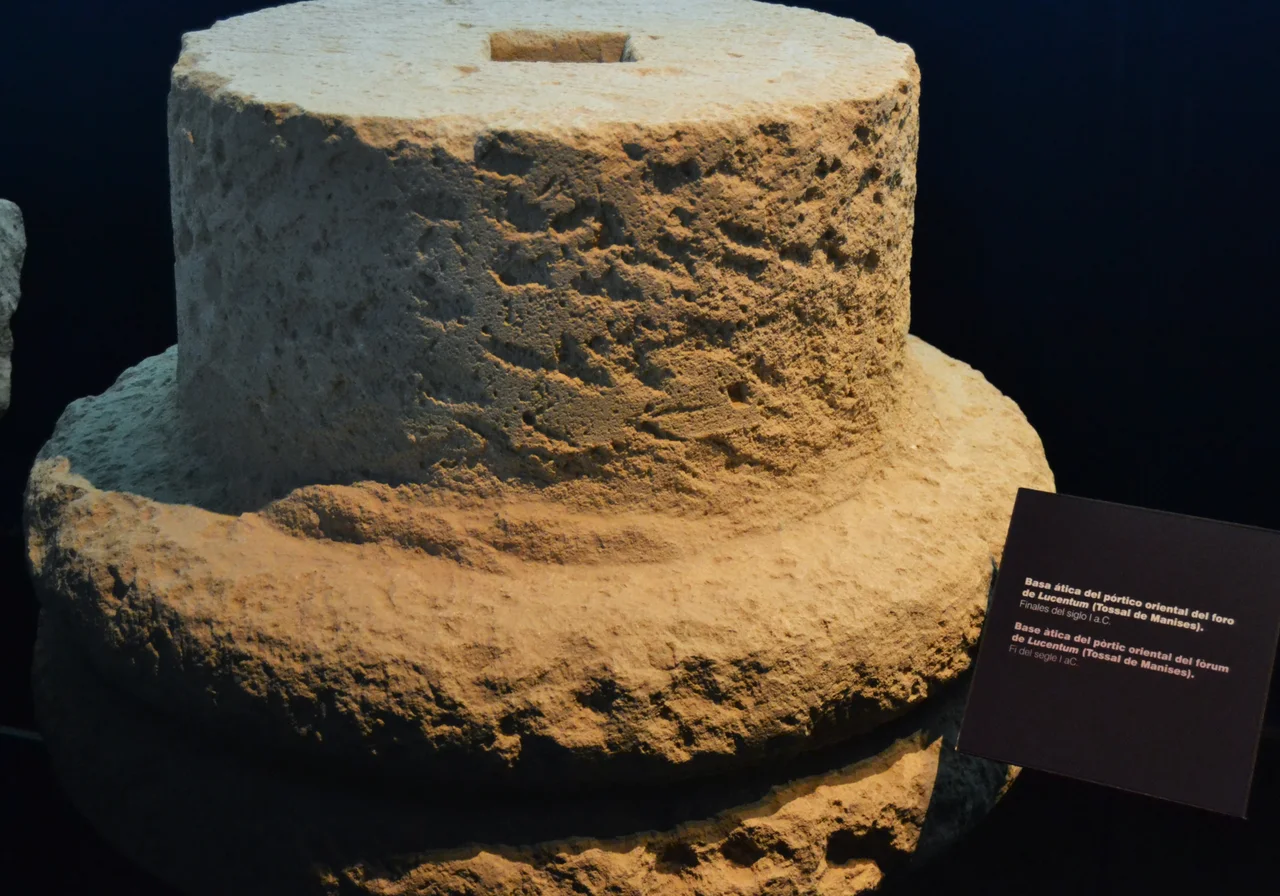
Lucentum reached its height between the first century BC and the first century AD, and it is Rome's hand that shows most plainly in what survives. The Romans built over the Iberian town, leaving little of it but the walls, and laid out a proper city: a forum, public baths, a defensive wall studded with the foundations of older towers, and streets of houses spread across some thirty thousand square metres. Then the tide turned. From the second century the town slipped into decline, undercut by its neighbour Ilici - today's Elche - which had better roads and water and slowly drew away Lucentum's trade. By the end of the third century the place was all but empty. Centuries later, its silent ground served only as a Muslim cemetery.
Buried and Rediscovered
For a long time no one was sure where the ancient city had stood. The first real clue came in 1780, when Antonio Valcarcel Pio de Saboya, the Count of Lumiares, argued that the ruins he had been digging at Tossal de Manises were Lucentum itself - against the settled opinion that the Roman town lay somewhere else entirely. Later excavators uncovered the Carthaginian layers beneath. In the 1930s, road construction cut through an ancient necropolis, and out of it came a striking haul now held in the Archaeological Museum of Alicante: bronze cauldrons, Iberian pottery painted with birds and fish, jewellery, weapons, and amulets carried all the way from Egypt. The elegant sculpted head known as the Kore de Alicante may have come from this very hill.
The Woman Who Saved It
By the middle of the twentieth century the ruins occupied prime coastal land, with a fine view over the old lagoon and bay - which made them a target for the developers reshaping the Costa Blanca. The site might have disappeared entirely but for the people who fought to keep it, above all the Swedish archaeologist Solveig Nordstrom, who made its defence her cause. In 1961 Lucentum was declared an Artistic and Historic Monument, winning it a measure of legal protection. The protection could not hold back the cranes; the ruins today stand ringed by high-rise blocks, anything but pristine. Yet they endured. Restored and consolidated in the 1990s, they remain open to anyone who wants to walk the streets of the White Citadel and stand where Alicante began.
From the Air
The archaeological site sits at 38.364 degrees N, 0.438 degrees W, on the low Tossal de Manises hill in the Albufereta district on Alicante's northeastern edge, close to the shore and the silted remnant of the old lagoon. From the air it reads as a cleared, walled enclosure hemmed in by dense apartment towers, a short distance up the coast from the Castle of Santa Barbara. Alicante-Elche Airport (LEAL) lies about 12 km southwest. Coastal visibility is generally excellent under the region's dry Mediterranean skies.
Nearby Stories
- Barxell Castle 2.1 km away
- Benissa 6.5 km away
- La Fonteta Phoenician Port 12 km away
- Fonda Milagros Nightclub Fire 18 km away
- Battle of Helike 20 km away
- Cerro de los Santos 20 km away
- La Muralla Roja 26 km away
- Battle of Cape Cherchell 238 km away