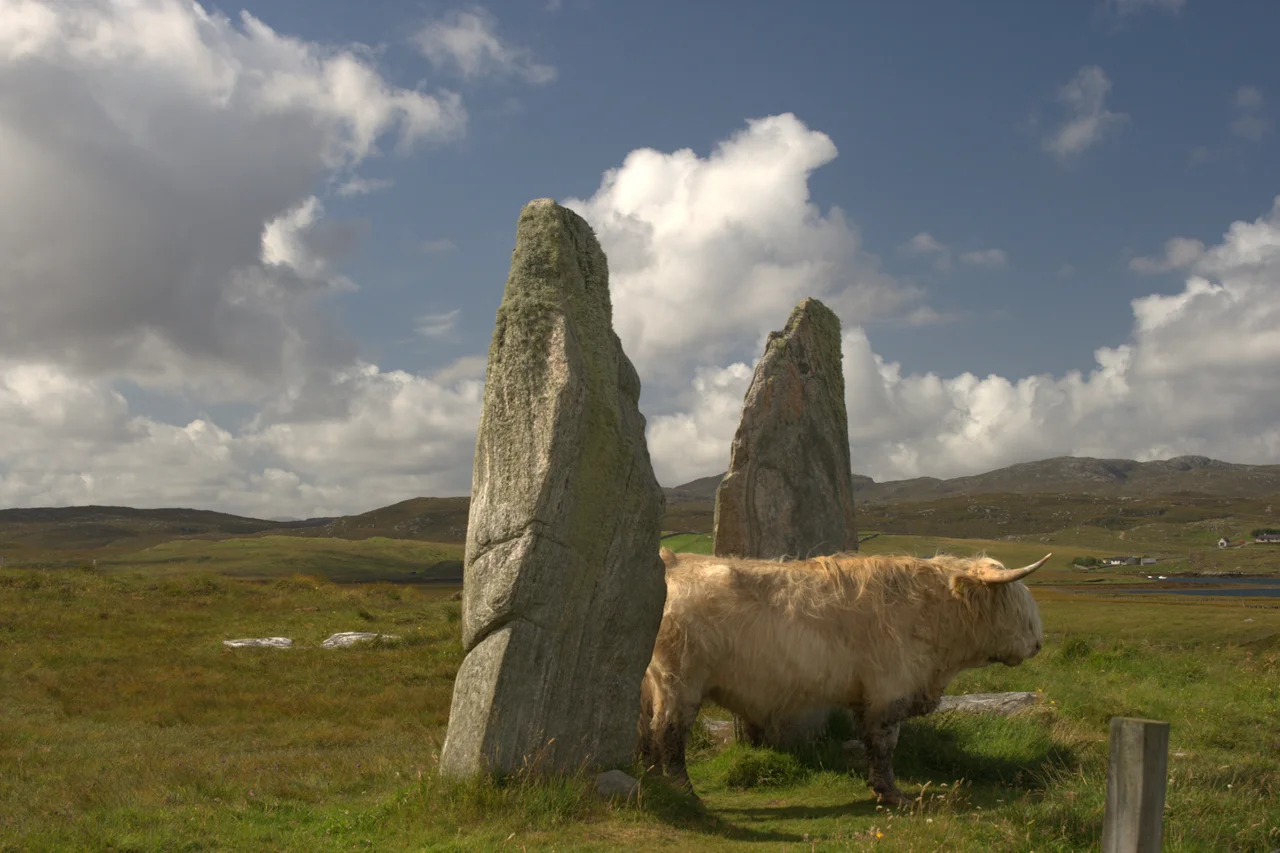

Callanish II
There is a Callanish I, the great cross-shaped monument that draws the cameras and the coach tours. And then there are the others - II through X, the satellites scattered across the moor within sight of the main ring. Callanish II is one of the closest. Five of its standing stones still rise from the bog, two have fallen, and at its centre sits a stone cairn eight and a half metres across. It is older than Stonehenge. It was already old when the Egyptians built the pyramids. And then, sometime in the Bronze Age or after, the bog grew over it.
Stones in the Peat
The circle that survives today is a fragment of what once stood here. Five upright stones, two fallen, varying in height from two to three and a third metres. A slab a metre and a half long lies in front of the western stone, pointing inward toward the centre. The stones surround a cairn - a built mound of piled rock - eight and a half metres in diameter, which suggests the circle was funerary or commemorative as well as ceremonial. The site lies on the moor near the head of East Loch Roag, within walking distance of Callanish I. Like its more famous neighbour, it almost certainly dates to roughly 3000 BC, the Late Neolithic. Then peat began to grow. By the 19th century the stones stood in a wet blanket of bog that had risen perhaps a metre up their flanks.
What the Peat Revealed
In 1848, three feet of peat was removed from the site - roughly a metre of accumulated moss and decay. The removal exposed something unexpected. Four post holes were noticed in the ground beneath: three grouped in an arc to the northwest, a fourth set apart to the southwest. Wood charcoal in the holes suggested they had once held timber posts, forming an earlier circle about ten metres across. The implication is striking. Before the stones, there were trees. A wooden ring of perhaps the same diameter as the stone setting stood here first, and at some point the timbers were either replaced by stone or rotted away while the stone circle was being raised around their decaying remains. The relationship between Britain's wooden henges and its stone circles has long puzzled archaeologists. Callanish II preserves one small piece of evidence that the two traditions, in this corner of the Hebrides at least, occupied the same ground.
A Landscape of Circles
Callanish II is one of seven smaller stone settings clustered around the main site. The locals call them by their Gaelic names too - this one is Cnoc Ceann a' Gharraidh, Tursachan, Ceann a' Gharaidh. Each circle is different. Some are squat rings of low stones. One, Callanish VIII, is a deliberate semicircle on the cliff edge of Great Bernera. Another, Callanish X, lies in collapsed fragments along a ridge. Why so many monuments in one small area is one of the central mysteries of British prehistory. The builders chose this corner of Lewis - this view across Loch Roag, this sky, this horizon - and returned to it for generations to set up more stones. Whatever drew them, the gathering of circles makes Callanish unlike anywhere else in Europe.
From the Air
Coordinates 58.19 N, 6.73 W. Callanish II sits on the moor just south of the main Callanish stone circle, near the head of East Loch Roag on the west coast of Lewis. Nearest airport is Stornoway (EGPO), about 13 nm east. Recommended viewing altitude 1,500-2,500 ft to take in the full cluster of satellite circles around the main site. The main Callanish ring is roughly 1 km north. Expect frequent low cloud and wind off the Atlantic; clear days give views back across Loch Roag to Great Bernera and the cliffs of Carloway.
Nearby Stories
- Hebrides 8.6 km away
- Tiumpan Head Lighthouse 11 km away
- The Flannan Isles Mystery: The Lighthouse Keepers Who Vanished 12 km away
- German submarine U-905 33 km away
- Rua Reidh Lighthouse 35 km away
- Spaceport 1 40 km away
- Sandwood Bay 104 km away
- The Laki Eruption: The Volcano That Changed World History 843 km away