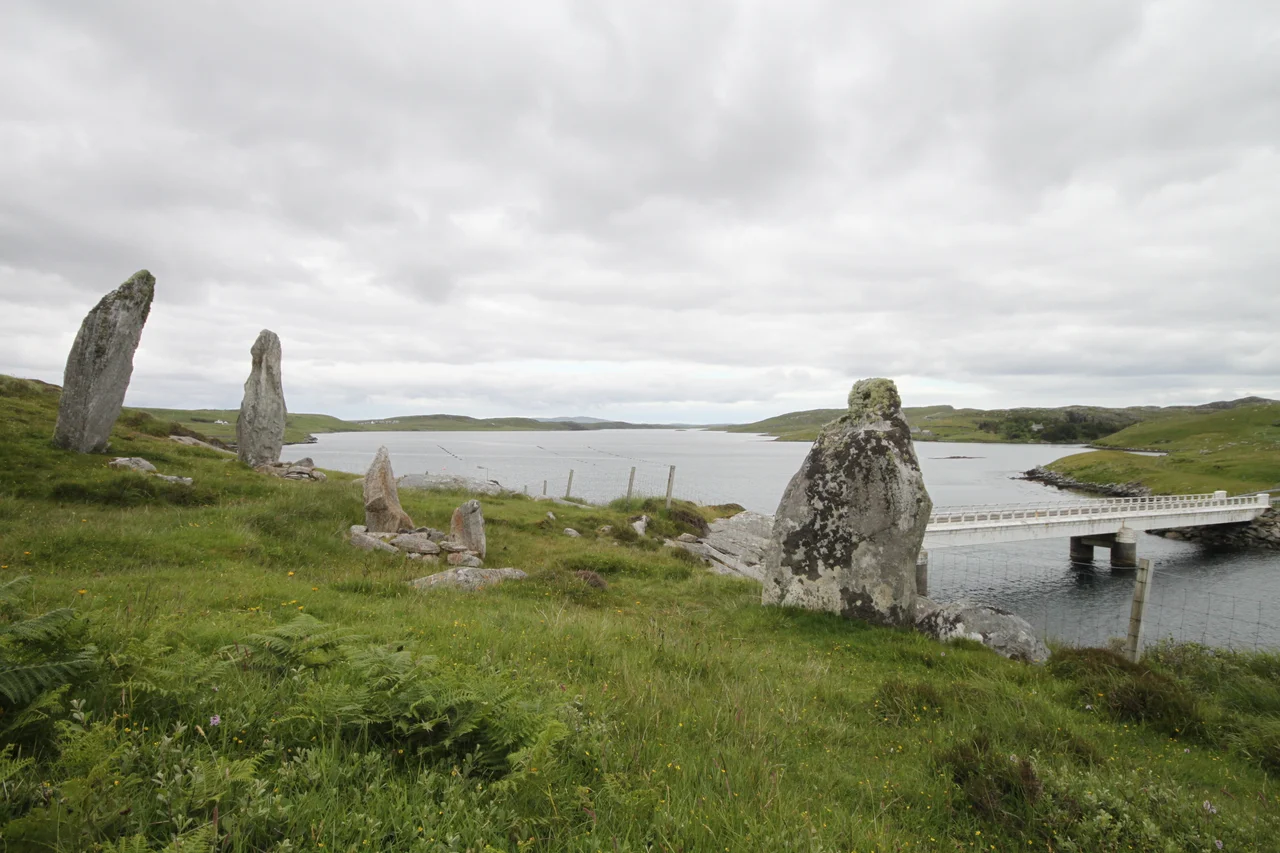

Callanish VIII
It is not a broken circle. That is the first surprise. Four megaliths stand in an arc on the cliff edge at the southern tip of Great Bernera, looking across the narrow strait at Lewis. There is no evidence the cliff ever extended further, no missing fragments lying below in the sea. The semicircle was the plan. The builders chose a curved edge and built half a ring against the sky, then stopped. Whatever they were doing here, they meant exactly what they did.
A Monument Like No Other
British stone circles, as the name suggests, are usually round. Some are oval. Some are partially collapsed. A few have stones removed by farmers or builders over the centuries. But the deliberate semicircle - a half-ring built against a natural edge - is extraordinarily rare in the megalithic record. Callanish VIII, locally known as Tursachan, is one of the clearest examples. Four large stones stand in an arc on the south side of Great Bernera, with the cliff edge serving as the diameter of the implied circle. The tallest stone rises nearly three metres. The diameter, measured along the cliff axis, is about twenty metres. The cliff has not eaten the missing half - there is simply no missing half. The builders used the precipice itself as a structural element, treating land and sky as parts of the same architecture.
The View Across the Strait
The site sits on the south coast of Great Bernera and looks directly across the narrow strait of Loch Roag toward Lewis. The view from the stones is one of the more theatrical settings of any Neolithic monument in Britain - water on three sides, the Lewis hills rising beyond, the cliff dropping away beneath the stones themselves. Like all the Callanish satellites, this one dates to roughly the third millennium BC, contemporary with the main cross-shaped ring at Callanish I about a kilometre to the southeast. Whatever rituals or observations brought people to these stones must have used the landscape as part of the ceremony. You cannot stand in a semicircle on a cliff and ignore what lies beyond it.
Among the Many
Callanish VIII is one of at least ten megalithic structures clustered within walking distance of the main Callanish site. The numbering scheme runs from I, the great central ring, through X. Some are small circles. One is a single standing stone. Callanish X lies in collapsed pieces along a ridge. Callanish II, just across the loch, still stands in fragments around a burial cairn. The cluster has no parallel in Europe for density. A community in this corner of Lewis returned to this landscape repeatedly across many generations to build new monuments near the old ones. Why is one of the central unanswered questions of British prehistory. The answer must include the geography itself - the sheltered loch, the long horizon, the long subarctic light, the way the sky sits over the water on a clear summer night. Whatever the builders saw here, they saw it again and again.
From the Air
Coordinates 58.21 N, 6.83 W. Callanish VIII stands on the south coast of Great Bernera, on a cliff edge facing the narrow strait that separates the island from Lewis. Nearest airport is Stornoway (EGPO), about 19 nm east-northeast. Recommended viewing altitude 1,500-3,000 ft. From the air the stones are small, but their position against the cliff edge and the strait below makes the site identifiable in clear conditions. The main Callanish ring lies roughly 5 km southeast across the loch.
Nearby Stories
- Hebrides 8.6 km away
- Tiumpan Head Lighthouse 11 km away
- The Flannan Isles Mystery: The Lighthouse Keepers Who Vanished 12 km away
- German submarine U-905 33 km away
- Rua Reidh Lighthouse 35 km away
- Spaceport 1 40 km away
- Sandwood Bay 104 km away
- The Laki Eruption: The Volcano That Changed World History 843 km away