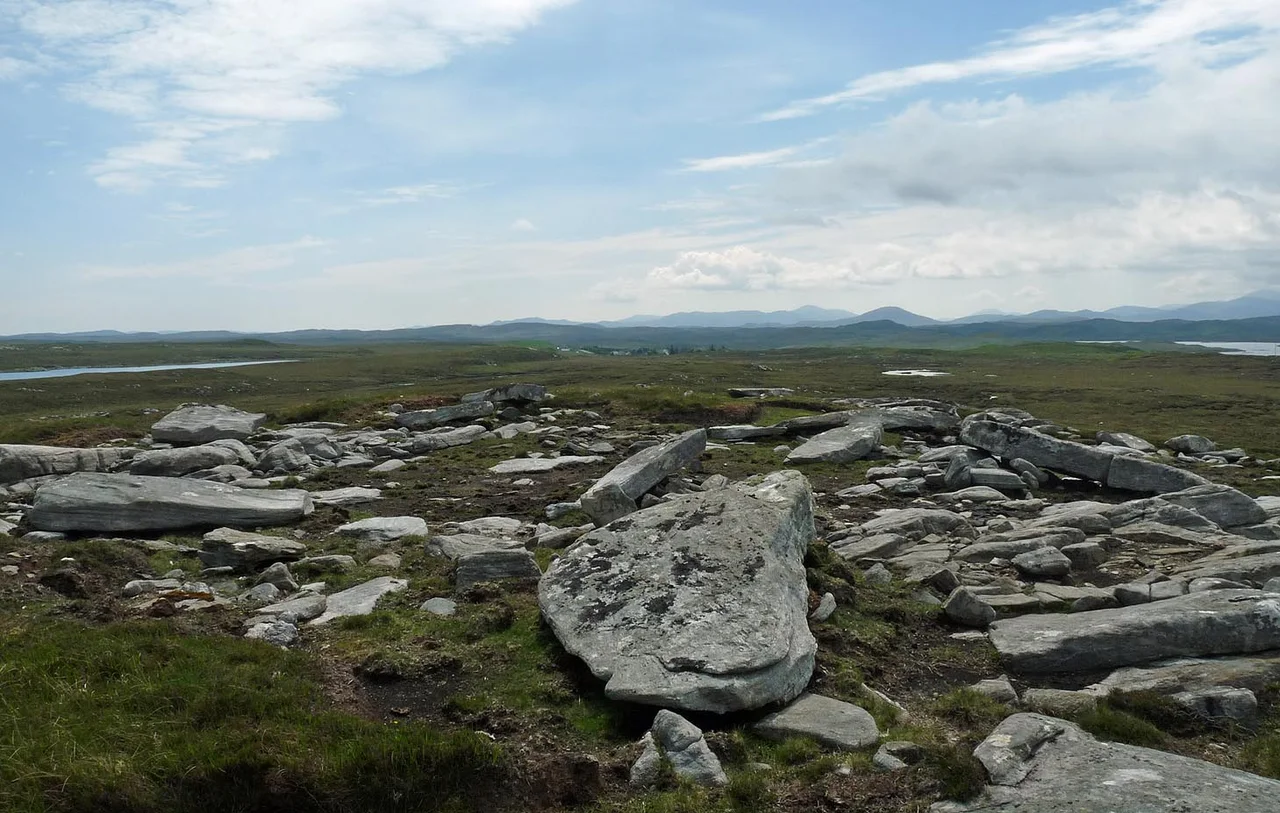

Callanish X
The Neolithic builders sometimes made mistakes. Most of the Callanish satellites still stand because their masons set their stones deep, but Callanish X - locally called Na Dromannan, the Ridges, or Druim Nan Eun, the Birds' Ridge - was built differently. Seventeen stones were raised in a ring on a rocky summit, packed in place with smaller stones jammed around their bases. It was not enough. After several hundred years the monoliths began to lean, and then to fall. They have been lying on the ridge ever since.
The Ring That Fell
Callanish X is one of at least ten megalithic structures clustered around the famous main ring at Callanish, but it is the only one in the cluster known to have collapsed almost entirely. Excavations between 2003 and 2006 removed the covering layer of peat that had grown over the site for thousands of years and exposed the full structure. The investigators counted seventeen stones in the original ring. Two are missing entirely, presumably broken up or carted away in some later century. The remaining fifteen are all on the ground. They lie where they fell, splayed outward and inward across the summit of the rocky ridge of Druim nan Eun. The excavation also recovered the packing stones - small rocks jammed around the bases of the original monoliths to keep them upright. There were not many of them, and they were not large. The builders had not dug deep foundation pits as at the main Callanish ring.
Several Hundred Years
The phrase the excavators used in their report was careful: most of the monoliths had fallen after 'several hundred years.' Compared with the main Callanish circle, which has stood essentially as built since around 3000 BC, this is a short life. The stones at Callanish I are anchored in deep sockets cut into the bedrock and surrounding peat. The stones at Callanish X were merely propped up, with packing material doing the work that the underlying ground refused to do. The result was a kind of slow-motion failure - first the leaners, then the tipped, then the fallen. By the time peat began to accumulate over the ridge in the late Bronze Age or Iron Age, the ring was probably already mostly collapsed. The peat preserved the pattern of the fallen stones, freezing the moment of failure in place until 21st-century archaeologists came along to read it.
What the Failure Reveals
Callanish X is, in some ways, more informative than its standing neighbours. A monument that still works tells you what its builders intended. A monument that failed tells you something about the builders themselves - their methods, their experience, perhaps their hurry. The site sits on a rocky ridge with thin soil, the kind of ground that does not accommodate deep stone sockets easily. The masons might have known this and chosen a different technique to suit it. Or they might not have known until the leans began. Either way, the comparison with the deep-set anchorage of Callanish I shows how much the survival of any megalithic monument depends on the unseen engineering below the surface. The cluster of circles at Callanish is not just a single act of vision repeated. It is a record of trial and refinement. Some of the rings stood. One did not. The peat covered them both.
From the Air
Coordinates 58.20 N, 6.72 W. Callanish X lies on the summit of a low rocky ridge known as Druim nan Eun, east of the main Callanish complex on the Isle of Lewis. Nearest airport is Stornoway (EGPO), about 13 nm east. Recommended viewing altitude 1,500-2,000 ft. The site itself is harder to spot than the standing circles - the fallen stones blend with the ridge from above - but the ridge is identifiable as a low spine of bare rock east of the main ring. Expect strong winds and frequent cloud; clear days reveal the full Callanish constellation of monuments across the moor.
Nearby Stories
- Hebrides 8.6 km away
- Tiumpan Head Lighthouse 11 km away
- The Flannan Isles Mystery: The Lighthouse Keepers Who Vanished 12 km away
- German submarine U-905 33 km away
- Rua Reidh Lighthouse 35 km away
- Spaceport 1 40 km away
- Sandwood Bay 104 km away
- The Laki Eruption: The Volcano That Changed World History 843 km away