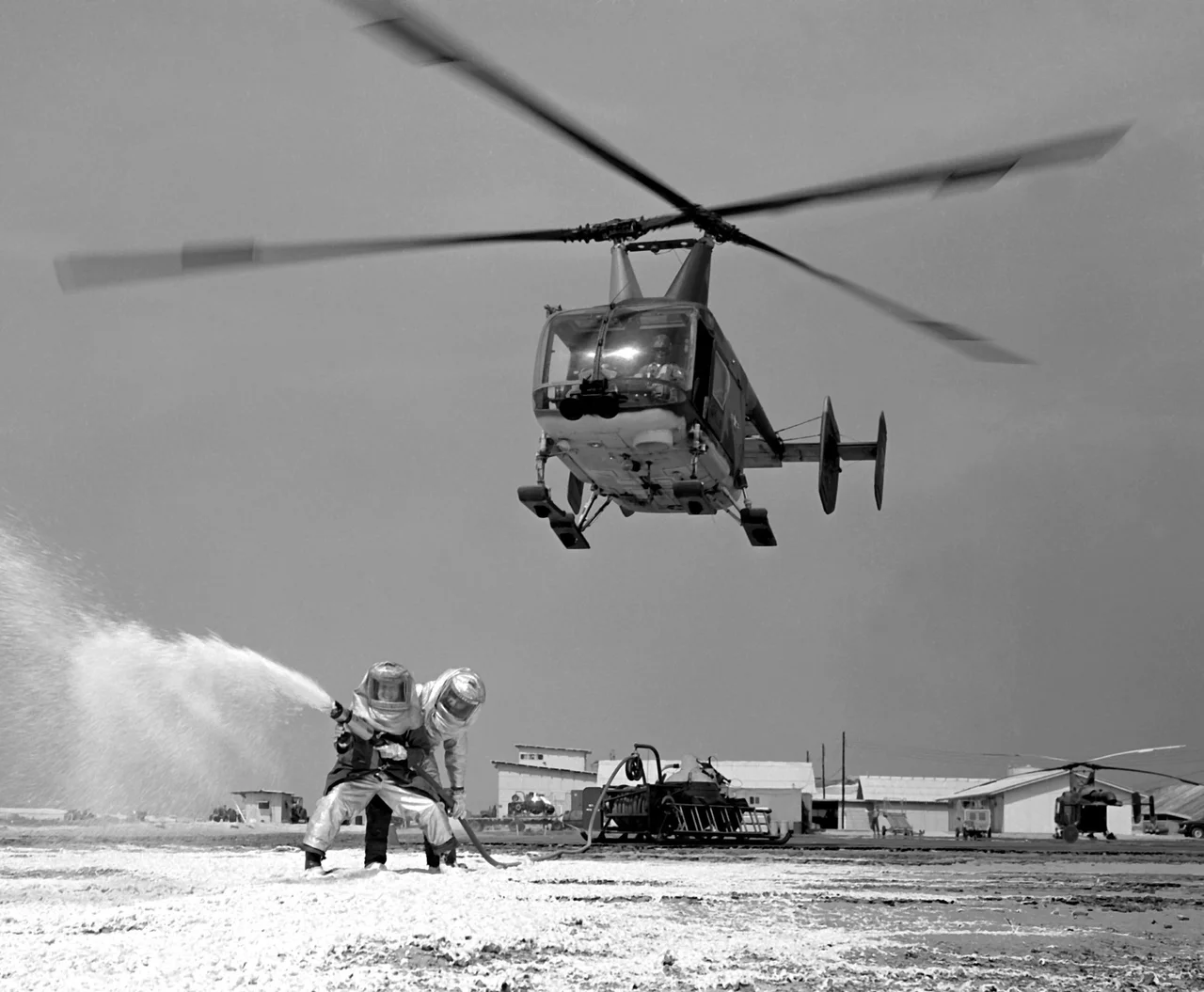

Cam Ranh Base
In the summer of 1965, over half of the 1,800 Vietnamese workers building a new American military runway at Cam Ranh Bay were women. They laid 2.2 million square feet of AM-2 aluminum matting in 50 days — fast enough that Admiral U.S.G. Sharp, commander of all US forces in the Pacific, flew in personally to lay the last plank on 16 October 1965. The runway was functional before many of the base's other buildings had roofs. War has its own logic about priorities.
The Bay That Empires Noticed
Cam Ranh Bay is a natural deep-water harbor, sheltered by a narrow peninsula that makes it one of the finest anchorages in Southeast Asia. The French understood this. The Japanese understood this. The Americans, arriving in force in 1965, understood it with the full weight of an industrial military complex behind them.
The base the United States built here was enormous — far larger than a single airfield. Cam Ranh Bay became the major military seaport for the entire war effort, handling the offloading of supplies and equipment for operations across South Vietnam. Army, Navy, Marine Corps, and Air Force units all maintained compounds here. By December 1966, the airfield alone was processing more than 27,000 aircraft movements per month — nearly one per minute, around the clock. The 12th Tactical Fighter Wing, equipped with F-4 Phantom IIs, was the first permanently assigned fighter wing in Southeast Asia, operating from Cam Ranh from 1965. C-130s from Tan Son Nhut, C-123s from Nha Trang, medevac aircraft, reconnaissance planes — the base was a hub through which the machinery of American military power flowed.
The VC Sapper and the Ghost Town
The base survived years of combat operations but could not survive the war's end. On 25 August 1971, Viet Cong sappers penetrated the base's perimeter and detonated the tri-service ammunition storage area — destroying more than 6,000 tons of munitions worth over $10 million in a single night. It was a reminder that no base, however large, was truly secure.
When American forces drew down and turned Cam Ranh over to the South Vietnamese, what followed was almost poignant. The base was simply too large for the RVNAF to operate meaningfully. Buildings sat empty. Equipment disappeared — air conditioners, desks, refrigerators, corrugated tin roofing — taken by people who needed those things more than an abandoned military facility did. What remained was described as a deteriorating ghost town. The Republic of Vietnam Air Force stored its aging A-1 Skyraiders here while their newer F-5s and A-37s flew combat missions from smaller, more active bases. On 3 April 1975, North Vietnamese forces advanced on Cam Ranh Bay and captured it entirely by 14:00 that afternoon.
The Red Star Over Cam Ranh
Four years later, the Soviet Union arrived. In 1979, Vietnam leased Cam Ranh to the Soviet Navy rent-free under a 25-year treaty — an arrangement that transformed the harbor into the largest Soviet naval base for forward deployment outside the Warsaw Pact. The Soviets added five piers to the existing two, built two dry docks, constructed facilities to support nuclear submarines, and expanded fuel and weapons storage. On any given day, some 20 Soviet ships were berthed here, along with six attack submarines.
Soviet Naval Aviation stationed MiG-23 fighters, Tu-16 bombers, Tu-95 strategic reconnaissance aircraft, and Tu-142 maritime patrol planes at Cam Ranh's airfield. From 1982 to 1989, the 169th Guards Mixed Aviation Regiment operated multiple squadrons from the base, with Tu-95s flying missions across the South China Sea and Indian Ocean — and, during the 1980s, some flights that violated Japanese airspace. Cam Ranh had become, from the Soviet perspective, a strategic prize: a warm-water port with open access to the Pacific. By 1989 the offensive aircraft were withdrawn and personnel reduced from 5,000 to 2,500. Vietnam reclaimed the base entirely on 2 May 2002.
The Long Afterlife
Today Cam Ranh is a civilian airport and a minor Vietnamese military installation. Cam Ranh International Airport (IATA: CXR) received its first commercial flight on 19 May 2004, after major reconstruction. The Vietnam People's Air Force bases its 920th Training Squadron here. The Vietnam Naval Air Force operates a small runway within the perimeter.
The 2014 agreement with Russia allows Russian warships to call at Cam Ranh with prior notice — a diplomatic formality that echoes the decades when Soviet ships arrived in force. Other foreign navies are limited to one annual visit. The harbor that has hosted French colonial warships, Japanese occupation forces, American carrier battle groups, and Soviet nuclear submarines now handles package tours and regional flights. The concrete poured by American engineers in fifty frantic days in 1965 is still there, somewhere beneath the airport apron — foundation layers from a different world.
From the Air
Cam Ranh Air Base / Cam Ranh International Airport (VVCR / CXR) is located at approximately 12.00°N, 109.22°E, on the Cam Ranh Peninsula in Khánh Hòa Province, South-Central Vietnam. The airfield sits on a long, narrow strip of land separating Cam Ranh Bay from the South China Sea — unmistakable from altitude as a thin tongue of land extending southward. The single runway runs roughly north-south along the peninsula. The bay itself offers excellent visual reference: deep blue, protected water on the western side. The Nha Trang urban area and its Nha Trang Air Base (VVNT) lie approximately 35 km to the north. Dalat and Lien Khuong Airport (VVDL) are roughly 120 km to the northwest, up in the highlands. Recommended approach altitude for sightseeing: 3,000–5,000 feet gives an excellent view of the peninsula's geography and the base's extensive footprint.
Nearby Stories
- Núi Chúa National Park 8.6 km away
- Linh Phước Temple 18 km away
- Bidoup Núi Bà National Park 20 km away
- Operation Byrd 49 km away
- Vũng Rô Bay 69 km away
- South-East Asian Theatre of World War II 201 km away
- Kashmir Princess 360 km away
- Battle of the Paracel Islands 511 km away