
Camp Kohler
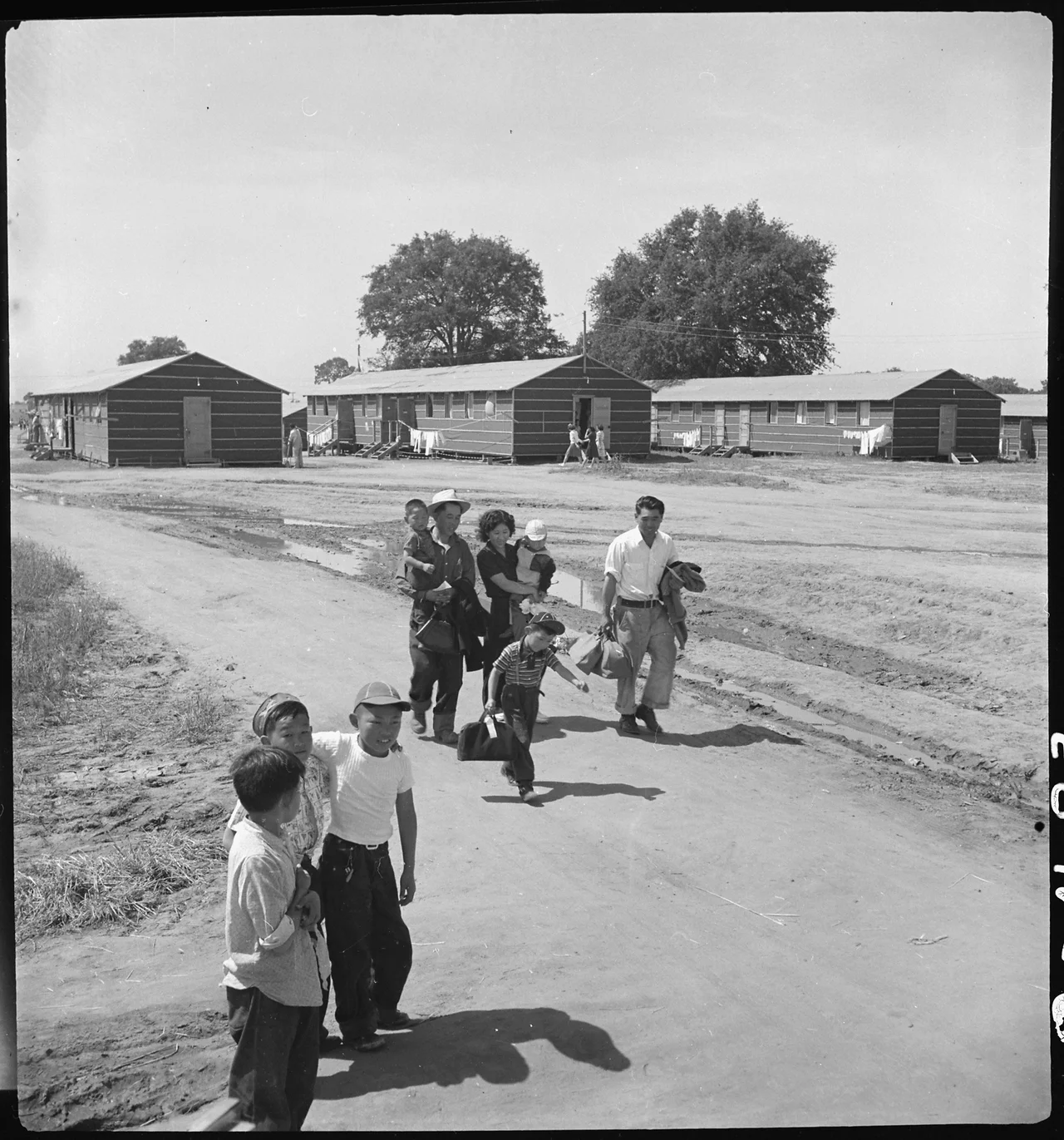
For fifty-two days in the spring of 1942, more than 4,700 Japanese Americans lived behind the fences of the Sacramento Assembly Center, waiting to learn which distant internment camp would become their next unwanted home. The site had been a camp for migrant farmworkers before the government requisitioned it, and it would become a military training ground after the detainees were shipped out. Few places in California changed purpose so rapidly or so completely. Today, the 3,014 acres where families were confined and soldiers later trained lie beneath the suburban streets of Foothill Farms, a residential community on Sacramento's northeastern edge where a small roadside sign is one of the few reminders of what happened here.
Fifty-Two Days Behind the Wire
The Wartime Civilian Control Administration operated fifteen temporary detention sites across the West Coast, and the Sacramento Assembly Center -- also called the Walerga Assembly Center -- was among the smaller ones. It opened on May 6, 1942, receiving Japanese Americans forcibly removed from Sacramento and San Joaquin Counties. Families arrived carrying only what they could hold, stepping off buses into a place that had recently housed itinerant agricultural laborers. The barracks offered no privacy, the facilities were rudimentary, and the duration of their stay was unknown. By June 26, the center had closed. Everyone confined there had been transferred to more permanent War Relocation Authority camps further inland, places designed to hold them for years. The entire operation lasted less than two months, but for the people who passed through it, those weeks marked the beginning of a displacement that would reshape their lives.
The Signal Corps Moves In
When the assembly center emptied, the Army Signal Corps took possession and rechristened the site Camp Kohler Training Camp. The same grounds that had confined civilians now trained soldiers. The camp expanded to accommodate 5,000 personnel, with five obstacle courses, a hospital, a swimming pool, and a small arms practice range spread across its acreage. A Southern Pacific Railroad spur line serviced the installation, delivering equipment and men. Camp Kohler also functioned as the Walerga Engineer Depot, a supply and logistics hub for the war effort in the Pacific. The military operated the camp until December 1946, when peacetime demobilization rendered it surplus. Six months later, on June 20, 1947, fire swept through the wooden buildings that remained, destroying much of the physical infrastructure. What the government no longer needed, the flames consumed.
Coming Home to Nowhere
The cruelest chapter may have come after the war ended. Japanese Americans returning to Sacramento found that discriminatory alien land laws had prevented many of them from retaining ownership of their prewar homes. A severe housing shortage compounded the problem. In late 1945, some 234 families moved into the very camp where Japanese Americans had been detained three years earlier -- not as prisoners this time, but as people with nowhere else to go. The irony was bitter and specific: the government that had removed them from their homes now offered the site of their initial confinement as temporary shelter. These families lived at Camp Kohler while searching for permanent housing in a market that had little interest in accommodating them.
Landmark Without a Landscape
Camp Kohler is one of twelve California assembly centers that share the designation of California Historical Landmark No. 934, a recognition that acknowledges the network of sites where the state's Japanese American population was first concentrated before being scattered to remote internment camps. The landmark designation groups all twelve centers together, a collective memorial to a policy that affected more than 100,000 people. At the actual site, suburban development has overwritten nearly every trace of the camp. A sign at 5922 Roseville Road reading "Camp Kohler" stands near a fenced compound with a single building and a rotating antenna tower. In Walerga Park, at the corner of Palm Avenue and College Oak Drive, scattered remnants hint at the camp's footprint. Children play where soldiers once ran obstacle courses, and families walk dogs over ground where other families once waited behind wire for a future they could not control.
From the Air
Camp Kohler's former location lies at 38.674N, 121.366W in the Foothill Farms area of unincorporated Sacramento County, northeast of downtown Sacramento. From the air at 2,000-3,000 feet AGL, the residential grid of Foothill Farms is visible, with Walerga Park providing one of the few open spaces in the area. The nearest major airport is Sacramento Executive (KSAC), approximately 8 nautical miles to the southwest, and Sacramento International (KSMF) lies about 15 nautical miles to the northwest. McClellan Airfield (KMCC), a former military base, is roughly 4 nautical miles to the west.
Nearby Stories
- Twenty Rounds in a Grandmother's Backyard 1.7 km away
- Sutter's Mill 5.9 km away
- The Siege at Lindhurst 9.1 km away
- The Warehouse on Oakdale Road 9.8 km away
- Where a Quarter Million Wings Converge 16 km away
- Gold Country 16 km away
- The Night Napa Burned 25 km away
- Malakoff Diggins State Historic Park 38 km away