
Campsite Memorial of Augustus
The inscription read: Imperator Caesar, son of the Divus Julius, victor in the war which he waged on behalf of the res publica in this region, when he was consul for the fifth time and imperator for the seventh, after peace had been secured on land and sea, consecrated to Mars and Neptune the camp from which he set forth to attack the enemy, now ornamented with naval spoils. Every word was chosen with precision. Octavian — who would formally become Augustus in 27 BC — was building not just a monument but an argument: that this victory was legitimate, divinely sanctioned, and conducted on behalf of the Roman people rather than for personal glory. The bronze rams of approximately thirty-six captured warships, mounted on the monument's terrace, were the physical evidence. The hill above Nicopolis, where his legions had camped before the battle, was the stage.
The Hill Where History Turned
The Campsite Memorial of Augustus — known in Latin as the tropaeum, the victory trophy — was built between 29 and 27 BC on the hill north of Nicopolis where Octavian's army had established its camp before the naval Battle of Actium on 2 September 31 BC. The choice of location was deliberate and loaded with meaning. Roman commanders traditionally erected a tropaeum on the battlefield itself, using captured enemy weapons hung on a wooden stake or post. Augustus transformed this convention into something permanent and monumental, in stone and bronze, on the exact ground his forces had occupied. A road linked the memorial directly to the new city of Nicopolis, and the city's grid plan and land centuriation — the systematic division of the surrounding territory — were aligned with the axis of this road. The memorial was not an afterthought to the city. It was the organizing principle from which the city radiated.
The Bronze Rams
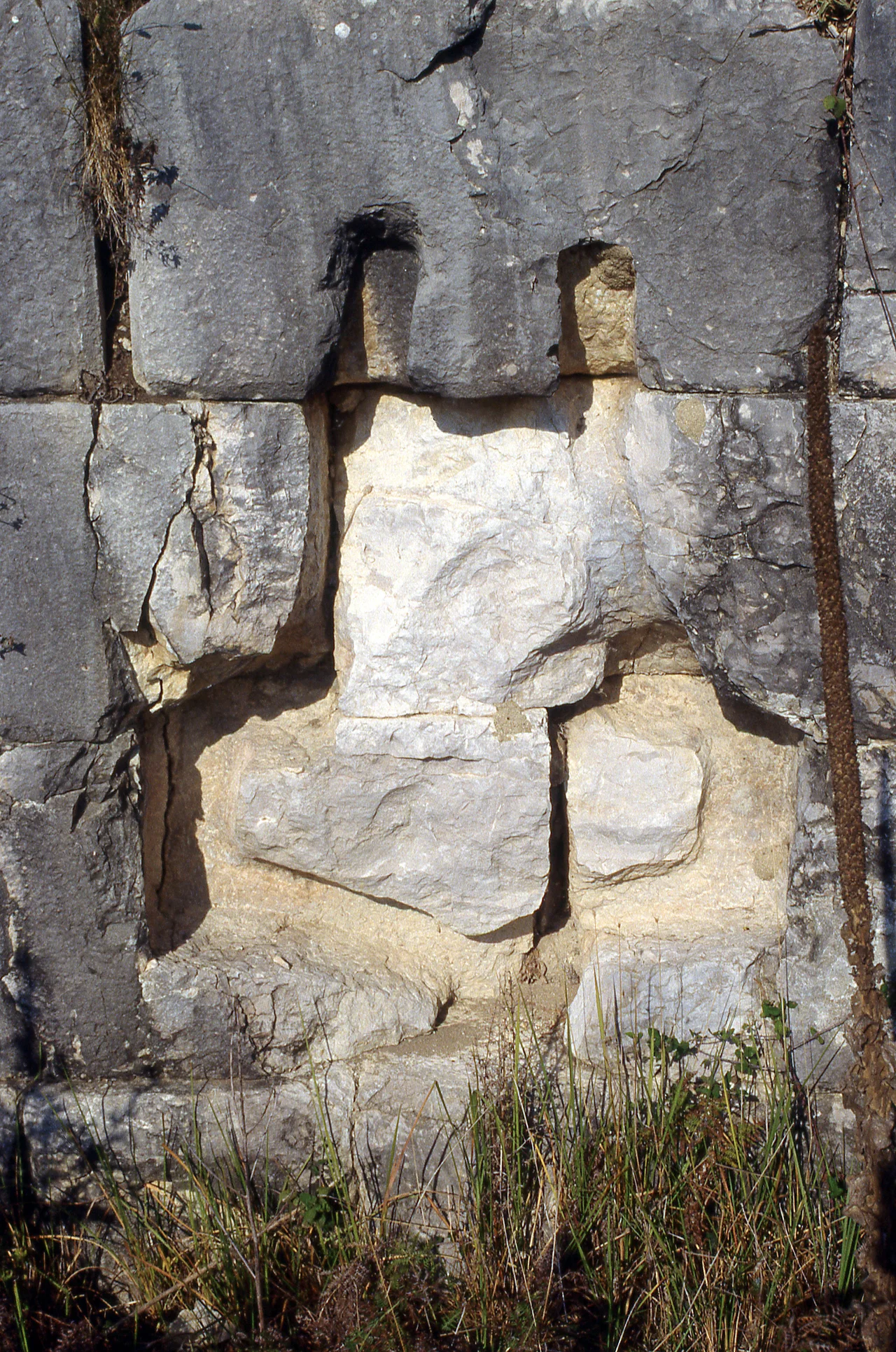
The most striking feature of the Campsite Memorial was its decoration with actual bronze rams from the defeated fleet. Warship rams — the metal-clad beaks that ancient vessels used to hole enemy ships below the waterline — were standard trophies in naval victories; the Romans had previously decorated the rostra in their own Forum with rams taken from Carthaginian ships. At Actium, Octavian mounted approximately thirty-six rams on anchor-shaped sockets along the upper wall of the monument. Above them ran the dedicatory inscription. The rams represented captured power made permanent, the enemy fleet converted into architectural ornament. The fleet that had carried Cleopatra's gold and Antony's ambitions was now literally holding up the monument that celebrated their defeat. Thirty-three blocks of the dedicatory inscription were recovered during excavations; ten more were lost, probably during the Second World War.
The Sacred Courtyard and Its Altar
Above the retaining wall and the rams, a colonnaded stoa — shaped like a Greek capital Pi, enclosing the northern, western, and eastern sides — defined a sacred courtyard open to the south, toward the former battlefield and the sea. At the center of this courtyard stood the main altar, dedicated to Apollo: a large rectangular platform measuring 22 by 6.5 meters, made of sandstone, aligned precisely with the monument's central axis. The altar's surface was decorated with relief sculptures. Excavators have recovered 1,129 sculpted fragments, enough to identify several major themes: naval motifs including steering oars and warship bows; weapons and trophies arranged on tree trunks; a possible Amazonomachy, interpreting Antony's eastern allies as symbolic Amazons against Rome's orderly west; and a triumphal procession whose composition closely resembles the procession scene on the Ara Pacis in Rome, which Augustus commissioned a few years later. The memorial was a rehearsal for the visual language of the Augustan age.
Time, Memory, and What Remains
The Campsite Memorial of Augustus was built at a specific historical hinge — after the Temple of Janus in Rome was closed in 29 BC, signaling the end of war, but before Octavian formally assumed the title Augustus in 27 BC. The monument was thus created in the interval between the old world and the new, at the exact moment when a Roman warlord was transforming himself into a constitutional emperor. Its message was aimed at posterity as much as at contemporaries: that the violence of the civil wars had been necessary, sanctioned, and conclusively ended. The structure has endured two millennia in modified form. The site is part of the broader Nicopolis archaeological area, and the retaining wall remains visible above ground. The stone pedestals that held the bronze rams are gone — the metal was too valuable to leave in place forever — but their positions are known, and the monument's outline is clear enough to read the intention behind it.
Propaganda Set in Stone
Roman victory monuments were not modest affairs. The Campsite Memorial of Augustus was designed to be seen — from the road to Nicopolis, from the surrounding landscape, from the sea. The city's entire street grid pointed at it. Its altar shared visual language with the great monuments of Rome itself. But what makes it unusual, even within the Augustan program, is its specificity: this monument is not in Rome, where most imperial commemorations lived. It is on the actual ground where the thing happened, where legionaries slept before the battle, where the smell of the cooking fires would have risen on the night before Octavian staked his future on the outcome. The combination of precise location and imperial scale gives the monument a quality that polished urban monuments sometimes lack: the sense that something real occurred here, that the bronze rams on their stone pedestals were not symbols but actual objects from actual ships, torn from hulls that once carried living sailors.
From the Air
The Campsite Memorial of Augustus sits on a hill north of Nicopolis at approximately 39.027°N, 20.736°E. From the air, the site is part of the wider Nicopolis archaeological zone, whose ancient walls and earthworks are visible as geometric patterns in the olive-covered terrain north of Preveza. The hill of the memorial rises slightly above the surrounding plain. Aktion National Airport (LGPZ) lies approximately 10 km to the south on the Actium peninsula across the gulf mouth. The Ambracian Gulf is the dominant geographic feature to the east and south; the former battlefield where the naval engagement occurred is the open water between the Actium peninsula (where the airport sits) and the mainland coast. Approach from the northwest at 2,000–4,000 feet for the broadest view of the Nicopolis plain, the gulf, and the Actium peninsula.
Nearby Stories
- Castle of Santa Maura 13 km away
- Battle of Olpae 19 km away
- Achilleion (Corfu) 24 km away
- Dodona 27 km away
- Stratos 28 km away
- Corfu 56 km away
- Meteora: The Monasteries Built on Impossible Pillars 60 km away
- Hellenic Trench 117 km away