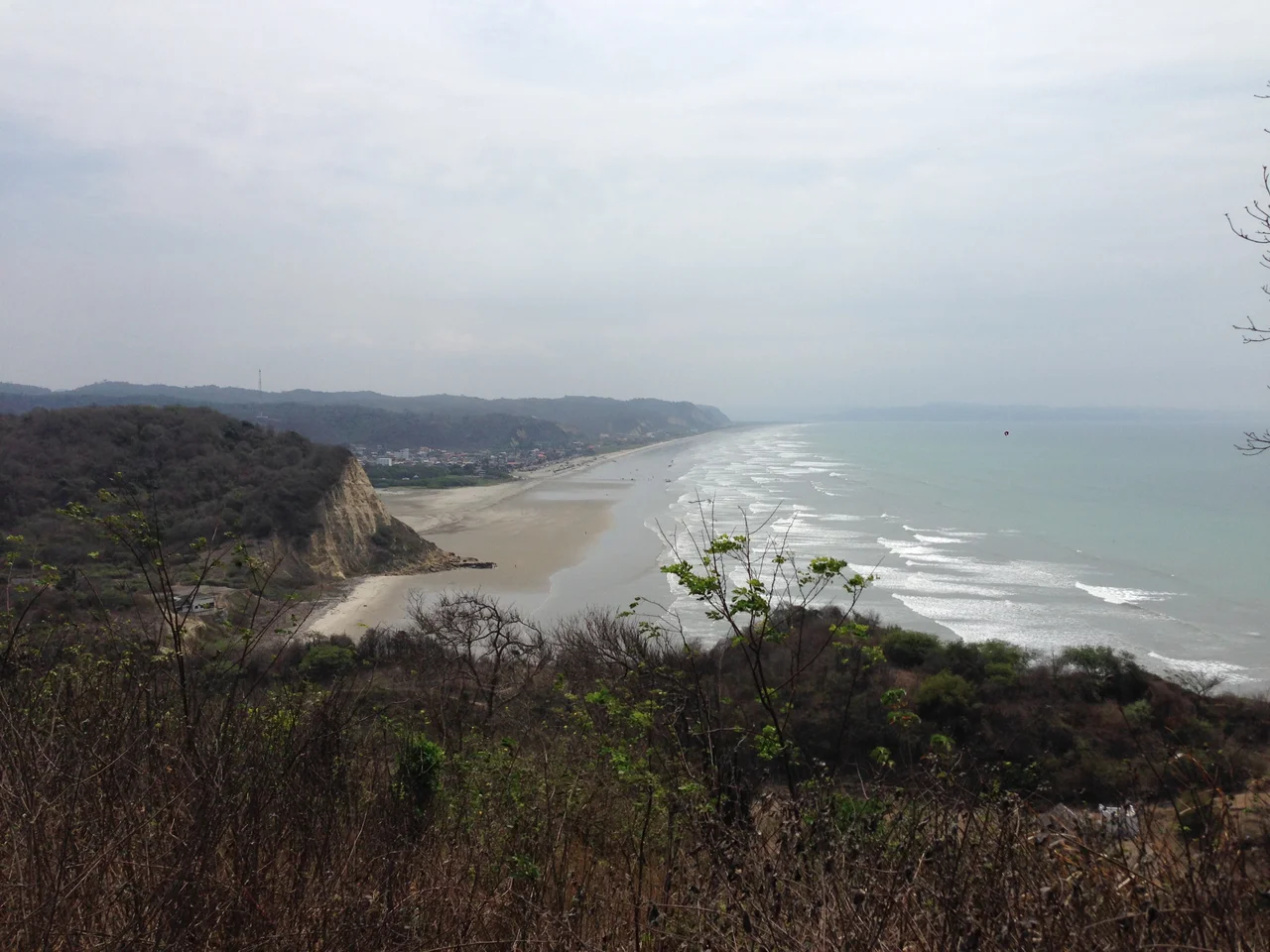

Canoa
Sixteen kilometers of beach. No rocks. No reefs. No riptides. Canoa is the kind of surf town that teaches you to catch a wave before it teaches you to be cool about it - a stretch of Ecuadorian coast in Manabi Province that tourism has found but has not yet overrun. The village earns its ecological pride the hard way: trash washes up from other stretches of coast, and Hotel Bambu will trade you a free cocktail for any bag you fill with it. You can fill a bag fast. Everyone wins, including the beach.
After the Earthquake
Canoa is a village that chose to come back. In April 2016, a magnitude 7.8 earthquake struck the coast of Ecuador and did serious physical and financial damage here. The hospitality industry - the bones of a beach economy - took the worst of it. Some businesses closed permanently. Others opened for the first time, new owners betting on recovery. Walk the town now and you see both histories at once: buildings that are clearly newer than 2016 and small plots where older buildings are not coming back. The area that matters to visitors is a compact grid - eight blocks long, two or three deep, west of the main road - with Xavier Santos running down to the beach and ending at the Malecon and a three-dimensional CANOA sign you will photograph whether you meant to or not.
The Beach and Its Rules
The beach runs ten miles, most of it as close to pristine as any mainland coast in Ecuador can claim. At low tide it flattens into something enormous and wide. Morning walks turn up tropical seashells along with the less welcome offerings - plastic, line, the daily tide of global debris - and Hotel Bambu's trade-a-bag-for-a-cocktail offer is not a gimmick but one of the more honest hospitality economics you will find anywhere. For surfers, the conditions are a gift. Peak season runs January through April, when waves get a little more serious, but beginners can ride most of the year without worrying about rocks, reef, or riptides. Instructors operate out of several setups on the sand. Fair warning on the beach at night: theft is common, so do not leave gear on the shore while you swim, and think hard before camping.
Getting In and Getting Out
Canoa is a crossroads town as well as a beach. Buses run every thirty minutes to San Vicente or Bahia de Caraquez, and from Bahia you can catch four daily buses to Quito - two in the morning at 06:30 and 09:00, two in the evening. Direct buses to Quito and Guayaquil now run from Canoa itself. North along the coast, a bus route runs up to Pedernales. South, you can reach Montanita and Manta directly, or transfer at Jipijapa for Puerto Lopez. Bus company offices cluster along Xavier Santos in the three blocks before Parque Central; street names are rare enough that locals use landmarks instead. One practical note: there is no bank or ATM in Canoa. The nearest is in San Vicente.
Rio Muchacho and the Spanish School
Two institutions extend the Canoa experience beyond the beach. Rio Muchacho Organic Farm offers one-to-three-day tours that read like a catalog of what sustainable Ecuador tourism tries to be: horse treks to howler monkey forests and waterfalls, chocolate and coffee made from the bean, crafts from natural materials, volunteer programs at both the farm and its eco-schools. Their office in Canoa sells fair-trade goods and can book the other tours across Ecuador. At the Sundown Inn south of town, the Canoa Spanish School runs a four-week immersion program - beachfront room, three meals a day, eighty hours of private tutoring - for around 800 dollars. That is the kind of deal you stop calculating exchange rates to understand.
The Evening and the Sand Fly
There is one practical warning that Canoa veterans pass along to newcomers: sand flies. The Lutzomyia species come out around dawn and dusk, and they bite where your skin is closest to the ground - feet, ankles, lower legs. Pack insect repellent and use it religiously around sunrise and sunset, especially if you walk the beach at those hours. This is not Canoa being dangerous - it is Canoa being tropical. Most evenings here are the kind you remember later for being exactly what you came for: a restaurant like Genesis on Javier Santos #306 with cheap, decent fish and the waiter bringing slightly more than you ordered, a horizon that turns orange for longer than seems fair, and the surf settling down into a white line of ripples. The earthquake took a lot from this place. The beach remained.
From the Air
Coastal village at 0.46S, 80.45W, on Ecuador's Manabi coast about 200km northwest of Guayaquil. Sea level, backed by low coastal hills. Nearest airports are Eloy Alfaro International (SEMT, Manta) 50nm south and Jose Joaquin de Olmedo International (SEGU, Guayaquil) 120nm southeast. Scenic approach along the coastline from Manta; ten miles of nearly uninterrupted beach give Canoa its distinct signature from the air. Best flown in morning light before afternoon coastal clouds build.
Nearby Stories
- Jama-Coaque Ecological Reserve 24 km away
- Western Ecuador Moist Forests 37 km away
- Portoviejo 41 km away
- Jatun Sacha Foundation 58 km away
- Buena Fe Canton 62 km away
- Salinas (Ecuador) 198 km away
- Malpelo Plate 381 km away